

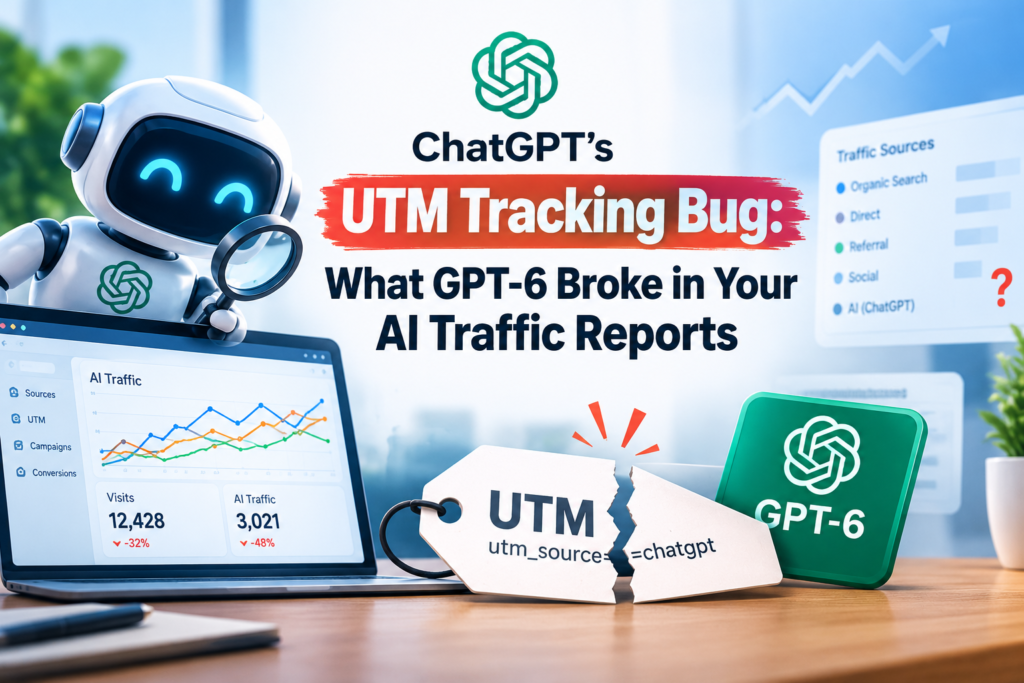
ChatGPT quietly stopped tagging most of its outbound links with UTM parameters during the GPT-6 rollout in early October 2026, and the change sent a wave of AI referral traffic into the “Direct” bucket in Google Analytics. OpenAI has since confirmed it was a bug and begun rolling out a fix, but the episode exposed just how fragile AI search attribution still is.
If you run SEO or GEO reporting, this is the ChatGPT UTM tracking bug you need to understand before you draw any conclusions from last week’s traffic dip.
This is not a rehash of general AI dark traffic advice. It is a specific, documented incident with real analytics data behind it, and it changes how you should read any ChatGPT-related dip or spike in your reports from October 8 onward.
What Is the ChatGPT UTM Tracking Bug
Starting around October 8 and 9, 2026, several independent analysts noticed that links ChatGPT shows inside its written answers had stopped carrying the utm_source=chatgpt.com parameter that OpenAI had added back in June. Without that tag, and without a reliable browser referrer, those visits landed in GA4 as unlabeled Direct traffic instead of the “AI Assistant” channel.
Graphite CEO Ethan Smith was among the first to flag it publicly, reporting on LinkedIn that ChatGPT-attributed sessions in GA4 had fallen sharply across sites Graphite tracks. Adobe’s Cedric Huesler followed with a more detailed look, and Search Engine Journal pulled the threads together in its report on the ChatGPT traffic drop, which remains the clearest single summary of what multiple analysts found.
Huesler examined roughly 500 pages that had previously received at least 5% of their visits from ChatGPT. Comparing October 9 through 13 against the prior week, he found ChatGPT-attributed visits down by about 31,000 a day, while Direct traffic on the same pages rose by roughly 26,000 a day. That pattern, a drop in one channel matched almost one for one by a rise in another, is the strongest piece of evidence that visits were being mislabeled rather than genuinely lost.
The AI visibility platform Profound added a more technical detail. It found that the share of ChatGPT answers containing at least one tagged source link fell from about 98% on October 8 to 66% by October 14, right around when ChatGPT’s newer “Intelligent UI” answer format, covered earlier on DevByteDaily in our piece on ChatGPT’s Intelligent UI, was expanding from 2% to roughly 35% of answers. Profound’s read is that inline links inside the newer answer format were the ones losing their tags, while links in ChatGPT’s separate Sources panel and shopping results kept theirs.
Peec AI’s Tomek Rudzki added one more data point worth knowing. He found that ChatGPT started showing bare, untagged destination URLs in about 42% of responses he sampled, up from roughly 8% to 10% before the rollout, and that more than half of those untagged links pointed to a brand’s homepage rather than a specific page. That matters for GEO reporting in a different way than the UTM issue. Even once tagging is fully restored, a shift toward homepage-level citations makes it harder to credit AI visibility back to the specific article or product page that actually earned the mention.
Put together, the timeline runs from GPT-6 reaching paid ChatGPT users on October 7 and Free and Go users on October 8, through the first analyst reports on October 9 through 11, to OpenAI’s informal bug confirmation on October 14 and a staged fix beginning October 15.
Why the ChatGPT UTM Tracking Bug Matters for GEO
Generative engine optimization, or GEO, lives and dies on being able to prove that AI platforms are sending people to your site. If the measurement layer breaks quietly, every downstream decision built on that data breaks with it.
Picture a marketing team that saw ChatGPT referral sessions fall by a third in mid-October and concluded their content was losing favor with the model. That conclusion would have been wrong. The actual cause, according to the reporting above, was a tagging bug, not a drop in how often ChatGPT cited their pages. Acting on the wrong read could mean cutting a content program that was working fine, or burning time rewriting pages that never needed it.
We already covered the broader version of this problem in our guide to auditing AI dark traffic, which treats referrer loss as a general, ongoing measurement gap. This incident is the sharpest real-world example of that gap so far: a single platform change, tied to a specific product rollout, with a measurable before-and-after. It is also a direct complication for anyone following the GA4 setup in our piece on tracking AI search visibility in GA4, since the “AI Assistant” channel that guide describes depends on exactly the kind of tagging that briefly failed here.
There is a wider lesson too. ChatGPT is not the only platform adding or dropping tracking parameters as it updates. Search Engine Journal has also reported that Gemini recently started adding UTM parameters to its own links, roughly two weeks before the ChatGPT bug surfaced. Attribution in AI search is being built and rebuilt in public, on a rolling basis, by vendors who owe publishers no advance notice.
What the Data Actually Shows, and What Is Still Unconfirmed
It is worth separating what multiple analysts independently measured from what is still an educated guess.
Confirmed by more than one source: ChatGPT-attributed sessions fell noticeably in GA4 starting around October 8 to 9, inline links in ChatGPT’s newer answer format lost their UTM tag, and Direct traffic rose on a large share of the same pages during the same window. Huesler also reported that OpenAI told him directly, on October 14, that this was a bug, and that a fix began rolling out early on October 15. By 9 a.m. Pacific that day, he said tagged clicks across thousands of domains in Adobe’s data were back to roughly 95% to 100% of the same hour the week before.
Still unconfirmed as of this writing: OpenAI has not published a public statement, blog post, or release note acknowledging the bug or the fix. Huesler’s account is secondhand and, however credible, is not the same as an official company statement. SEO consultant Glenn Gabe said he was not yet seeing tagged links return on either paid or free ChatGPT accounts when the fix was first reported, which means the rollout was staged rather than instant. And no one tracking this has said whether the sessions lost to Direct between October 8 and 15 will ever be reclassified. They almost certainly will not be.
What This Means for You
My own read, and this is interpretation rather than a reported fact, is that this kind of gap is becoming a recurring cost of doing SEO and GEO work rather than a one-off accident. AI platforms ship fast, and tracking parameters sit low on their priority list compared to model quality and feature launches. Treat any sudden move in your ChatGPT, Gemini, or Perplexity referral numbers as a data quality question first, and a content performance question second.
How to Audit Your Own ChatGPT Traffic Right Now
You do not need to wait for an official OpenAI statement to check your own exposure. Here is a practical sequence.
- Pull daily sessions for your “AI Assistant” channel and your “Direct” channel in GA4 from October 1 to today. Look for a dip in one that lines up with a rise in the other starting around October 8 or 9.
- Check landing pages, not just the channel total. If specific pages that previously earned meaningful ChatGPT traffic show a Direct traffic bump in the same window, that is a strong signal the visits are the same people, just mislabeled.
- Segment by device where you can. Mobile ChatGPT visits have been reported as more dependent on the UTM tag than desktop, since referrer headers are stripped more often in mobile apps and in-app browsers.
- Look at your Search Console AI Overviews and AI Mode data separately. That reporting is independent of ChatGPT’s tagging and will not be affected by this specific bug, so it gives you a clean second data point.
- Run a manual check. Ask ChatGPT a handful of questions in your topic area, click through the links it shows, and inspect the destination URL for a UTM parameter. Repeat the check every few days through the rest of October.
- Hold off on reallocating budget or content effort based on October 8 to 15 ChatGPT numbers alone. Treat that window as unreliable and wait for at least two clean weeks of post-fix data before making any real decision.
If you have not yet built the custom GA4 channel grouping described in our AI search visibility in GA4 guide, this is a good prompt to do it now, since a broader net catches more of these platform-level hiccups automatically.
Fixing Your Attribution Going Forward
A few habits will make the next version of this bug, and there will be a next version, much less disruptive to your reporting. None of this requires new software or a bigger budget. It mostly requires treating AI referral data as inherently less stable than organic search data, because the platforms behind it are still changing their own plumbing on a weekly basis.
First, stop relying on referrer strings alone. Count UTM-tagged visits as a separate, explicit metric from referrer-based attribution, so you can see the two drift apart when a platform changes behavior.
Second, annotate your analytics timeline the moment you spot an anomaly. A simple GA4 annotation marking “October 8 to 15, 2026: suspected ChatGPT tagging bug” saves a future version of you from misreading the trend line in a quarterly report.
Third, diversify how you measure AI-driven visibility. Our guide to auditing AI search lead generation walks through checks that do not depend purely on UTM parameters, including branded search lift and direct attribution surveys, both of which stayed accurate throughout this entire episode.
Finally, keep an eye on vendor behavior rather than assuming today’s tagging setup is permanent. OpenAI’s own announcement of the GPT-6 rollout said nothing about link tracking, which is exactly the point. These changes tend to surface through independent analysts and trade press, not through advance notice, so a standing habit of checking your numbers weekly catches problems faster than waiting for an official statement.
Frequently Asked Questions
Is the ChatGPT UTM tracking bug fully fixed now?
Largely, but not with full certainty. Adobe’s Cedric Huesler reported tagged click rates back near normal levels by the morning of October 15, but the rollout was staged, and at least one analyst said he had not yet seen the fix on his own accounts a day later. Check your own data before assuming it is resolved everywhere.
Did this bug mean ChatGPT actually sent less traffic to websites?
The evidence points the other way. Direct traffic rose on roughly two out of three pages that lost ChatGPT-attributed sessions during the affected window, which suggests visits were mislabeled rather than genuinely lost.
Does this affect AI Overviews or Google AI Mode too?
No. This specific bug was limited to ChatGPT’s own UTM tagging. Google’s AI Overviews and AI Mode traffic is measured separately through Search Console’s generative AI performance reporting, which this incident did not touch.
What should I do if I already reported the October traffic dip to a client or manager?
Send a short follow-up noting that independent analysts and OpenAI have attributed the dip to a tracking bug rather than a real loss of visibility, and share the Search Engine Journal summary of the issue as a source. It is a quick, honest correction and it is better than letting a wrong number stand.
How can I avoid being caught off guard by the next tracking change?
Build redundancy into your measurement. Combine GA4’s AI Assistant channel, Search Console’s AI reporting, branded search tracking, and periodic manual prompt checks, so that no single platform’s tagging decision can quietly erase a whole slice of your reporting.


Leave a response