

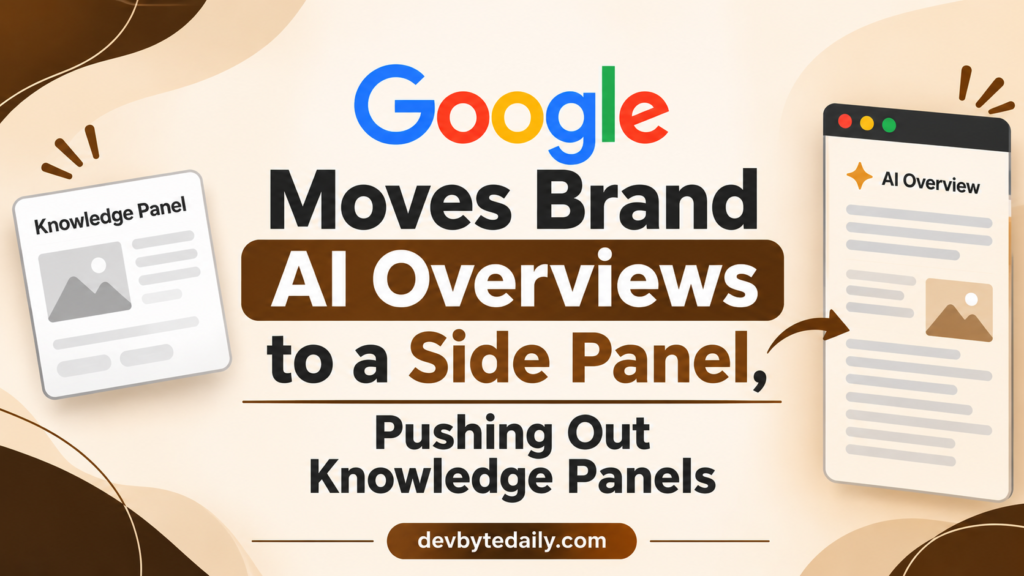
Google is showing something new when you search your own brand name. Over the past week, several SEOs reported that Google moved brand AI Overviews into a right-side column on desktop, pushing the familiar Knowledge Panel out of its usual spot. Search Engine Roundtable’s Barry Schwartz reported the change on November 2, 2026, after reviewing screenshots shared by multiple SEOs. Google has not confirmed the test. If you manage how your brand shows up in search, this is worth checking today.
For more than a decade, the Knowledge Panel has been the box brands fight to control: the card on the right side of the results page that pulls facts from Wikipedia, Wikidata, and your own verified business data. Now Google appears to be replacing that space, at least for some brand searches, with an AI-written summary instead. That is a meaningful shift for anyone doing GEO work, because it changes who writes the first thing a searcher reads about you.
What Changed With Brand AI Overviews This Week
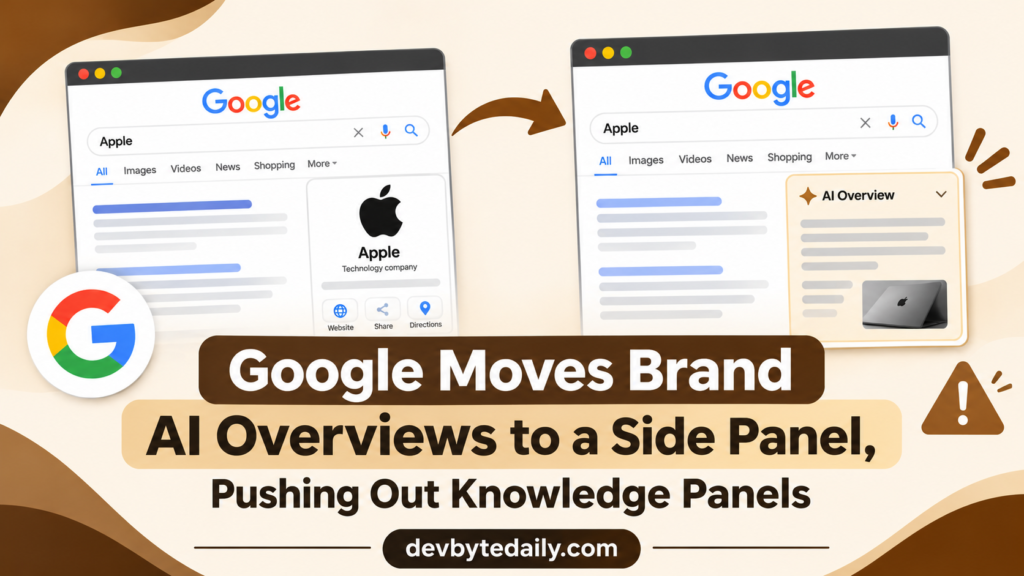
The clearest example came from a search for “Apple.” According to Schwartz’s report, the AI Overview for that query used to sit in the middle of the results page, mixed in with organic listings. Now it has moved into the right column, in roughly the same spot where a Knowledge Panel traditionally lives.
SEO consultant Chris Long first spotted the shift and posted about it on X, saying Google was showing brand AI Overviews in a side column instead of a Knowledge Panel for several brand terms he checked. Schwartz credits Long’s post as the first public sighting.
Marketer David McSweeney followed up on October 31, 2026, with his own observation: branded searches now generally show an AI Overview in the desktop side panel, and sometimes further down the page depending on the query. A few days earlier, on October 27, 2026, SEO practitioner Sachin Patel posted that Google’s Knowledge Panel had started carrying an “AI-generated” label on some brand searches, which lines up with the same pattern.
Schwartz’s own screenshots show brand AI Overview panels appearing for Zillow, Coca-Cola, Google itself, and Search Engine Roundtable. None of this is confirmed as a permanent rollout. Google has a long history of running search layout tests that only a slice of users ever see, and some never ship at all.
How This Compares to the Traditional Knowledge Panel
To understand why this matters, it helps to know what a Knowledge Panel actually is. Google’s own support documentation describes knowledge panels as information boxes that pull facts from several sources: Google’s Knowledge Graph, structured data on your site, your Google Business Profile, and public databases like Wikipedia and Wikidata. Verified brands can claim a panel and submit corrections through a feedback tool.
That system has flaws. Wikipedia edits can lag, Wikidata entries can be incomplete, and small businesses often never get a panel at all. But the sourcing is traceable. You can usually tell where a fact in a Knowledge Panel came from, and you have a defined path to fix it if it is wrong.
I have spent years telling clients that a Knowledge Panel is worth claiming even when the process is slow, because it gives you one clean record you can point to and correct. That advice does not disappear with this test, but it now sits next to a second, murkier record that nobody can claim yet.
A brand AI Overview works differently. It is a generated paragraph, written by Google’s AI model, synthesizing whatever pages and data it judges relevant to the query at that moment. There is no claim process. There is no single structured record to correct. If the AI gets a fact wrong about your company, your options are narrower: you can try to publish clearer, more authoritative content and hope the model picks it up on a future crawl, but there is no form to submit a correction the way there is with a Knowledge Panel.
We covered an earlier, related shift in our piece on Google’s local knowledge panel redesign tests, where Google tried an AI Overview-style summary at the top of local business panels. This brand-search version appears to extend that same idea to major national and global brands, not just local listings.
Why Google May Be Testing Brand AI Overviews Now
This change did not happen in isolation. Google has been widening where AI Overviews and AI Mode show up all year, including a recent push to expand AI Mode and its ad formats into more countries, as Google leans harder into AI-generated answers across more query types, including branded and navigational ones that used to return a clean set of blue links.
It is also not the only AI Overview layout change this week. Just days earlier, SEOs reported a separate test where AI Overviews showed far fewer citation cards on some desktop searches, the small boxes that list the sources behind an AI-generated answer. Taken together, both reports point to Google actively experimenting with how much space AI Overviews occupy and how they are sourced, on more than one front at the same time.
My read is that Google is testing whether an AI summary can do the Knowledge Panel’s job better than the Knowledge Panel itself, at least for well-known brands with plenty of training data available. Apple, Coca-Cola, and Zillow are the kind of brands a model has seen described thousands of times across the web, which makes them easier to summarize accurately than a smaller or newer company would be.
There is also a simpler, less strategic explanation worth considering. Google runs dozens of small layout experiments on the results page at any given time, and most never get an official name or announcement. A right-column AI Overview for brand searches could just as easily be one of those routine tests that quietly fades out in a few weeks as it could be a deliberate step toward replacing Knowledge Panels. Schwartz himself treats it as a layout test worth watching, not a confirmed direction, and that is the right level of caution until Google says otherwise.
What Brand AI Overviews Mean for GEO and Entity Control
None of this changes the core idea behind GEO, which is still about earning citations by publishing clear, well-sourced, directly answerable content. What it changes is which surface decides how your brand gets described on the exact query that matters most to you: your own name.
For years, brand entity work has centered on Wikipedia accuracy, Wikidata entries, structured data markup, and keeping your Google Business Profile current, all in service of a Knowledge Panel that pulls from defined sources. If brand AI Overviews become the norm, that work does not stop mattering, but it stops being the only lever. The AI model forming the summary is reading your website copy, your press coverage, review sites, and other mentions across the web, then deciding what to say in its own words.
That raises a real question Schwartz asks directly in his report: will an AI Overview describe a brand as accurately as the brand’s own website does? There is no settled answer yet. Early examples from well-documented brands look reasonable, but a smaller company with thin coverage online has more room for the model to get something wrong, and less recourse if it does.
There is a second wrinkle worth flagging. A Knowledge Panel is static until someone updates the underlying data, so it tends to say the same thing to everyone who sees it. A brand AI Overview is generated fresh, which means it could, in theory, phrase things differently from one search to the next, or update faster when new information appears online. Neither Google nor the SEOs tracking this have confirmed how consistent the wording actually is across repeated searches, so treat that as an open question rather than a settled fact.
Knowledge Panel vs. Brand AI Overview: What’s Different
Here is a side-by-side look at how the two surfaces currently compare, based on Google’s own documentation and the reports described above.
| Feature | Knowledge Panel | Brand AI Overview |
|---|---|---|
| Main data sources | Knowledge Graph, Wikipedia, Wikidata, Google Business Profile | Synthesized from crawled web pages, including your site and third-party mentions |
| Who can claim or verify it | Brand owners, through Google’s verification process | No claim process reported so far |
| How you correct an error | Submit feedback through Google’s panel feedback tool | No defined correction path; publishing clearer content may help over time |
| Source transparency | Often traceable to a specific database entry | Generally not broken down source by source in the summary itself |
| Placement seen in recent reports | Right column, desktop | Right column, desktop, in the tests reported this week |
What to Do If You Manage a Brand’s Search Presence
Start by searching your own brand name today, on desktop, and taking a screenshot of what you see. You need a baseline before you can tell whether anything changes next week.
Read whatever AI-generated summary appears carefully. Check it against what you know to be true about your company: founding details, product names, pricing claims, and anything related to safety or compliance if that applies to your industry. Small inaccuracies in a generated summary are easy to miss if you only skim it.
If something is wrong, do not expect a quick fix. Since there is no confirmed claim process for a brand AI Overview the way there is for a Knowledge Panel, your best move is the same one that works for GEO generally: publish a clear, direct, well-structured page that states the correct fact plainly, ideally on a page Google already trusts, like your homepage or an official “About” page.
Keep your structured data and Google Business Profile current regardless of which surface shows up. If this test rolls back and Knowledge Panels return to their old spot, that groundwork still pays off. If brand AI Overviews stick around instead, accurate structured data and a clean, authoritative website are still the best signals you can hand the model.
Check this again in a few weeks rather than assuming today’s layout is final. Google tests search page layouts constantly, and a right-column AI Overview that exists today could disappear by the time you read this, or it could become the default for every major brand. I would not rebuild a brand SEO strategy around one unconfirmed test, but I would absolutely start tracking what your own brand’s AI Overview says, since that costs nothing and tells you where you stand if the change does stick.
Frequently Asked Questions About Brand AI Overviews
What exactly changed with Google’s brand AI Overviews?
Based on reports from multiple SEOs this week, Google appears to be moving AI Overviews for some brand-name searches from the middle of the results page into the right-side column on desktop, the spot traditionally occupied by the Knowledge Panel. Google has not confirmed or explained the change.
Has Google confirmed this is a permanent change?
No. As of this writing, Google has not issued any statement about the test. The reports rely on screenshots and observations shared by SEOs on X, not an official Google announcement.
Does this mean Knowledge Panels are going away?
Not necessarily, and not yet. The reports describe brand AI Overviews appearing in place of Knowledge Panels for some queries, but there is no indication Google plans to remove Knowledge Panels entirely. Treat this as a layout test to watch, not a confirmed retirement.
How can I tell if my brand is affected?
Search your own brand name on a desktop browser and look at the right column of the results page. If you see an AI-generated summary instead of, or alongside, your usual Knowledge Panel, your brand is part of whatever test is currently running.
What should I do if the AI Overview describes my brand incorrectly?
There is no confirmed correction process yet for brand AI Overviews. Publishing accurate, clearly written information on a page Google already trusts, such as your homepage, is the most direct step available right now, alongside keeping your structured data and Google Business Profile accurate.
Status Right Now
Right now, this is a reported layout test, not a confirmed global rollout. Multiple SEOs have independently spotted brand AI Overviews appearing in the right column on desktop over the past week, replacing the usual Knowledge Panel position for queries like “Apple,” “Zillow,” and “Coca-Cola.” Google has stayed quiet on the record.
Watch your own brand’s search results over the next few weeks. If the pattern holds and expands to more brands, the practical shift is clear: the first thing people read about your company on its own name search may soon come from a model summarizing the web, not from a structured panel you can directly claim and correct. Either way, the fix is the same one GEO has always pointed to: make sure the clearest, most accurate version of the truth about your brand lives on a page you control, and keep checking that the sources feeding Google still say what you need them to say.



Leave a response