

Google said on October 28, 2026, that weaker AI Mode monetization was one of the reasons its Search revenue growth slowed in the third quarter. The same day, Google announced it is expanding ads in AI Mode to ten more countries, with the UK, Brazil, and Mexico set to follow by the end of the year. For anyone tracking AI Mode monetization, the two announcements landed on the same day for a reason.
Alphabet’s Q3 2026 earnings call gave the clearest public signal yet that Google’s AI search interface is still working out how to make money the way classic blue-link search does. That gap matters for publishers, advertisers, and anyone doing GEO work, because it shapes how aggressively Google will keep changing what AI Mode results look like.
What Google Actually Said About AI Mode Monetization
Philipp Schindler, Google’s chief business officer, told analysts on the earnings call that lower monetization in AI Mode was one of three drags on Search revenue growth in the quarter. Currency swings were the biggest factor, he said, followed by a retail hit tied to the EU ending its de minimis exemption for low-value imports, and a tougher year-over-year comparison in media and entertainment spending after a strong Q2 that included the FIFA World Cup. AI Mode’s lower monetization was the third factor he named, according to Search Engine Journal’s account of the call.
Schindler did not say what AI Mode’s monetization rate was lower than, or put a number on the gap. He did say that most AI Mode queries are upper-funnel, meaning people are still early in a buying decision, and that he expects those queries to open up more monetization opportunities as AI Mode matures.
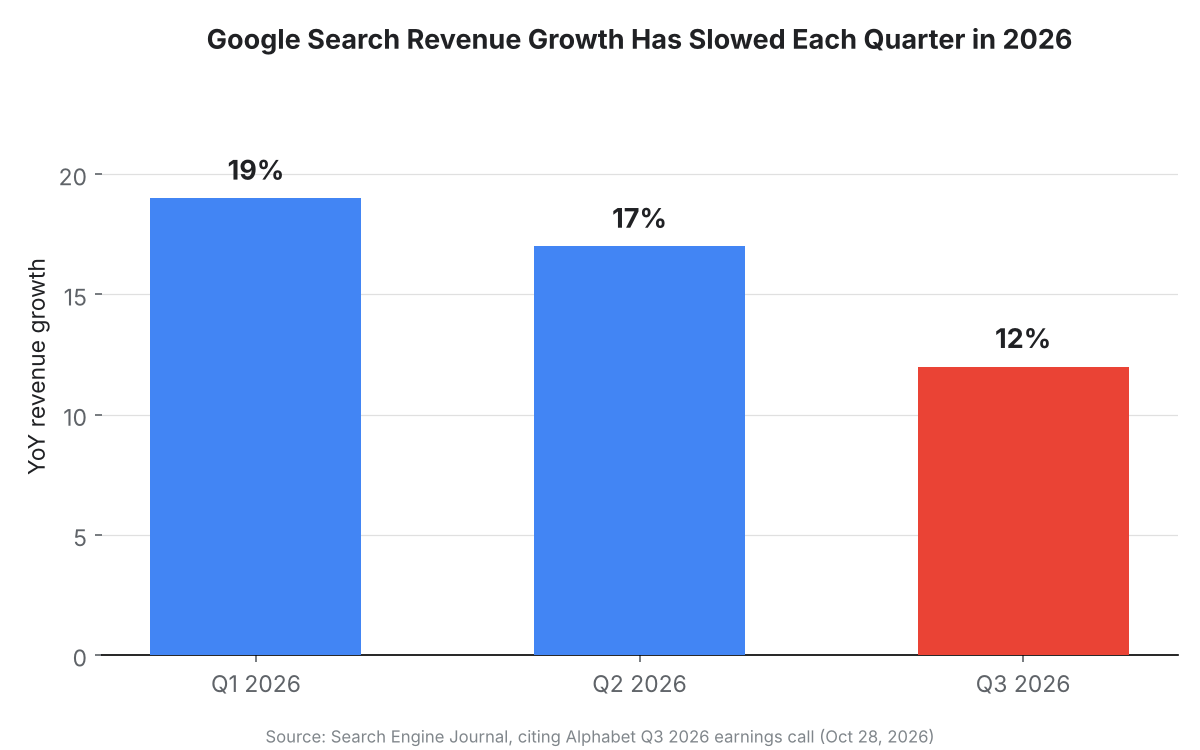
Google’s own numbers show why the growth deceleration got attention. Search and Other revenue rose 12% year over year to $63.35 billion in Q3, according to The Register’s coverage of the earnings report. That is down from 17% growth in Q2 and 19% in Q1. Alphabet shares fell nearly 10% the day after the report.
Sundar Pichai framed the quarter differently in his shareholder letter, saying year-over-year query growth was the highest in five years and crediting AI investment for driving it. Both things can be true at once: more people are searching, through AI Mode in particular, and Google has not yet converted that growth into ad revenue at the same rate it did with classic search results.
The Numbers: Three Straight Quarters of Slower Growth
Lay the three quarters next to each other, and the trend is hard to miss. Google’s Search revenue growth rate has dropped every quarter this year.
CFO Anat Ashkenazi pointed to currency headwinds and a tougher comparison against last year’s accelerating Search growth as additional factors. She said she expects a slightly bigger currency drag in Q4 at current exchange rates. None of that contradicts Schindler’s point about AI Mode. It just means AI Mode monetization is one ingredient in a slowdown with several causes, not the whole story.
Why AI Mode Doesn’t Monetize Like Classic Search, Yet
Classic Google search results show a page of blue links with ads clearly separated above, beside, or below organic results. Advertisers bid on keywords tied to a single query, and Google has had two decades to refine that auction.
AI Mode works differently. A user asks a longer, more conversational question, often as part of a back-and-forth. Google’s own AI Mode report from May 2026 found AI Mode queries run about three times longer than traditional searches. There is no obvious slot to drop a static text ad into a generated paragraph, and a query that spans several follow-up turns breaks the old one-query, one-ad-auction model.
That is also why so much of Google’s recent AI Mode work, including the topics we have covered in our look at the AI Mode sidebar test and AI Mode’s new creator profiles, has been about finding new surfaces and formats for both organic citations and ads inside a conversational interface, instead of porting over the old search results page unchanged.
Schindler’s “incremental” argument is worth unpacking, because it is doing a lot of work in Google’s explanation. The claim is that most AI Mode queries would not have happened at all in classic Search, either because the question was too complex for a keyword search or because the user would have given up rather than piece together an answer from several searches. If that holds up, AI Mode is not just moving existing ad-eligible queries to a lower-paying format. It is also creating a pool of brand-new queries that monetize at close to zero today, which would explain a lot of the growth-without-revenue pattern Google reported this quarter. The flip side is that nobody outside Google can verify that claim independently right now, since Google has not published incrementality data broken out by query type.
Google’s Answer: Expand Ads in AI Mode, Not Pull Back
Google’s response to a monetization gap was not to slow AI Mode down. Instead, it widened where AI Mode ads run. In the same announcement, Shashi Thakur, VP and GM of Google Search Ads, said ads in AI Mode are now scaling to Australia, Canada, India, Kenya, Malaysia, New Zealand, Nigeria, Pakistan, the Philippines, and Singapore. Google plans to roll out Brazil, Mexico, and the UK in the fourth quarter of 2026. In the US, Google is also rolling out multi-turn ads, which let an advertiser’s ad appear across a user’s follow-up questions in the same AI Mode session, not just the first query.
Thakur also cited internal data. Between August 20 and September 3, 2026, Google found click-through rates on sponsored and organic product list items in AI Mode were already similar in the US, and said its research shows users are comfortable with ads in AI Mode and find them relevant. Those are Google’s own figures from a two-week internal study, not an independent audit, so I would treat the “comfortable with ads” framing as a company talking point rather than settled fact. It is the kind of claim worth watching for independent confirmation over the next few quarters.
Ads in AI Mode will carry a “Sponsored” label, consistent with how Google labels ads elsewhere in Search and in AI Overviews, where coverage has climbed through 2026.
Why Google Won’t Slow AI Mode Down Over a Monetization Gap
It’s worth asking why Google would keep pushing AI Mode into more countries while publicly admitting it monetizes worse than classic search. The answer shows up elsewhere in the same earnings report. Alphabet spent $51.4 billion on capital expenditure in Q3 2026 alone, roughly two-thirds of it on servers and networking equipment for AI infrastructure, and left its full-year 2026 capex guidance unchanged at $195 billion to $205 billion. Pichai told investors Google intends to spend “significantly” more in 2027. That is not the posture of a company treating AI Mode as a side experiment.
Pichai also said the Gemini app passed a billion users faster than any product in Google’s history. Between that user growth and the record query growth Pichai cited for Search, Google bets that AI search usage is a race worth running at a near-term revenue discount, on the assumption that ad formats and user comfort with those ads catch up later. Whether that bet pays off is a multi-year question. What is confirmed now is the direction: more AI Mode ad surfaces, in more countries, not fewer.
What This Means for GEO and Site Owners
None of this changes the core GEO playbook, but it does change the pressure behind it. Here is my read on what matters.
More countries getting AI Mode ads means more AI Mode surfaces where organic citations now compete directly against paid placements for the same screen space, not just against other organic results. If you publish in Australia, Canada, India, the Philippines, or the other newly added markets, expect the visual layout of AI Mode answers to include sponsored product or service listings alongside, or ahead of, the cited sources your content might otherwise earn.
Multiturn ads in the US are worth watching closely if your audience does a lot of follow-up questioning in AI Mode, since an advertiser’s message can now persist across a whole conversation rather than a single query. That is a different kind of competition for attention than a one-off ad on a single results page.
Google’s own framing, that AI Mode queries skew upper-funnel and commercial intent builds over a conversation, lines up with what our earlier piece on tracking brand visibility in AI Mode found: a single citation rarely closes a sale, but repeated, trustworthy appearances across a multi-turn session shape which brands a user considers by the end of it. Showing up consistently across the follow-up questions in a topic, not just the first query, is becoming as important as ranking for the initial one.
If Google keeps leaning on ad expansion rather than slowing AI Mode’s rollout, the practical move is to treat AI Mode visibility the same way you would treat a results page that is getting more crowded with paid placements: assume organic citations need to work harder to stand out, and verify your most important brand and product queries directly in AI Mode rather than only in rank trackers built for classic search.
A few concrete steps for the newly added markets in particular. If you sell into Australia, Canada, India, or any of the other seven countries in this expansion, check how your branded and category queries render in AI Mode from those regions over the next few weeks, since sponsored product listings are rolling out live rather than in a single flip of a switch.
For anyone running Google Ads alongside organic GEO work, multiturn ads in the US are a format worth testing directly, since they compete for the same follow-up-question real estate that citation-focused GEO tactics are trying to win organically. And because Google itself says AI Mode query growth is outpacing AI Mode revenue growth, expect more ad formats and placement tests before this gap closes, not fewer.
Status Right Now
As of this earnings call, Google has not said when AI Mode monetization might catch up to classic Search, only that it expects the gap to narrow as upper-funnel queries convert into later purchase intent. Ad expansion to ten new countries is confirmed and scaling now, with the UK, Brazil, and Mexico due before the end of Q4 2026. Multiturn ads are rolling out in the US. Whether click-through parity between sponsored and organic AI Mode listings holds up outside Google’s own two-week US sample is still an open question, and it is one worth checking again once Google reports Q4 results in early 2026.
Frequently Asked Questions
What did Google say about AI Mode monetization on the Q3 2026 earnings call?
Chief business officer Philipp Schindler said lower monetization in AI Mode was one of three factors that slowed Search revenue growth in Q3 2026, alongside currency headwinds and tougher year-over-year comparisons. He did not quantify the gap, but said most AI Mode queries are upper-funnel and incremental, which he expects to create more monetization opportunities over time.
How much did Google’s Search revenue growth actually slow?
Search and Other revenue grew 12% year over year in Q3 2026, down from 17% in Q2 2026 and 19% in Q1 2026, per Alphabet’s earnings figures as reported by Search Engine Journal and The Register.
Which countries are getting ads in AI Mode now?
Google says ads in AI Mode are scaling to Australia, Canada, India, Kenya, Malaysia, New Zealand, Nigeria, Pakistan, the Philippines, and Singapore now, with Brazil, Mexico, and the UK planned for Q4 2026, on top of existing availability in the US and other earlier markets.
Does this change how GEO or AI Overviews optimization works?
Not the fundamentals. Clear, well-sourced, directly answerable content still earns citations. What changes is the competitive environment: more markets now show sponsored results inside AI Mode conversations, so organic citations have to work harder to stand out, especially across multiturn sessions where ads can now follow a user through several related questions.



Leave a response