
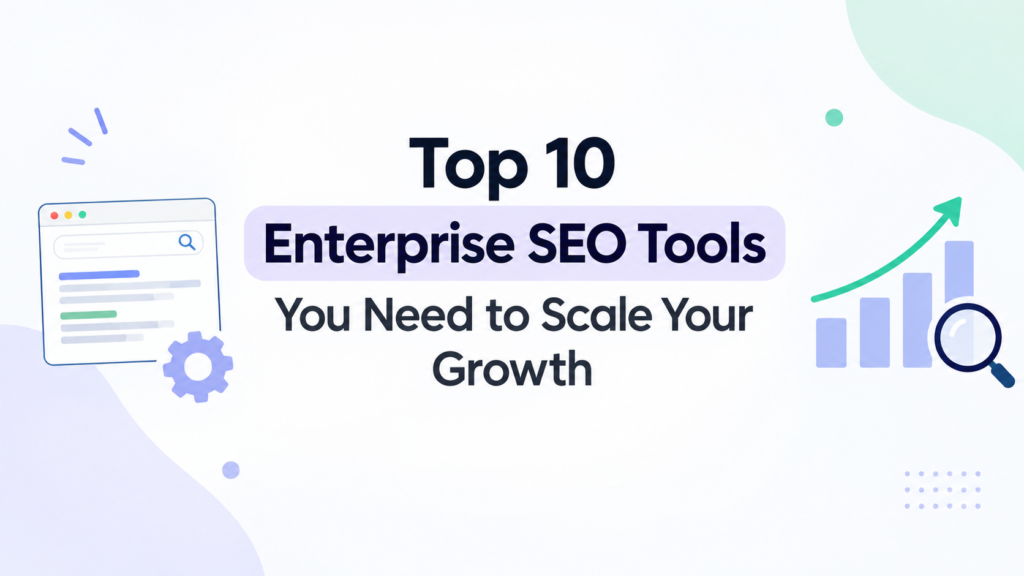
Managing SEO for a large website is very different from optimizing a small business site. Once a website has thousands or millions of URLs, multiple markets, large content libraries, and several teams working on it, even a small technical issue can affect organic visibility at scale.
That is where Enterprise SEO tools become important. The right platform can help teams monitor rankings, analyze competitors, discover technical problems, optimize content, track search performance, and turn large amounts of SEO data into practical decisions.
In this guide, we explore 10 Enterprise SEO tools and explain what each one is best suited for, so you can build a search technology stack that matches your organization’s needs.
What Makes Enterprise SEO Different?
Traditional SEO often focuses on optimizing individual pages, researching keywords, fixing technical errors, and building relevant content.
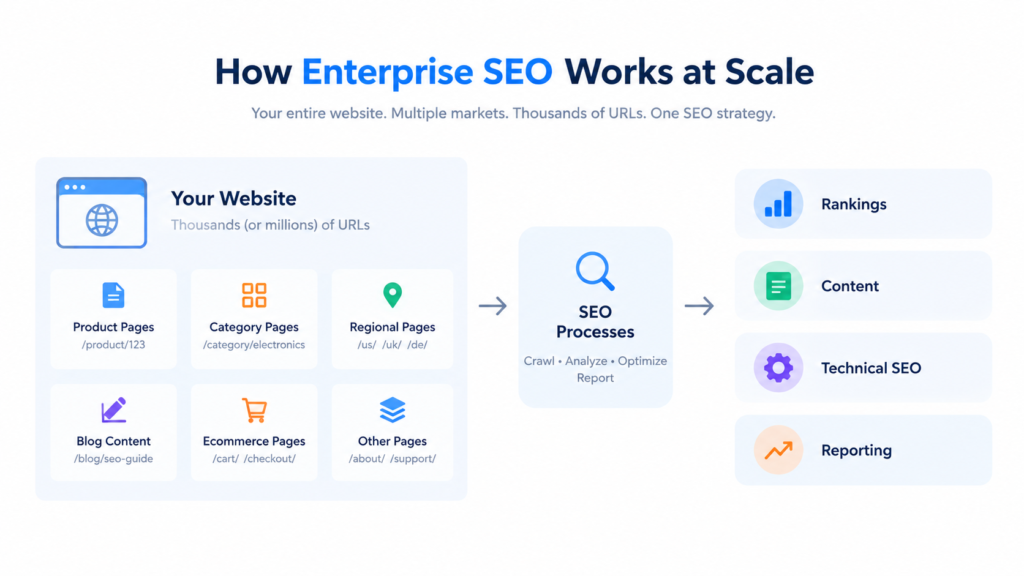
Enterprise SEO operates on a much larger scale.
A single template change can affect thousands of product pages. A poor internal linking structure can make entire sections of a website harder for search engines to discover. Changes to JavaScript, canonical tags, redirects, or indexation rules can also create widespread problems.
Large organizations may also manage:
- Multiple websites
- International domains
- Hundreds of content categories
- Thousands of target keywords
- Multiple CMS platforms
- Several SEO and marketing teams
- Regional search strategies
- Large ecommerce catalogs
- Complex reporting requirements
Because of this complexity, Enterprise SEO requires more than a keyword research tool. Teams need technology that can crawl, analyze, monitor, report, and automate SEO activities at scale.
Google’s Search Central documentation is a useful reference for understanding the fundamentals behind crawling, indexing, search appearance, and technical SEO. Google Search Central SEO documentation
How to Choose an Enterprise SEO Tool
Before comparing platforms, identify what your SEO team actually needs.
1. Website Scale
Check how many URLs the platform can crawl and analyze. Large websites should also consider crawl frequency, JavaScript rendering, segmentation, historical data, and API access.
2. Technical SEO
A good Enterprise SEO platform should help identify issues involving:
- Broken links
- Redirects
- Canonical tags
- XML sitemaps
- Indexability
- Duplicate content
- JavaScript rendering
- Internal linking
- Structured data
- Site architecture
3. Keyword and Competitor Research
Large SEO teams need more than basic keyword volume.
Look for competitor visibility, ranking history, keyword gaps, content gaps, SERP analysis, and market-level data.
4. Reporting
Enterprise stakeholders rarely need the same report.
SEO specialists may want technical details, while executives may need organic traffic, conversions, revenue, and visibility trends.
Look for customizable dashboards, segmentation, scheduled reports, exports, and integrations.
5. Automation and Integrations
Automation becomes increasingly valuable as website size increases.
Look for integrations with Google Search Console, Google Analytics, business intelligence systems, CMS platforms, and APIs.
Top 10 Enterprise SEO Tools
1. Semrush Enterprise
Semrush Enterprise combines competitive research, keyword data, technical SEO, content optimization, reporting, and automation.
Its Enterprise SEO platform is designed around large organizations managing multiple markets, domains, and teams. Semrush highlights features including large-scale keyword and backlink data, integrations with GA4 and Google Search Console, content audits, competitor intelligence, forecasting, and SEO automation.
Best for:
- Competitive research
- Global SEO
- Keyword and backlink analysis
- Content optimization
- Enterprise reporting
- SEO automation
Semrush makes sense for organizations that want a broad SEO platform rather than relying on many disconnected tools.
2. Ahrefs Enterprise
Ahrefs is particularly well known for backlink analysis, keyword research, competitor research, and Site Audit.
Its Enterprise platform adds features such as portfolios, keyword clustering, page history, Google Search Console integration, API access, Data Studio connectors, SSO, and advanced Site Audit capabilities.
Best for:
- Backlink research
- Competitor analysis
- Keyword research
- Content opportunities
- Technical auditing
- Enterprise SEO data
Ahrefs is especially useful when competitive intelligence and link analysis are major parts of your SEO strategy.
3. BrightEdge
BrightEdge is an enterprise-focused SEO and content performance platform.
It provides large organizations with tools for keyword tracking, content performance, competitive analysis, reporting, and search visibility management.
Best for:
- Large corporate websites
- Enterprise reporting
- Content teams
- SEO performance monitoring
- Executive dashboards
Its enterprise positioning makes it particularly relevant for organizations where SEO teams need to communicate search performance across marketing and leadership departments.
4. Conductor
Conductor combines SEO, content, website monitoring, reporting, and AI-search visibility capabilities.
Its Enterprise platform focuses on cross-domain reporting, collaboration, role-based access, and large-scale website management. Conductor describes its platform as being designed for organizations managing millions of pages and multiple teams.
Best for:
- SEO and content collaboration
- Large organizations
- Cross-domain reporting
- Website monitoring
- Search visibility management
Conductor can be useful when SEO needs to connect closely with content and broader digital marketing operations.
5. seoClarity
seoClarity is built around enterprise SEO data, rank tracking, technical analysis, content intelligence, and reporting.
Its platform is designed for organizations managing large-scale SEO programs where teams need centralized data and automation.
Best for:
- Enterprise rank tracking
- Technical SEO
- Content intelligence
- Competitive analysis
- Large SEO teams
The platform can be particularly useful for organizations that need extensive search data across markets and websites.
6. Botify
Botify focuses heavily on technical SEO, crawling, indexation, and large-scale website analysis.
Its approach is especially relevant to websites where search-engine crawling and indexing create significant operational challenges.
Best for:
- Large ecommerce websites
- Technical SEO
- Crawl analysis
- Indexation
- Log analysis
- Large URL inventories
If your biggest SEO challenge involves how search engines discover and process your pages, a technically focused platform such as Botify can be worth evaluating.
7. Lumar
Lumar focuses on technical website health and SEO auditing.
It helps SEO and development teams identify technical issues across large websites and monitor changes over time.
Best for:
- Technical SEO
- Website migrations
- Site health monitoring
- JavaScript websites
- Developer collaboration
Lumar is a strong fit when technical SEO requires close coordination between marketers and developers.
8. Screaming Frog SEO Spider
Screaming Frog SEO Spider is a specialist website crawler available for Windows, macOS, and Linux.
It can identify hundreds of SEO issues, including broken links, server errors, redirects, metadata problems, canonical issues, and other technical problems.
Best for:
- Technical SEO audits
- Website migrations
- URL-level analysis
- Broken-link discovery
- Internal linking analysis
Screaming Frog can complement a larger Enterprise SEO platform when SEO specialists need detailed URL-level crawling.
9. Siteimprove
Siteimprove takes a broader website-governance approach by combining SEO with areas such as content quality and accessibility.
This can make it useful for large organizations where SEO operates alongside digital governance and content management.
Best for:
- Website governance
- Content quality
- Accessibility
- SEO monitoring
- Distributed marketing teams
For organizations managing large numbers of contributors, governance can be just as important as keyword tracking.
10. Moz Pro
Moz Pro offers keyword research, rank tracking, site crawling, link analysis, and other core SEO capabilities.
It can work as a primary or complementary platform for organizations that need established SEO research and monitoring features.
Best for:
- Keyword research
- Rank tracking
- Link analysis
- Site audits
- SEO reporting
Moz Pro can be useful when teams want straightforward SEO research without building their entire workflow around a highly specialized enterprise platform.
Enterprise SEO Tools Compared
| Tool | Main Strength | Best For |
|---|---|---|
| Semrush Enterprise | Broad SEO intelligence | Global SEO and competitive research |
| Ahrefs Enterprise | Backlinks and research | Competitor and content analysis |
| BrightEdge | Enterprise search intelligence | Large corporate teams |
| Conductor | SEO and content workflow | Cross-team collaboration |
| seoClarity | Data and automation | Large SEO operations |
| Botify | Crawling and indexation | Very large websites |
| Lumar | Technical SEO | Site health and migrations |
| Screaming Frog | Detailed crawling | Technical audits |
| Siteimprove | Website governance | SEO and content governance |
| Moz Pro | Core SEO research | Research and monitoring |
Which Type of Enterprise SEO Tool Does Your Business Need?
Instead of asking which platform is universally best, start with your primary SEO challenge.
If Technical SEO Is Your Priority
Focus on platforms with strong crawling, rendering, indexation, and site-health capabilities.
Consider: Botify, Lumar, Screaming Frog, seoClarity.
If Competitor Research Is Your Priority
Look for strong keyword databases, backlink analysis, competitive research, and historical data.
Consider: Semrush Enterprise or Ahrefs Enterprise.
If Content Is Your Main Challenge
Choose a platform that connects keyword research, content gaps, optimization, workflow, and performance measurement.
Consider: Semrush, Conductor, BrightEdge, or seoClarity.
If Reporting Is the Biggest Problem
Look for customizable dashboards, segmentation, integrations, scheduled reports, and executive-level views.
Consider: BrightEdge, Conductor, Semrush, or seoClarity.
If You Need Detailed URL-Level Audits
A specialist crawler can be valuable even if your organization already uses another Enterprise SEO platform.
Consider: Screaming Frog.
A Practical Enterprise SEO Workflow
The best Enterprise SEO stack should support a repeatable workflow rather than simply generate reports.
Step 1: Crawl
Start by understanding the technical condition of the website.
Identify broken URLs, redirects, indexability issues, duplicate pages, canonical problems, and important architecture issues.
Step 2: Segment
Divide your website into meaningful groups.
For example:
- Product pages
- Category pages
- Blog posts
- Regional pages
- Country folders
- High-revenue URLs
- New content
- Declining pages
Segmentation helps teams find patterns that disappear inside a massive dataset.
Step 3: Identify Opportunities
Combine technical data with rankings, traffic, competitors, content performance, and search demand.
Look for pages that already rank but could improve, content gaps against competitors, and important pages receiving little organic visibility.
Step 4: Prioritize
Not every SEO issue deserves immediate attention.
Prioritize problems according to factors such as:
Business impact + SEO impact + implementation effort
A technical problem affecting 100,000 important pages should generally receive more operational attention than a minor issue affecting a handful of low-value URLs.
Step 5: Implement
SEO teams should work with developers, content writers, product teams, and marketing stakeholders to implement changes.
Create clear ownership so every important issue has a responsible team.
Step 6: Monitor
After implementation, monitor rankings, traffic, indexation, conversions, and technical health.
For crawling and detailed technical auditing, Screaming Frog’s documentation also covers crawl comparisons, site architecture visualization, broken-link discovery, and JavaScript crawling.
Common Enterprise SEO Mistakes
Treating Every Page Equally
Large websites contain pages with very different business value.
Prioritize pages according to traffic potential, revenue, conversions, strategic importance, and search opportunity.
Collecting Data Without Acting on It
An enormous SEO dashboard does not automatically create better results.
Teams should turn data into prioritized tasks with clear owners and deadlines.
Ignoring Developers
Technical SEO often depends on development changes.
SEO teams should establish a workflow with developers instead of treating technical optimization as a separate marketing task.
Using Too Many Disconnected Tools
A large technology stack can create duplicate data, inconsistent reporting, and unnecessary manual work.
Choose tools that integrate with each other and centralize important information where possible.
Measuring Only Rankings
Rankings matter, but they are not the complete picture.
Track organic traffic, conversions, qualified leads, revenue, visibility, and technical health alongside rankings.
Frequently Asked Questions
What is Enterprise SEO?
Enterprise SEO is the process of managing organic search optimization for large websites and organizations with extensive content, complex architecture, multiple markets, or large teams.
Why do large companies need Enterprise SEO tools?
Large websites generate too much SEO data to manage efficiently through spreadsheets and manual checks alone. Enterprise tools help teams crawl websites, monitor rankings, analyze competitors, identify technical problems, and automate recurring workflows.
What should I look for in an Enterprise SEO platform?
Focus on scalability, crawling, technical SEO, keyword data, competitor research, content optimization, reporting, integrations, APIs, automation, and collaboration features.
Can one Enterprise SEO tool handle everything?
Some platforms cover a wide range of SEO functions, but large organizations often combine an all-in-one platform with specialist tools for technical crawling, analytics, reporting, or other specific requirements.
Is technical SEO more important for large websites?
Technical SEO becomes increasingly operationally important as website size grows because a single template or infrastructure problem can affect large groups of URLs.
How should Enterprise SEO performance be measured?
Use a combination of organic traffic, rankings, impressions, clicks, conversions, leads, revenue, indexed pages, technical health, and other business-specific KPIs.


Leave a response