

Google has started showing pop-up prompts inside AI Mode that push searchers to turn on Personal Intelligence. The feature lets AI Mode pull context from a user’s Gmail and Google Photos. Search Engine Watch contributor Sachin Patel spotted the prompt on November 6, 2026, and Search Engine Roundtable’s Barry Schwartz covered it the same day. For site owners working on Google Personal Intelligence AI Mode visibility, this is a clear signal. Google wants personalization, not just public web content, driving more of what AI Mode shows.
The pop-up headline reads “Supercharge Search with Personal Intelligence.” A line underneath invites users to “make Search uniquely yours by connecting more of your Google apps.” A blue continue button sits below it. Google also tells users they can turn the setting off at any time, and that Personal Intelligence still works without connecting any content apps. That last detail matters. Google is not making the feature mandatory, but it is now asking for it directly inside the product, not just through a settings menu or an email.
What the new Personal Intelligence pop-up actually says
Patel’s screenshot shows the prompt appearing mid-session in AI Mode, rather than during onboarding. That placement is new. Earlier mentions of Personal Intelligence came from Google’s own announcement posts and from account settings pages, not from an interruption inside an active search.
Schwartz has covered Google’s search product changes for close to two decades. He called the approach “a bit extreme,” while noting Google has used similar opt-in nudges before for other features. Neither Patel nor Schwartz reported exactly which searchers see the prompt, how often it appears, or whether it is a full rollout or a limited test. Google has not issued a statement confirming the pop-up or its criteria, so treat the scope as unconfirmed for now. Still, the pattern fits a broader push: Google Personal Intelligence AI Mode prompts now appear to be reaching regular searchers mid-session, not just subscribers browsing a settings page.
What Personal Intelligence actually does in AI Mode
Personal Intelligence is not brand new. Robby Stein, VP of Product for Google Search, announced it on the official Google blog on January 22, 2026. It lets AI Mode draw on a user’s connected Gmail and Google Photos to shape answers around that person’s own life, rather than generic web results alone.
Google’s own examples describe fairly specific scenarios. If someone has a hotel booking in their inbox and old photos from a past family trip, AI Mode might suggest activities based on both. If a flight confirmation shows a trip to Chicago, AI Mode might recommend a coat, factoring in the user’s past brand preferences and the forecast for that city.
The feature runs on Gemini 3, and Google says it does not train its models directly on a user’s Gmail inbox or Photos library. Training, Google says, is limited to data like the AI Mode prompts themselves and the model’s responses to them.
Connecting Gmail and Photos is opt-in. People can switch it off at any time from Search profile settings, under Search personalization and Connected Content Apps. Google has also acknowledged the system can get things wrong, linking unrelated topics or misreading context, and that users can correct it with a follow-up message or a thumbs-down.
At launch, Personal Intelligence was a Labs experiment limited to Google AI Pro and AI Ultra subscribers, in English, in the United States, on personal Google accounts only. Workspace business, enterprise, and education accounts were excluded. That changed somewhat on March 17, 2026, when Google expanded access to free-tier users through the Gemini app and Gemini in Chrome. AI Mode access in Search stayed tied to the original eligibility rules reported in January.
It helps to separate Personal Intelligence from Preferred Sources, a different AI Mode feature DevByteDaily covered when its usage jumped 7x earlier this year. Preferred Sources lets a searcher manually pick publications they want AI Mode to favor when citing links. Personal Intelligence works automatically in the background, pulling from a user’s own Gmail and Photos rather than from sites the user chose. One is a citation preference a person sets. The other is a context layer the model reads on its own, once a user opts in.
A timeline most publishers have not been tracking
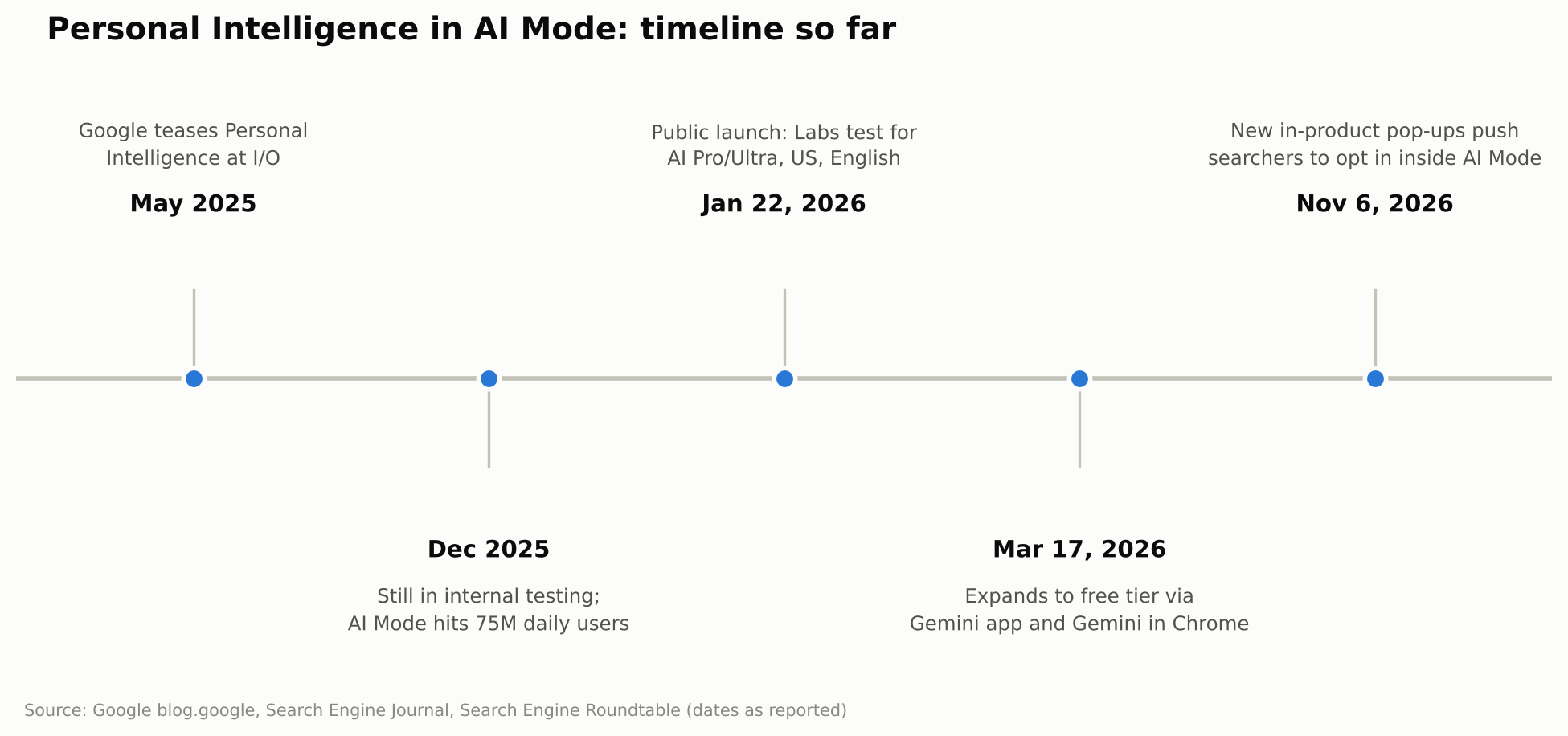
Google first teased this direction at I/O in May 2025, well before it had a name or a public demo. By December 2025, Nick Fox, Google’s SVP overseeing Search, told reporters the feature was still in internal testing with no public launch date. He also disclosed that AI Mode had reached 75 million daily active users. That single number is worth sitting with. Google was already testing deep personal-data integration across a search surface used by tens of millions of people every day. Most SEOs had never even heard of Personal Intelligence at that point.
The public launch came about six weeks later, on January 22, 2026. Expansion to the free tier followed in March. And now, in November, Google is actively prompting people to opt in from inside the product itself. Each step moved the feature from idea to test to live product to actively promoted default. The chart below lays out that sequence using only the dates and figures reported by Google and by the outlets that covered each stage.
Why Google appears to be pushing adoption now
Google has not explained why it chose this moment to start prompting users directly inside AI Mode. A few reasonable, clearly labeled theories are circulating among people who cover search closely, and none of them come from an official Google statement.
Schwartz’s framing links the push to engagement and revenue. More searches inside AI Mode could support more ad opportunities, especially from a feature that makes answers feel more relevant to an individual. Google continues to test monetization formats inside AI Mode responses. That connects to a pattern DevByteDaily has covered before: AI Mode’s growth in usage has been outpacing its growth in ad revenue. That gap gives Google an incentive to get more people fully set up with features that could eventually carry more commercial weight.
A second, separate theory is competitive pressure. OpenAI has been building its own memory and personalization layers into ChatGPT, and reports this month describe OpenAI building business-facing analytics and citation tools for ChatGPT as well. If AI assistants increasingly compete on how well they know an individual user, Google has an incentive to act. It wants more of its 75 million-plus daily AI Mode users connected to products it already controls, like Gmail and Photos, rather than leaving that personalization advantage on the table.
Neither explanation is confirmed by Google. Both are plausible based on public information, and worth treating as informed speculation rather than fact.
There is also a simpler possibility worth naming. Google has tried personalized, context-aware search before, through products like the old Google Now and parts of Discover. Those efforts took years of gradual prompting to build real usage. An in-product pop-up fits that same playbook. Getting a feature used usually takes more than a blog post and a settings toggle. Google may simply be running its standard adoption push a year into the feature’s life, independent of any single competitive or revenue trigger.
What Google Personal Intelligence AI Mode means for GEO strategy
This is where the story stops being a product footnote and starts being a GEO problem. Everything the industry has studied about AI Overviews and AI Mode citations, source diversity, preferred sources, link carousels, has assumed one thing. Most searchers see roughly the same answer for the same query, shaped mainly by what is published publicly on the web. Personal Intelligence breaks that assumption for any query that touches something personal: travel, shopping, recommendations tied to someone’s own history.
If a user asks AI Mode what to pack for a trip, Personal Intelligence may already know their destination from a flight confirmation and their brand preferences from past purchases. AI Mode may never need to cite a public buying guide or a retailer’s product page at all. The informational need gets met from the user’s own data. No click happens, and no public source gets credited, because none was required to generate the answer.
That is a different failure mode than the ones covered in recent AI Overview citation research, where sources get skipped in favor of a competitor’s page. Here, there may be no public source in the running to begin with. Google has not published data on how often this happens, or which query categories are most affected, so the scale of the shift is still unknown.
How to adjust for a more personalized AI Mode
You cannot optimize directly for a user’s inbox or photo library, and you should not try. But a few adjustments make sense given what is now publicly known about where Google Personal Intelligence AI Mode is headed.
Favor content that still earns a citation even when personal context is available. Specific pricing, availability, inventory, reviews, and comparisons are harder for a personalization layer to substitute, because they require current public data rather than something pulled from a user’s own history. Generic “what to pack” or “what to do” content is more exposed, since a personalized answer can increasingly stand in for it.
Watch your own AI Mode visibility data rather than assuming flat exposure across all searchers. DevByteDaily’s guide to tracking brand performance in AI Mode covers the reporting tools Google has made available so far. Those numbers will matter more, not less, as personalization makes blanket visibility checks less reliable.
Finally, treat queries with a strong personal or logistical angle, travel, shopping, scheduling, as the category most likely to see reduced click-through over time, and plan content investment accordingly. That does not mean abandoning those topics. It means measuring them separately from more comparison-driven or research-driven queries, where public sources still carry more of the answer.
Common questions about Personal Intelligence and AI Mode
Is Personal Intelligence on by default?
No. Google says connecting Gmail and Google Photos is opt-in, and the new pop-up is a prompt to turn it on, not an automatic activation. Users can decline, and Personal Intelligence still works in a limited way without connected apps.
Does Personal Intelligence train Google’s AI models on my Gmail or Photos?
Google says no. The company states it does not train directly on a user’s Gmail inbox or Photos library. Training data, it says, is limited to things like AI Mode prompts and the responses the model gives to them. This is Google’s stated policy, not independently verified by a third party.
Who can use Personal Intelligence right now?
At launch it was limited to Google AI Pro and AI Ultra subscribers on personal accounts, in English, in the United States. Free-tier access came later, in March 2026, through the Gemini app and Gemini in Chrome. Workspace business, enterprise, and education accounts remain excluded as of this writing.
Does this affect how my site gets cited in AI Mode?
Potentially, for queries where a user’s personal data can answer the question without needing a public source. Google has not published figures on how often this happens or which topics it affects most. Site owners should treat this as an emerging risk to monitor, not a confirmed, measured drop in citations.
Is this related to the AI Mode “continue with this search” prompt also reported this week?
No, they appear to be separate changes. The “continue with this search” prompt was also reported on November 6 by Search Engine Roundtable. It involves a warning message about resuming a search and appears tied to account verification or anti-automation behavior, not personalization.
Can I tell if Personal Intelligence is affecting a specific AI Mode answer?
Not directly. Google does not currently label which parts of an AI Mode response came from a connected Gmail or Photos account versus the public web. If an answer references something clearly personal, like a specific past trip or purchase, that is a reasonable sign personalization played a role. Otherwise, there is no public indicator to confirm it one way or the other.
Google has not said whether the Google Personal Intelligence AI Mode pop-up is reaching all users or a limited test group, and it has not released adoption numbers since launch. The next useful signal will be whether Google confirms a wider rollout or extends eligibility beyond paid US English accounts. A second signal would be published data tying Personal Intelligence to changes in AI Mode’s citation behavior. Until one of those happens, the safest move is to keep watching your own AI Mode visibility reports. Do not assume this year’s citation patterns will hold steady into next year.



Leave a response