
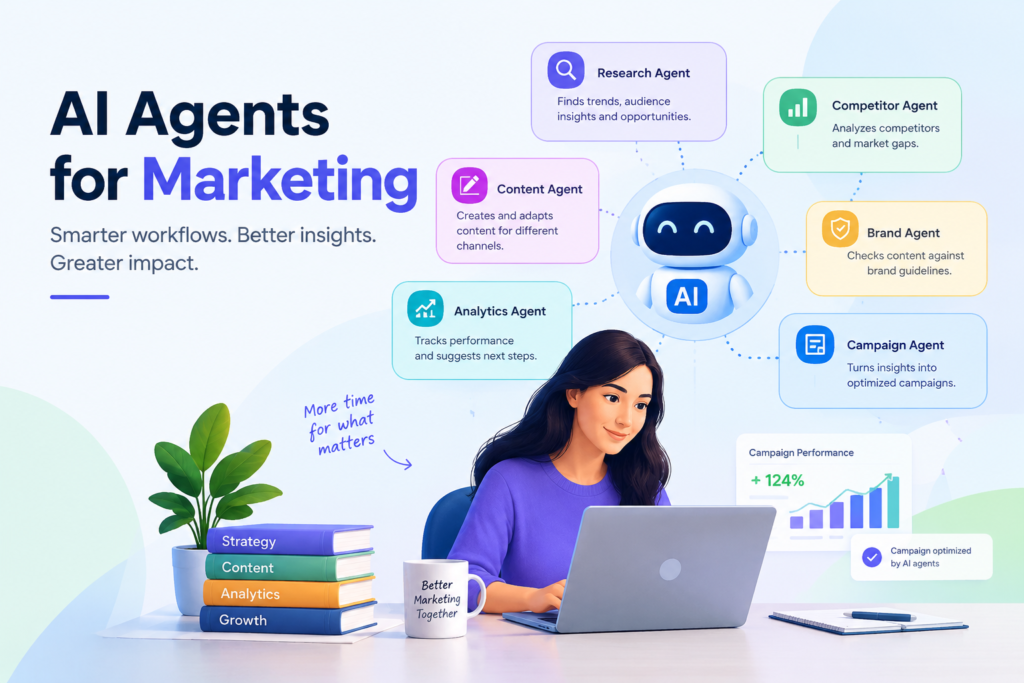
AI agents for marketing are changing how modern marketing teams plan, create, analyze, and optimize campaigns. Instead of relying on a single AI tool to complete one task at a time, marketers can use specialized AI agents to handle different parts of the marketing workflow. These agents can work toward specific goals, use business data, connect with other tools, and complete multiple steps with less manual effort.
For example, an AI research agent can identify customer trends and emerging topics, while a competitor agent can analyze competing brands and find market gaps. A brand agent can review content against established guidelines, while a campaign agent can bring these insights together to help marketers plan, launch, and optimize campaigns.
This shift is moving marketing beyond simple AI assistance toward agentic AI in marketing, where AI systems can reason through tasks, use connected tools, and take action across different workflows instead of simply generating an answer.
The goal of using AI agents for marketing is not to replace marketers. It is to give marketing teams more time for strategy, creativity, and decision-making while AI handles repetitive tasks, research, analysis, and connected workflows. When implemented with reliable data and clear human oversight, AI agents can help marketers work more efficiently and scale their efforts without adding the same amount of manual work.
What Are AI Agents for Marketing?
AI agents are software systems designed to pursue a defined goal by reasoning through tasks, using available tools, accessing relevant information, and taking actions.
Traditional generative AI usually responds to a prompt. You ask a question, provide some context, and receive an answer.
An AI agent can go further.
You might tell an agent:
Research our target audience, identify emerging topics, compare competitor content, suggest campaign ideas, and prepare a brief for the marketing team.
Instead of producing one response and stopping, an agent can potentially break the objective into smaller tasks, gather information, use connected tools, evaluate results, and produce an output based on the workflow it was given.
This distinction is important for marketers because modern campaigns rarely involve just one task.
A typical campaign may require:
- Market and competitor research
- Keyword and audience research
- Content planning
- Copywriting
- Brand-voice checking
- Creative development
- Campaign setup
- Performance analysis
- Personalization
- Reporting and optimization
AI agents can help connect these activities into a more continuous workflow.
AI Agents vs. Traditional AI Tools
The easiest way to understand AI agents is to compare them with traditional AI tools.
A traditional AI workflow might look like this:
Prompt → AI response → Human review → Next prompt
An agentic workflow can look more like this:
Goal → Research → Analysis → Action → Review → Optimization
The difference is not simply that one system is “smarter.” The key difference is how the workflow is structured.
Generative AI is extremely useful for creating content, summarizing information, brainstorming ideas, and answering questions. AI agents add another layer by connecting those capabilities with tools, data, instructions, and actions.
For example, a marketer could use generative AI to write five ad variations.
An AI agent could be given the goal of improving an advertising campaign and then work through a broader process involving audience information, previous campaign performance, creative variations, and defined marketing rules.
That makes agents particularly useful for workflows that involve several connected steps.
How AI Agents Are Transforming Modern Marketing
The biggest change is that AI is moving from content generation to workflow execution.
Marketing teams are beginning to use agents for research, campaign planning, personalization, customer engagement, analytics, and optimization.
Here are some of the most important applications.
1. Marketing Research Becomes More Automated
Market research can take hours because marketers need to collect information from multiple sources and turn it into something useful.
A research agent can be designed to monitor specific topics, competitors, customer questions, industry developments, or search trends.
For example, a content research workflow could:
- Identify emerging topics in your industry.
- Analyze competitor content.
- Find common customer questions.
- Identify content gaps.
- Group topics by search intent.
- Create a content brief for the writer.
The marketer still decides which opportunities matter, but the initial research process becomes much faster.
This is particularly useful for SEO teams because search behavior continues to change as users interact with traditional search engines, AI-generated answers, and conversational assistants.
McKinsey describes this broader shift as marketing becoming a more continuous system that connects insights, content, commerce, and performance rather than treating each campaign activity as an isolated task.
2. AI Agents Can Help Maintain Brand Voice
One of the biggest challenges with AI-generated content is consistency.
A brand may have specific rules for:
- Tone
- Vocabulary
- Messaging
- Formatting
- Product claims
- Target audiences
- Visual identity
- Compliance requirements
Instead of asking a general AI model to “sound like our brand,” businesses can create an agent with access to brand guidelines, approved content, product information, and other trusted resources.
The agent can then review content before publication.
For example:
Content Agent: Creates the first draft.
Brand Agent: Checks tone, terminology, claims, and style.
SEO Agent: Reviews search intent, headings, internal links, and on-page optimization.
Human Marketer: Makes the final decision.
This creates a review system rather than relying on one AI prompt to do everything correctly.
3. Content Production Can Become a Connected Workflow
AI has already changed content creation, but agents can connect more parts of the content process.
Imagine you want to publish an article about a new industry trend.
A content workflow could assign different responsibilities to specialized agents:
Research Agent
Finds relevant information and supporting sources.
SEO Agent
Analyzes keywords, search intent, related questions, and content gaps.
Content Agent
Creates the article structure and draft.
Brand Agent
Checks the writing against brand guidelines.
Editor Agent
Identifies unclear sections, repetition, and unsupported claims.
Distribution Agent
Creates social posts, email copy, and other promotional assets.
The human team can then review the work before publication.
The important idea is not that every piece of content should be created entirely by AI. The value comes from reducing repetitive work between the different stages.
4. Campaign Optimization Becomes More Continuous
Traditional campaign management often involves manually checking performance, identifying problems, and making changes.
AI-powered advertising platforms are already moving toward more automated optimization.
For example, Google’s AI Max for Search campaigns use AI for search-term matching and creative optimization, while Google has also introduced marketing-agent capabilities such as Ask Advisor across Google Ads, Merchant Center, and Google Analytics.
This means marketers increasingly work with systems that can process real-time signals and make recommendations or adjustments within defined controls.
The role of the marketer shifts from manually adjusting every setting toward defining:
- Campaign goals
- Target audiences
- Budget boundaries
- Brand rules
- Geographic restrictions
- Conversion goals
- Measurement requirements
AI handles more of the repetitive optimization, while humans remain responsible for the strategy and guardrails.
5. Personalization Can Happen at Greater Scale
Personalization has traditionally required marketers to create audience segments and manually build different experiences.
AI agents can help make this process more dynamic.
For example, an ecommerce workflow could consider:
- Previous purchases
- Browsing behavior
- Product interests
- Customer lifecycle stage
- Recent engagement
- Location
- Campaign interactions
An agent can use these signals to determine which message, offer, product recommendation, or customer journey is appropriate within predefined rules.
Klaviyo is one example of this direction. In 2026, the company introduced Composer as an AI marketing agent alongside its Customer Agent, with both operating from customer data within its CRM environment.
The broader trend is important: personalization is moving from static audience segments toward more context-aware customer journeys.
6. Marketing and Customer Service Are Starting to Connect
Marketing does not end when someone clicks an advertisement.
A customer may discover a product through an ad, visit a website, ask a question, make a purchase, contact support, and later receive another marketing message.
Historically, these interactions were often managed by separate teams and systems.
Agentic AI is pushing businesses toward more connected customer journeys.
Klaviyo’s recent research and product direction, for example, focuses on marketing and customer service as parts of one continuous agentic customer experience.
This creates opportunities for workflows such as:
Marketing Agent → Customer Agent → Sales Agent → Support Agent
The agents can potentially share relevant customer context instead of treating every interaction as a completely new conversation.
7. AI Agents Can Support SEO and AI Search Optimization
SEO is also changing as search engines increasingly incorporate AI-generated answers and conversational experiences.
An SEO workflow can use specialized agents to analyze:
- Search intent
- Keyword opportunities
- Competitor pages
- Topic coverage
- Internal linking
- Structured data
- Content freshness
- AI-search visibility
- User questions
An SEO research agent could identify opportunities.
An SEO content agent could turn those opportunities into briefs.
An optimization agent could review existing pages.
A monitoring agent could track changes over time.
This does not mean traditional SEO is disappearing. It means SEO teams have more systems available to process information and manage optimization workflows at scale.
8. Multi-Agent Marketing Teams Are Emerging
One of the most interesting developments is the move from a single AI assistant to multiple specialized agents.
Instead of building one giant marketing agent that tries to handle everything, companies can assign different responsibilities to different agents.
A simple marketing agent team might look like this:
| AI Agent | Main Responsibility |
|---|---|
| Research Agent | Trends, competitors, audience insights |
| SEO Agent | Keywords, search intent, content opportunities |
| Content Agent | Articles, landing pages, campaign copy |
| Brand Agent | Tone, messaging, brand guidelines |
| Analytics Agent | Performance analysis and reporting |
| Campaign Agent | Campaign planning and execution |
| Customer Agent | Questions, recommendations, support |
The agents can then pass relevant information between workflows.
Salesforce is moving in this direction with Agentforce. In 2026, Salesforce announced multi-agent orchestration designed to allow specialized agents to coordinate work across roles, systems, and stages of the customer journey.
Salesforce has also described an AI marketing team where agents can support activities such as building pipeline, creating content, and running campaigns.
AI Marketing Tools and Platforms to Watch
The AI-agent market is developing quickly, so marketers should focus less on finding one “best AI tool” and more on understanding which platforms fit their existing workflow.
OpenAI Agents
OpenAI’s current agent tooling is designed around agents that can use tools, work with files, operate in controlled environments, and coordinate longer-running tasks. Its Agents API was introduced publicly in September 2026, while the Agents SDK has added capabilities for tool use, memory, sandbox execution, and multi-step workflows.
For marketing teams, this type of infrastructure can support custom research, analytics, content, reporting, and workflow agents.
HubSpot Breeze
HubSpot provides agent-building capabilities through Breeze Assistant and its agent builder.
Marketers can describe what they want an agent to accomplish, and Breeze can propose a configuration involving goals, tools, and knowledge sources. The resulting agent can then be reviewed and customized before deployment.
This approach is particularly relevant for teams already using a CRM because the agent can operate within existing customer and business data.
Salesforce Agentforce
Salesforce is building agentic capabilities across sales, service, commerce, and marketing.
Its 2026 updates include multi-agent orchestration, job-specific agents, and tools for improving agents over time. Salesforce’s marketing products are also moving toward campaign agents that can assemble audiences, content, journeys, and channels around marketer-defined goals.
Google Marketing AI
Google is incorporating AI more deeply into advertising and marketing workflows.
AI Max for Search campaigns use AI to expand search-term matching and optimize creative, while Google’s 2026 Marketing Live announcements highlight marketing-agent capabilities designed to connect insights with actions across products such as Google Ads, Merchant Center, and Google Analytics.
Adobe Marketing Agent
Adobe has also introduced agentic marketing workflows. Its Marketing Agent can connect Adobe customer experience data, content, campaign performance, audience insights, and journey intelligence into workflows within ChatGPT Work and Codex.
These developments show an important trend: marketing AI is moving closer to the systems where marketers already manage campaigns, customer data, content, and analytics.
The Biggest Challenge: Data Quality
AI agents can only work as effectively as the information and permissions available to them.
If your customer data is fragmented, outdated, duplicated, or stored across disconnected systems, an agent may struggle to make useful decisions.
This is one of the most important lessons for businesses adopting agentic AI.
Adobe’s 2026 AI and Digital Trends research found that 74% of surveyed martech leaders identified data integration and quality as a top barrier to implementing agentic AI. The same research found that only 42% reported having a unified customer data foundation for extracting insights from AI-generated data.
That means businesses should not start with:
“Which AI agent should we buy?”
A better starting point is:
“Does our AI agent have reliable data, clear instructions, the right tools, and defined boundaries?”
Human Oversight Still Matters
More automation does not mean marketers should remove humans from the process.
AI agents can analyze information and perform actions, but marketing decisions often involve context that is difficult to define completely.
Brand reputation, cultural context, customer sensitivity, business priorities, and creative judgment still require human oversight.
A practical setup is:
AI researches → AI drafts → AI checks → Human reviews → AI executes → Human monitors
This keeps people involved at the points where judgment matters most.
It also reduces the risk of an agent making an incorrect assumption and turning it into a large-scale campaign action.
How to Start Using AI Agents in Marketing
You do not need to build a complex multi-agent system on day one.
Start with one repetitive workflow.
Step 1: Identify a Time-Consuming Task
Look for work that is:
- Repetitive
- Clearly defined
- Based on accessible data
- Easy to measure
- Low-risk if reviewed
Research, reporting, content briefs, lead qualification, and campaign analysis are good starting points.
Step 2: Define the Desired Outcome
Do not simply tell an agent to “do marketing.”
Give it a specific objective.
For example:
Analyze our previous campaign performance and produce a weekly report showing the top-performing audiences, creative themes, conversion trends, and areas that need attention.
A clear objective produces a much more useful workflow.
Step 3: Give the Agent Trusted Context
Provide access to the information it actually needs.
This could include:
- Brand guidelines
- Product information
- Customer data
- Analytics
- Campaign history
- SEO data
- Approved messaging
- Business rules
The goal is to prevent the agent from making decisions using incomplete context.
Step 4: Define What the Agent Can Do
Not every agent needs permission to publish, spend money, modify campaigns, or contact customers.
Start with recommendations and drafts.
Then, once the workflow is tested, allow the agent to perform specific actions within controlled boundaries.
Step 5: Measure the Results
Track whether the agent actually improves the workflow.
Useful metrics include:
- Time saved
- Cost per task
- Error rate
- Conversion rate
- Content production time
- Campaign performance
- Human review time
- Customer satisfaction
AI adoption should be measured by business outcomes, not simply by how impressive the technology looks.
The Future of AI Agents for Marketing
The next stage of AI marketing is likely to involve more connected systems rather than isolated AI tools.
Instead of opening five different applications and manually moving information between them, marketers will increasingly interact with AI systems that can access approved tools and business context.
Google is already working on standards to discover and connect AI capabilities across the web. Its Agentic Resource Discovery specification helps agents find, verify, and connect to tools, skills, and other agents.
This points toward a more connected agent ecosystem.
A marketing team could eventually define a business goal such as:
Increase qualified leads from organic and paid channels while maintaining our brand guidelines and budget.
Different agents could then handle research, content, advertising, analytics, personalization, and reporting as parts of the same workflow.
The marketer would still set the strategy and boundaries.
The difference is that more of the execution could happen continuously in the background.
Research agents can find opportunities. SEO agents can identify content gaps. Brand agents can protect consistency. Analytics agents can turn performance data into insights. Campaign agents can help coordinate execution.
But the strongest systems still depend on the same fundamentals that have always mattered in marketing: clean data, clear goals, strong positioning, useful content, accurate measurement, and good human judgment.
AI agents can help marketing teams move faster and operate at greater scale. The competitive advantage will come from knowing where to use them, what to give them, and where humans should remain in control.



Leave a response