


Search Has Changed (And So Must We)
If you have used a search engine recently, you have likely noticed that the traditional list of ten blue links is no longer the only thing greeting you.
When you ask a question today, you frequently see an interactive, summarized answer sitting right at the top of your screen. Whether it is Google AI Overviews, Perplexity, or Search GPT, artificial intelligence is reshaping how people find information online.
For website owners, developers, and digital creators, this shift might feel overwhelming. You might be wondering:
- Are traditional SEO practices dead?
- How do I make sure my website gets referenced by AI search engines?
- Can I use AI tools to speed up my content creation without getting penalized?
The good news is simple: High-quality, helpful content created for real people is more important than ever.
AI SEO is not about finding secret tricks to game an algorithm. Instead, it is about understanding how modern language models and search engines read your pages, making your information easy for machines to parse, and providing unmatched value that only a human voice can offer.
In this guide, we will break down everything you need to know about AI SEO in plain, everyday language without confusing technical jargon.
What Exactly Is AI SEO?
At its core, AI SEO refers to two closely related concepts working together:
- Optimizing for AI-Driven Search: Structuring, writing, and formatting your website’s content so generative search engines and answer engines (like Google AI Overviews, Copilot, Perplexity, and ChatGPT) can easily understand, cite, and recommend your articles.
- Using AI to Enhance Your SEO Workflow: Using artificial intelligence tools to conduct keyword research, identify content gaps, improve site architecture, optimize metadata, and draft clear outlines faster.
In short, AI SEO is the modern evolution of search engine optimization. It blends technical clarity and conversational formatting with genuine subject expertise.
The Two Sides of AI in Search: SEO with AI vs. SEO for AI
To build a winning search strategy, it helps to separate the two main aspects of artificial intelligence in search marketing:
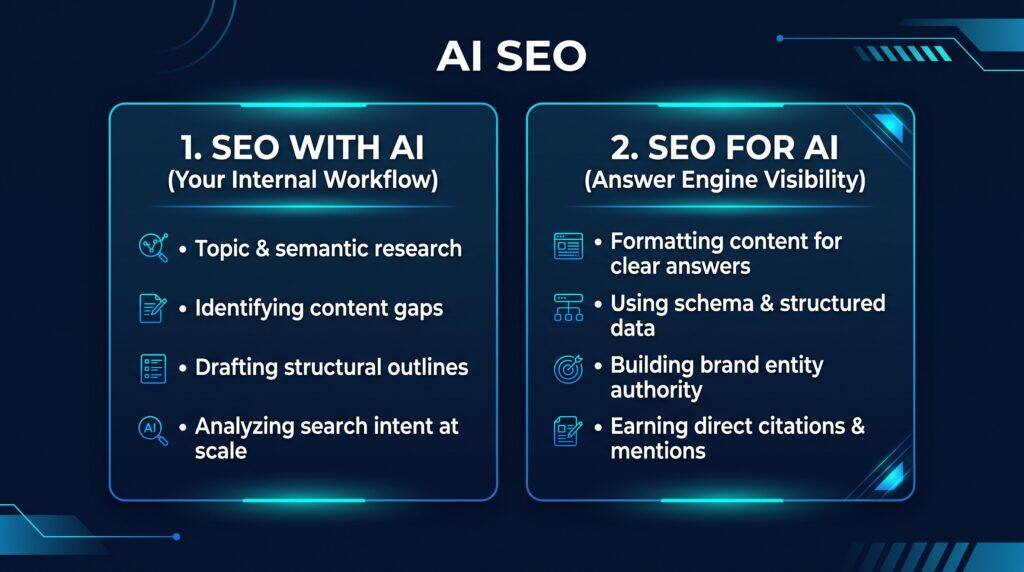
Side 1: SEO with AI (Enhancing Your Workflow)
This is about productivity and insight. Instead of spending five hours manually analyzing search engine results pages (SERPs), you can use AI tools to:
- Group related keywords into topical themes (semantic clustering).
- Pinpoint common questions users ask across forums and discussions.
- Audit your existing articles to find missing subheadings or weak explanations.
Side 2: SEO for AI (Answer Engine Optimization / AEO)
This is about how your content is consumed by search engines. In generative search, models scan the web to synthesize a direct answer. If your article provides a crisp, authoritative summary supported by real-world context, the AI engine is far more likely to feature your site as a primary source.
How Search Engines Use Artificial Intelligence Today
Search engines no longer rely on simple keyword matching. In the early days of the web, placing an exact phrase five times in a paragraph was often enough to rank. Today, modern search systems use sophisticated machine learning models to understand meaning, context, and intent.
- Natural Language Processing (NLP)
Search engines read sentences much like a human does. They analyze the relationship between words, synonyms, and related concepts. If your article talks about web hosting, search engines naturally look for related terms like uptime, servers, SSL certificates, and DNS records to judge depth.
- Entity-Based Understanding
An “entity” is a distinct person, place, organization, or concept. Search engines build vast knowledge graphs connecting entities together. When you write an article, search engines evaluate how accurately and reliably your brand is connected to the topics you discuss.
- Direct Answer Generation
When a user asks a question, generative AI models scan top-ranking pages, extract key data points, and generate a synthesized paragraph. To be included, your content needs clear definitions, direct answers, and clean formatting.
The Core Pillars of Modern AI SEO Strategy
To succeed in this evolving search landscape, focus your efforts on these four core pillars:
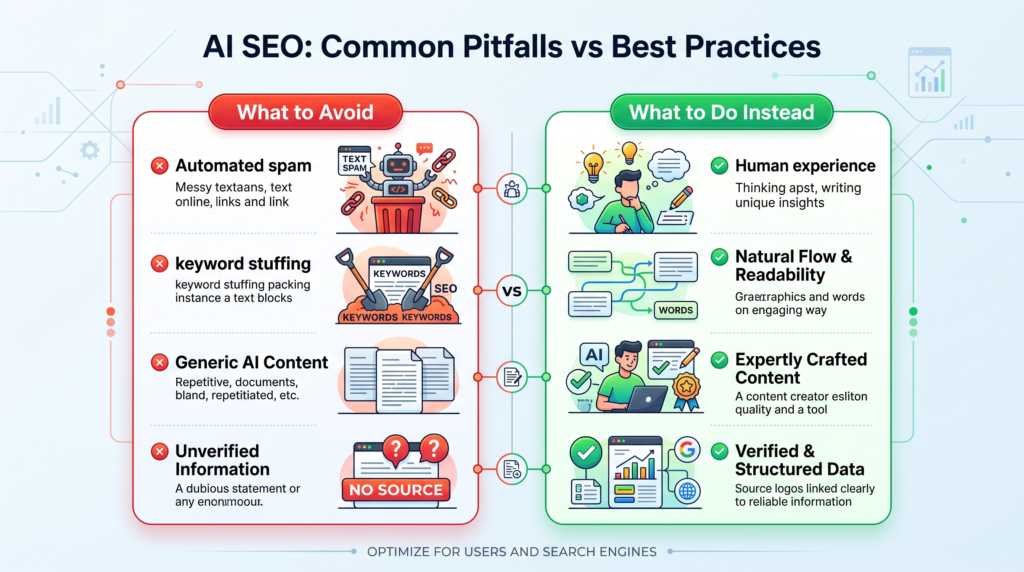
Pillar 1: Semantic Depth (Topic Coverage)
Instead of writing ten short, shallow articles targeting ten minor keyword variations, build one comprehensive, well-structured guide. Cover the primary question, the underlying “why,” practical examples, and common follow-up questions.
Pillar 2: Direct, Scannable Formatting
AI summarizers favor clean structures. If you answer a question, place a direct 2- to 3-sentence summary immediately below the heading, followed by a bulleted list or a table that explains the finer details.
Pillar 3: Real Human Experience (E-E-A-T)
Google and other search engines place immense value on Experience, Expertise, Authoritativeness, and Trustworthiness (E-E-A-T).
-
Share direct observations (“When we tested this approach…”).
-
Include original screenshots, custom graphics, or practical code snippets.
-
State your opinion and explain your reasoning clearly.
Review Google Search Central’s Official Guidance on Creating Helpful, People-First Content to ensure your editorial standards align with quality guidelines.
Pillar 4: Structured Data & Schema Markup
Structured data (JSON-LD schema) is the language search engines use to explicitly understand your page structure. Adding Article, FAQPage, Howto, and BreadcrumbList schema helps machines parse your pages without ambiguity.
Step-by-Step: How to Optimize Your Website for AI Overviews and Search Engines
Here is a practical, step-by-step workflow you can apply to every article you publish on DevByte Daily.
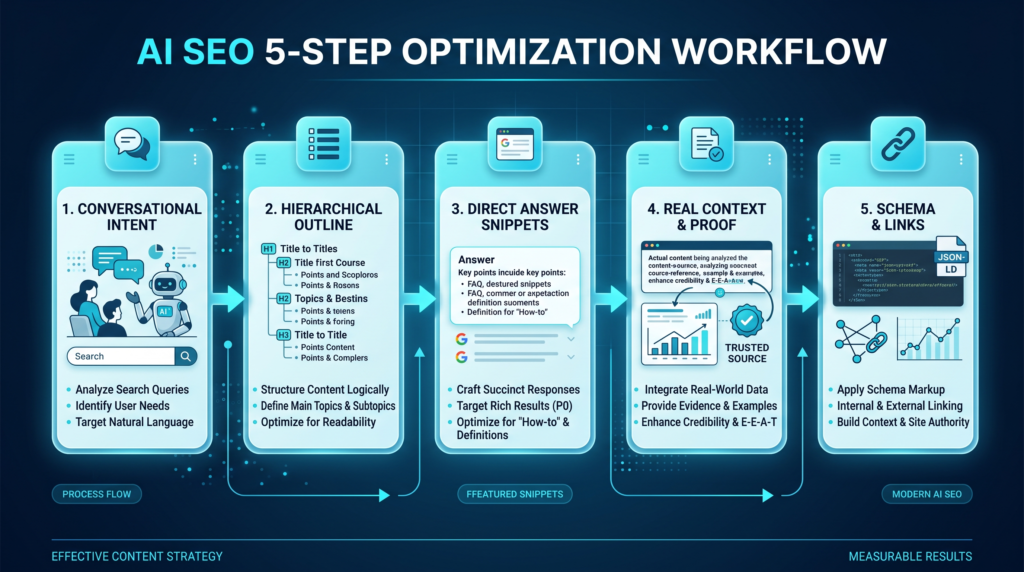
Step 1: Research Conversational Intent
People search differently when talking to AI assistants. Instead of typing best code editor mac, users often type:
“What is the most lightweight code editor for Mac with good Git integration?”
Action Item: Use tools like Google’s “People Also Ask”, AnswerThePublic, or conversational queries in AI tools to discover full-sentence questions people are asking.
Step 2: Build a Logical, Hierarchical Outline
Structure your article like a well-organized book.
-
H1: Main topic containing your primary keyword.
-
H2s: Core subtopics and major phases.
-
H3s / H4s: Specific steps, direct questions, and comparisons.
If you have an existing guide on website performance, link to your internal guide on DevByte Daily’s Web Performance Optimization Checklist with the anchor text “optimizing web page load speeds”.
Step 3: Use “Snippet-Friendly” Answer Blocks
Under major question headings (e.g., What is AI SEO?), write a concise, direct answer in 40–60 words. Avoid fluff or introductory throat-clearing like “In today’s fast-paced digital world…”. Get straight to the answer.
Step 4: Inject Real Context and First-Hand Perspective
AI models can summarize facts, but they cannot replace genuine human experience.
-
Tell the reader what worked well and what failed during your testing.
-
Give clear recommendations tailored to different user situations (e.g., beginners vs. advanced developers).
Step 5: Implement Internal and External Links
-
Internal Links: Connect related articles across your site to show search engines the breadth of your knowledge.
-
External Links: Cite authoritative, reputable documentation, research papers, and industry leaders to back up your claims.
The Best AI SEO Tools and How to Use Them Responsibly
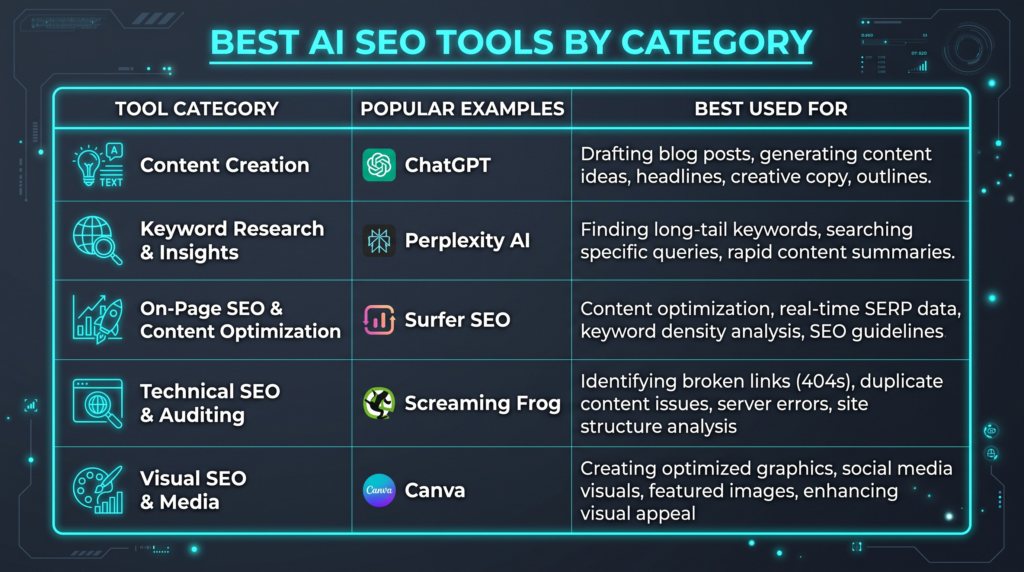
You do not need dozens of subscriptions to benefit from AI SEO. Here is a breakdown of the most useful tool categories:
How to Use AI Responsibly
-
Do not publish raw AI outputs: Always review, fact-check, and rewrite drafts in your own unique voice.
-
Verify all statistics: Generative tools can hallucinate dates, numbers, or quotes. Double-check every claim against an official source.
-
Focus on clarity: Keep paragraphs short (2–4 sentences) and use bullet points for lists.
Common Pitfalls to Avoid in AI SEO
Avoid these common mistakes to keep your site safe from algorithmic penalties and loss of reader trust:
-
Mass-Publishing Unedited AI Content: Flooding your site with hundreds of generic articles often triggers spam filters. Search engines look for unique insight, not recycled summaries.
-
Ignoring Technical Fundamentals: Even the best-written content will struggle to rank if your website takes ten seconds to load, lacks mobile responsiveness, or has broken internal links.
-
Over-Optimizing for Bots: Always write for the human reader first. If a sentence sounds awkward when read aloud, rephrase it.
Measuring Success: Metrics That Actually Matter
As search habits evolve, standard organic click tracking only tells part of the story. Keep an eye on these essential metrics:
-
Brand Search Volume: Are more people searching for “DevByte Daily” by name? Brand mentions indicate growing topical authority.
-
Featured Snippet & AI Citations: Check if your site is quoted in Google’s AI summaries or linked in AI chat engines.
-
Engagement & Dwell Time: Are visitors reading through your guides and clicking on internal links?
-
Organic Impressions & Keyword Breadth: Look at your Google Search Console reports to see if your pages are ranking for a wider variety of long-tail questions.
Frequently Asked Questions (FAQs)
Does Google penalize AI-generated content?
No. Google’s official search guidance clearly states that they reward high-quality content regardless of how it is produced. However, using automation to create low-quality, spammy content solely to manipulate search rankings violates their spam policies.
How is AI SEO different from traditional SEO?
Traditional SEO focuses heavily on exact keyword placement, backlink counts, and metadata. AI SEO builds on these basics while prioritizing natural language understanding, topic completeness, entity relationships, and Answer Engine Optimization (AEO).
What is Answer Engine Optimization (AEO)?
AEO is the practice of structuring content so that AI-powered search engines (such as Perplexity, SearchGPT, and Google AI Overviews) can directly extract accurate summaries and credit your website as a source.
Can beginners rank for competitive keywords using AI SEO?
Yes, especially by targeting specific, long-tail conversational questions that larger sites overlook. Providing detailed, step-by-step answers with unique personal insights helps newer websites build topical authority faster.





Leave a response