
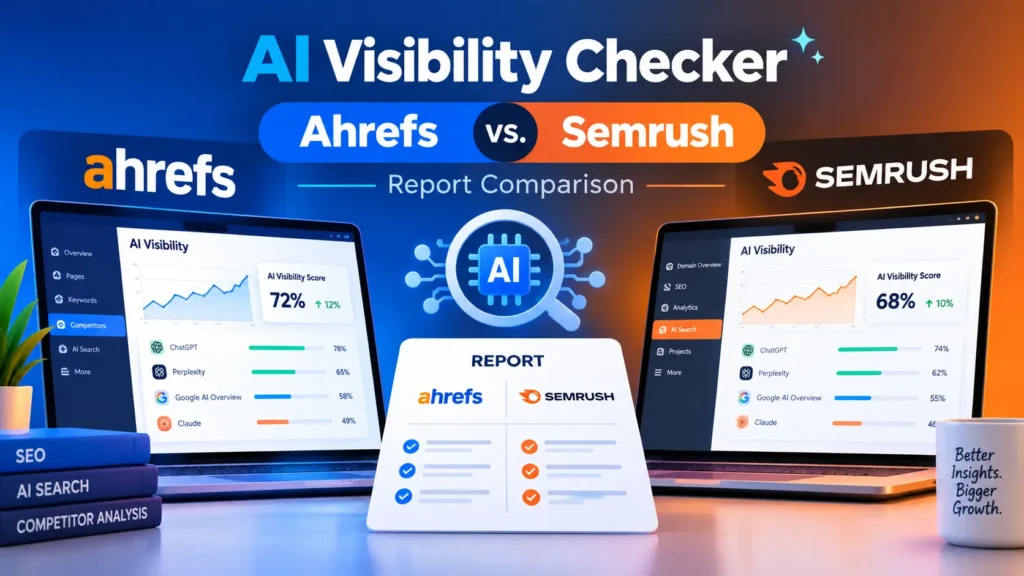
Search behavior has shifted from ten blue links to synthesized answers powered by Google AI Overviews, Perplexity, ChatGPT Search, and Microsoft Copilot. Measuring organic performance now requires tracking whether generative models quote your content, cite your domain, or omit your brand entirely.
Both Ahrefs and Semrush offer tools to monitor AI-driven discovery, but their architectural philosophies, metric models, and data capture cadences produce different readouts.
What Is an AI Visibility Checker?
An AI visibility checker monitors how frequently, prominently, and accurately your domain or brand appears within generative search engines and synthesized summaries.
Unlike traditional rank trackers that report a static numerical rank (positions 1 through 100), AI visibility engines evaluate complex generative surfaces:
-
Citation Frequency: Does the model link back to your URL as a primary grounding source?
-
Brand Mention Share: Does your brand appear in the natural-language synthesis?
-
SERP AI Real Estate: When an AI Overview expands on a desktop or mobile screen, does it dominate the viewport and push standard organic rankings below the fold?
-
Sentiment & Sentiment Context: Does the AI present your product favorably, neutrally, or critically when responding to transactional and informational queries?
As Generative Engine Optimization (GEO) matures alongside traditional SEO, tracking these attributes reveals whether search algorithm updates are reducing your click-through rates (CTR) via zero-click AI summaries.
Architectural Philosophy: How Both Platforms Approach AI Search
Understanding why Ahrefs and Semrush report different visibility numbers starts with how each tool gathers and processes its data.
Traditional SERP Crawl (HTML parsing)
1. Ahrefs: Focuses on Google SERP AI Overview integration, CTR compression, and organic footprint impact.
2. Semrush: Blends SERP AI Overview snapshots with cross-platform AI brand tracking (Perplexity, ChatGPT, Gemini).
Ahrefs: SERP Feature Integration & Search Intent Impact
Ahrefs treats AI visibility primarily as an evolution of Google SERP layout changes. Rather than treating AI as a separate entity disconnected from core web search, Ahrefs monitors Google AI Overviews (AIO) directly within its Rank Tracker and Site Explorer environments.
-
Tracking Mechanism: Monitors whether monitored keywords trigger an AI Overview, whether your target URL appears in the carousel of cited sources, and how that AI Overview shifts your traditional organic snippet.
-
Core Philosophy: AI search is currently a feature layer on top of classical search engine crawlers. If you win high authority, topical depth, and quality backlinks, generative engines pull from your corpus naturally.
Semrush: Multi-Pronged AI Overviews & Brand Monitoring Ecosystem
Semrush splits AI tracking across two specialized environments: the Position Tracking / Sensor tool (for Google AI Overviews) and its dedicated AI Search Tracker / Brand Monitoring Toolkit (which scans LLMs like ChatGPT, Perplexity, and Gemini).
-
Tracking Mechanism: Logs both standard Google SERP snippet positions and separate citation frequencies across independent generative conversational engines.
-
Core Philosophy: Generative engines operate both within search engines and as standalone conversational portals. Brand sentiment and entity citations require dedicated monitoring outside of Google SERP frames.
Core Feature Breakdown: Ahrefs vs. Semrush
1. Data Collection & Engine Coverage
-
Ahrefs: Specializes primarily in Google’s implementation of generative search (AI Overviews across desktop and mobile devices). It flags keywords triggering AIOs, detects presence in the source citation links, and evaluates organic cannibalization.
-
Semrush: Offers dual-path coverage. Within standard Position Tracking, it detects Google AI Overviews. Through the Semrush App Center and Brand Monitoring extensions, it expands sampling to conversational AI agents, collecting prompts and responses from ChatGPT, Perplexity, and Microsoft Copilot.
2. Metric Reporting & Scoring Systems
-
Ahrefs Visibility Score: Calculates an overall percentage score based on estimated CTR across top-ranking organic keywords, adjusted downward when zero-click features like AI Overviews push results down. It isolates keywords where you are cited inside the AI summary versus standard rankings.
-
Semrush AI Share of Voice (SoV): Uses a weighted formula that awards higher visibility points when your brand is explicitly mentioned in the opening sentence of an AI response or featured in top citation cards.
3. Historical Tracking & Volatility
-
Ahrefs: Integrates AI feature presence into its historical chart overlays. You can view a 12-month trend to see the exact day an AI Overview appeared for a head keyword and evaluate the resulting drop or increase in organic traffic.
-
Semrush: Offers real-time volatility tracking via the Semrush Sensor. This monitors daily global fluctuations in AI Overview generation rates across industries (e.g., Health, Finance, E-commerce).
Head-to-Head Comparison
| Feature / Dimension | Ahrefs AI Visibility Workflow | Semrush AI Tracking Toolkit |
| Primary Focus | Google SERP AI Overviews & Organic Cannibalization | Google AI Overviews + Standalone LLM Prompts |
| Monitored Engines | Google (Desktop & Mobile) | Google, ChatGPT, Perplexity, Copilot (via add-ons) |
| Citation Attribution | Direct URL cards inside Google AI Overviews | Direct links, entity mentions, and co-citations |
| Competitor Benchmarking | Side-by-side URL citation overlap in Rank Tracker | Share of Voice (SoV) ranking against named rivals |
| Sentiment Analysis | Not available (purely quantitative link/presence metric) | Contextual sentiment scoring (Positive, Neutral, Negative) |
| Update Frequency | Daily / Weekly (depends on selected project tier) | Daily SERP tracking; periodic on-demand LLM prompt scans |
| Reporting Integration | Integrated into main Site Explorer & Rank Tracker | Segmented across Position Tracking, Sensor, and App Center |
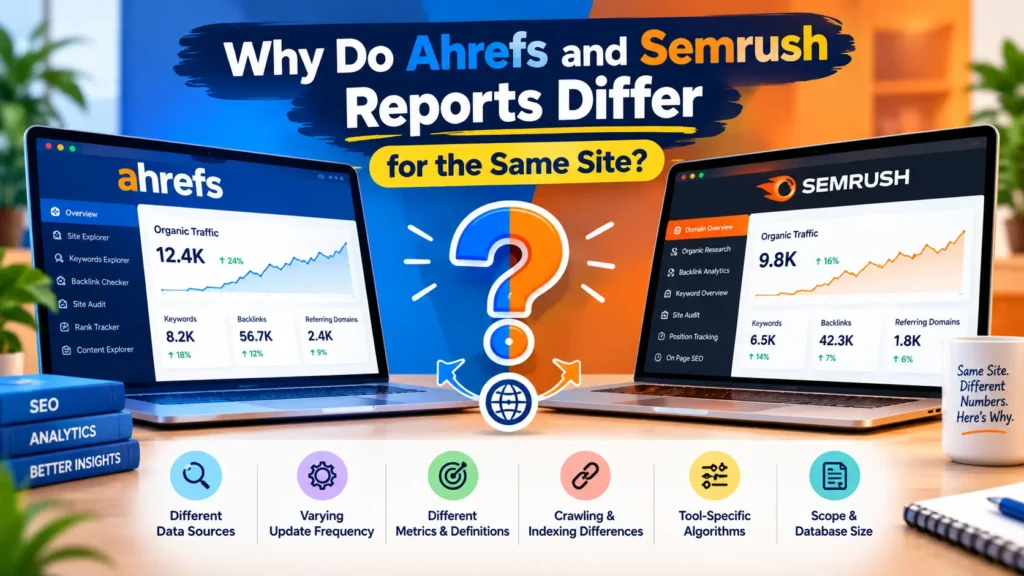
Why Do Ahrefs and Semrush Reports Differ for the Same Site?
Running both tools against the same domain often reveals differing visibility percentages. These discrepancies stem from four core factors:
1. Query Prompting vs. Keyword Tracking
Traditional search queries like “best cloud hosting” behave differently than conversational prompts like compare the top 3 cloud hosting platforms for a Python backend.
-
Ahrefs focuses on the explicit search query entered into Google, recording whether Google generates an AI synthesis for that exact term.
-
Semrush’s multi-engine tools often test synthesized variations and natural language prompt modifications, leading to varying presence rates across conversational variants.
2. Geographic & Personalization Variations
Google AI Overviews adapt dynamically based on user IP location, search history, and signed-in status.
-
Ahrefs and Semrush use independent proxy grids to scrape SERP results.
-
If Ahrefs samples a data center in Virginia while Semrush pulls from an IP in Texas, Google’s testing clusters may display an AI Overview on one server while serving standard organic results on another.
3. Attribution Models (Mentions vs. Clickable Citations)
An AI engine can cite a brand in two ways:
-
Implicit Text Mention: “According to recent tests by ExampleBrand, performance increased…” (No clickable link).
-
Interactive Citation Card: An explicit link button directing to [examplebrand.com/test-gudie] (https://examplebrand.com/test-guide).
Ahrefs places heavy emphasis on actionable URL links that generate referral and organic traffic. Semrush tracks conversational entity mentions alongside raw links, reporting brand visibility even when a clickable link is absent.
1. Identify Queries Losing Clicks to AI Overviews (Ahrefs / Semrush)
2. Analyze Cited Source Domains & Common Information Extraction Patterns
3. Restructure Content: Clear Entity Definitions, Data Tables, & Direct Answers
4. Build Authoritative Digital PR Mentions for Co-Citation Footprints
Practical Workflow: Optimizing for AI Visibility
Step 1: Isructure Content with Self-Contained Information Blocks
Generative models favor clean, extractable content chunks. Avoid burying the core answer behind 600 words of filler. Use concise definition blocks (40–60 words) immediately after descriptive headings.
Step 2: Implement Structured Data and Semantic Schema
Mark up your pages with correct JSON-LD schemas (Article, Product, TechArticle, FAQPage, Author). Schema provides structured semantic hooks that make it straightforward for RAG (Retrieval-Augmented Generation) parsers to parse your site’s entities.
Step 3: Publish Original Research and Proprietary Data
AI models reference the source of proprietary statistics, surveys, and unique industry data. Content that synthesizes third-party claims without contributing original data is frequently bypassed in citation cards.
Strategic Linking Architecture
Internal Linking Recommendations
To build topical authority and strengthen your internal cluster for this topic, integrate links with the following internal structures:
-
Link to: Your foundational Generative Engine Optimization (GEO) Guide using anchor text: actionable GEO optimization tactics.
-
Link to: Your Rank Tracking Software Comparison using anchor text: enterprise rank tracking software.
-
Link to: Your Zero-Click Searches and CTR Analysis Case Study using anchor text: mitigating zero-click traffic drops.
-
Link from: Existing SEO tool review pages pointing into this guide using anchor text: Ahrefs vs Semrush AI visibility reports.
External Authority Link Suggestions
Cite reliable industry platforms to ground technical claims in primary sources:
-
Google Search Central Documentation: Google Search Central for referencing official documentation on Google structured data requirements and Search Generative Experience guidelines.
-
Search Engine Land: Search Engine Land for referencing ongoing industry studies and data on Google AI Overview rollout rates and SERP volatility.
-
W3C Schema Guidelines: Schema.org for technical validation on semantic entity tags and microdata markup.
-
Pew Research Center / Nielsen Norman Group: Nielsen Norman Group for usability studies on how consumers read and interact with AI-generated search summaries.
Choosing the Right Tool for Your Stack
Selecting between Ahrefs and Semrush for AI visibility tracking depends on your team’s existing operational focus:
-
Choose Ahrefs if: Your team is hyper-focused on Google organic traffic preservation, monitoring backlink equity, and evaluating how AI Overviews affect click-through rates on your primary revenue keywords.
-
Choose Semrush if: Your marketing scope extends beyond Google into broader brand reputation management, cross-engine LLM presence (ChatGPT/Perplexity), and sentiment analysis.
-
The Ideal Hybrid Approach: Track day-to-day Google search cannibalization and citation stability in Ahrefs Rank Tracker, while monitoring brand share of voice and conversational sentiment via Semrush.


Leave a response