

On October 7, 2026, OpenAI began rolling out GPT-6 alongside a new ChatGPT interface called ChatGPT Intelligent UI, replacing some of ChatGPT’s plain text-and-links answers with charts, interactive diagrams, calculators, and tappable buttons. OpenAI confirmed the change in its own release notes, with Plus, Pro, Business, and Enterprise accounts getting access first and Free and Go accounts following the next day.
For anyone working in generative engine optimization (GEO), the practice of making your brand and content visible inside AI-generated answers rather than only in a list of blue links matters because it changes what an “answer” inside ChatGPT actually looks like, and potentially how often a user ever needs to click through to a website at all. Here is exactly what changed, what OpenAI has confirmed versus what is still unclear, and what to actually do about it.
What OpenAI Announced on October 7
According to OpenAI’s own ChatGPT release notes, the entry titled “GPT-6 and Intelligent UI in ChatGPT” describes a ChatGPT that can now combine “text, visuals, and interactive elements” depending on the question being asked. The model chooses the format automatically — a plain text answer is still used when that is genuinely the best format, but a comparison question might render as a side-by-side layout, and a process question might become a diagram you can interact with.
Two new model variants ship with this update. Paid tiers (Plus, Pro, Business, Enterprise) receive GPT-6 Sol, while Free and Go accounts receive GPT-6 Luna. OpenAI describes both as tuned for everyday conversation, distinct from the separate Work and Codex models, which are unaffected by this rollout. Notably, the Pro reasoning tier running GPT-6 Astra does not support ChatGPT Intelligent UI at all, so the experience is already inconsistent across OpenAI’s own product line.
ChatGPT Intelligent UI vs. the Old Text-and-Links ChatGPT
Reporting from TechCrunch, relayed by AI Weekly, quotes OpenAI product manager Aarush Selvan describing ChatGPT until now as “predominantly a text-based interface.” The stated goal of ChatGPT Intelligent UI is to help users get things done inside the chat itself, not just read about how to do them elsewhere.
Demo examples cited in that coverage include an interactive diagram explaining how an airplane wing generates lift, a breakdown of bicycle mechanics, a multi-day hiking trip rendered as stops on a map, and a small built-in savings calculator. Other examples mentioned in press coverage include a recipe shown with a cooking timeline, a bill-splitting tool, and simple in-chat games. In each case, the answer is no longer just prose with a source link beneath it; it is a working tool generated on the spot.
OpenAI says this is powered by a library of streamable components and a compiler that renders the interface progressively, piece by piece, while the model is still generating its response. The company has publicly acknowledged that the model’s judgment about which format to use “needs improvement,” which is itself a useful admission: this is an early-stage feature, not a finished, stable product behavior.
Streaming Answers While the Model Is Still Thinking
Alongside Intelligent UI, GPT-6 can begin answering before it has finished reasoning, then add findings as they come in rather than waiting for a single completed response. OpenAI claims GPT-6 Instant answers web-search questions 44% sooner on average than GPT-5.6 Instant, a figure cited via TestingCatalog’s benchmark reporting rather than independently reproduced by a third party at the time of writing.
OpenAI also says GPT-6 Extra High, in an internal test of everyday agentic tasks, began answering in roughly the same time as the smaller GPT-5.6 Medium model while scoring higher than GPT-5.6 Extra High on the same tasks. These are the company’s own internal benchmark results, published alongside a system card, not figures confirmed by an outside research group.
Confirmed, Claimed, and Still Unknown
It is worth separating what is actually established here from what is still an open question, because a one-day-old product rollout invites both overreaction and dismissal.
Confirmed by OpenAI directly: the October 7 rollout date, the Sol/Luna model split, the tiered access schedule, the existence and basic behavior of ChatGPT Intelligent UI, and the streaming-while-reasoning capability. These all appear in OpenAI’s own release notes and are not in dispute.
Company claims, not yet independently verified: the 44% speed improvement figure, the agentic benchmark comparisons, and the characterization of GPT-6’s safety improvements over GPT-5.6. These are OpenAI’s internal test results, reported secondhand through outlets like TestingCatalog, and should be treated as marketing-adjacent performance claims until outside researchers reproduce them.
Editorial commentary, not fact: some coverage has framed ChatGPT Intelligent UI as running at roughly 1.2 billion user scale with no equivalent in-chat rendering layer at Google or Anthropic. That framing was explicitly presented by its own author as editorial analysis, not an OpenAI statement, and it should be read that way a reasonable opinion, not a confirmed competitive fact.
Genuinely unknown right now: how, or whether, ChatGPT Intelligent UI changes source attribution, how it affects referral traffic to websites, and how often users actually choose to see the interactive version versus plain text. OpenAI’s release notes do not address any of these questions, and no independent data existed at publication time, less than 24 hours after rollout began.
Why ChatGPT Intelligent UI Matters for GEO and AI Search Visibility
If you are unfamiliar with the term, GEO (generative engine optimization) is the practice of structuring content so it gets surfaced, summarized, or cited inside AI-generated answers from ChatGPT to Google’s AI Overviews (the AI-written summaries that appear above traditional results) to AI Mode (Google’s full conversational search experience) rather than only competing for a ranked list of links. It is the newer, answer-focused sibling of AEO (answer engine optimization) and traditional SEO.
Intelligent UI matters for GEO because it changes what “being the answer” looks like inside ChatGPT specifically. If a user asks a question and gets back a working calculator, an interactive chart, or a map, the question may be fully resolved without the user ever seeing a source link, let alone clicking one. That is the zero-click search problem, familiar from years of Google AI Overviews coverage, potentially showing up in a new and more literal form: a self-contained tool instead of a self-contained paragraph.
What This Means for Citations and Brand Visibility Inside ChatGPT
The practical concern for publishers and brands is attribution. OpenAI’s release notes describe the visual and interactive formats in detail but say nothing about how, or whether, underlying sources are credited inside a chart, a diagram, or a built-in tool the way a footnote-style citation currently appears in a standard ChatGPT answer. Until OpenAI documents this directly, treat the citation behavior inside ChatGPT Intelligent UI responses as unconfirmed rather than assuming it works the same as before.
This is also a useful moment to compare platforms rather than treat ChatGPT in isolation. A separate, verified data point reported in late September found that Google’s AI Overviews now include external links far more often than before; one analytics vendor’s data, shared on social media and covered by Search Engine Roundtable, showed the share of AI Overviews containing external links rising from close to zero to over 25%. That is third-party vendor data, not a Google-confirmed statistic, but directionally it suggests Google is currently moving toward crediting more sources inside its AI answers, even as OpenAI pilots an interface that could, in some cases, need fewer of them. Two major AI search surfaces may be evolving in different directions on the exact same question of source visibility, which is exactly why a single-platform GEO strategy is risky.
5 Things to Do Now If You Run a Website, Blog, or Brand
None of this calls for a full content strategy overhaul one day after a rollout. It does call for a few concrete, low-effort checks.
- Audit your content for “interactive-answer potential.” Steps, comparisons, numeric data, timelines, and decision trees are exactly the kind of content that a system like ChatGPT Intelligent UI appears built to turn into a chart or tool. Content that is already structured this way (clear steps, labeled comparisons, real numbers) is more likely to be usable as underlying material, whether or not it gets a visible citation.
- Track brand mentions inside AI tools, not just referral clicks. If more queries get resolved without a visit, click-through data alone will understate your real visibility. Our guide to comparing AI visibility checkers like Ahrefs and Semrush walks through tools built for exactly this gap.
- Keep building genuinely citation-worthy authority content. Being the source behind an AI-generated chart or answer still builds brand recall and trust even without a click, and the fundamentals for earning that position haven’t changed. See our breakdown of practical strategies for ranking in AI search for the underlying tactics.
- Don’t treat a one-day-old feature as a confirmed ranking factor. Wait for OpenAI to publish clearer documentation on sourcing and attribution inside ChatGPT Intelligent UI before rewriting technical SEO guidance around it.
- Diversify across AI engines rather than optimizing for just one. Google, OpenAI, and others are not moving in lockstep — read our coverage of AI Overviews now appearing in 80% of branded searches alongside this story, and consider how AI agents built for marketing teams might need to account for both interaction styles.
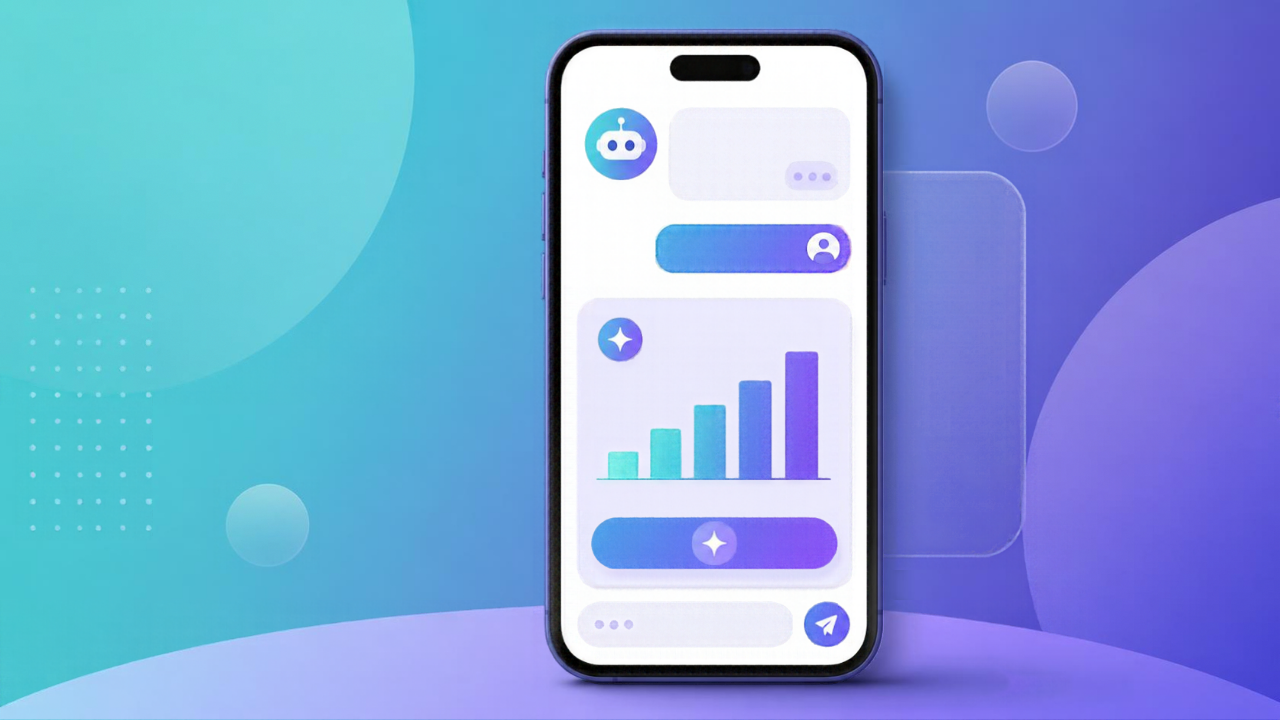
An example of what a ChatGPT Intelligent UI response can look like on mobile: an interactive chart and a tappable button in place of plain paragraphs.
Limitations and Open Questions Worth Tracking
A few caveats are worth keeping in mind before drawing firm conclusions from this rollout.
First, OpenAI has not published guidance on whether, or how, sources are credited inside the new visual and interactive formats, which is the single biggest open question for GEO purposes. Second, there is no independent, third-party data yet on how ChatGPT Intelligent UI affects referral traffic to websites, since the feature was roughly 24 hours old at the time of this article’s research. Third, users can turn the visual formats off if they prefer plain text, so actual adoption and behavior may vary significantly by user type and query. Finally, the feature does not yet work identically across ChatGPT’s own tiers, since the Pro reasoning tier (GPT-6 Astra) does not support Intelligent UI at all.
Questions About ChatGPT Intelligent UI
What is ChatGPT Intelligent UI?
It is a new ChatGPT interface, rolled out alongside GPT-6 on October 7, 2026, that can automatically present answers as charts, interactive diagrams, built-in calculators, maps, or tappable buttons instead of only text and links, choosing the format based on the question asked.
Do I need to turn on GPT-6 or ChatGPT Intelligent UI myself?
No. OpenAI’s release notes describe this as an automatic rollout appearing in the Chat tab as each account receives it, with Plus, Pro, Business, and Enterprise accounts first and Free and Go accounts the next day. Users can disable the visual formats if they prefer plain text answers.
Does ChatGPT Intelligent UI remove source links and citations?
This is not confirmed either way. OpenAI’s release notes focus on the visual and interactive format itself and do not describe how, or whether, source attribution appears inside charts, diagrams, or built-in tools. Treat any specific claim about citation behavior here as unverified until OpenAI documents it directly.
How is GEO different from traditional SEO because of changes like this?
Traditional SEO optimizes for ranking in a list of links; GEO optimizes for being surfaced, summarized, or cited inside an AI-generated answer itself, where there may be no list of links at all. Our guide on how to rank in AI search covers the practical differences in more depth.
Will this affect Google’s AI Overviews or AI Mode too?
Not directly — Intelligent UI is a ChatGPT-specific feature from OpenAI, separate from Google’s AI Overviews and AI Mode products. But it reflects a broader industry direction worth watching across every AI search surface your brand appears in, not just one.
What to Do Next
Skip the full strategy rewrite for now. Instead, over the next week, open ChatGPT yourself (or ask a colleague with a paid account) and run two or three of your actual target queries to see whether they now render as an interactive answer, and whether your brand or content shows up anywhere in that response, even without a visible link. That single, concrete check will tell you more about your real GEO exposure to this change than any assumption made from the outside, and it is the first data point you will want on hand once OpenAI publishes more detail on how sourcing works inside Intelligent UI.



Leave a response