

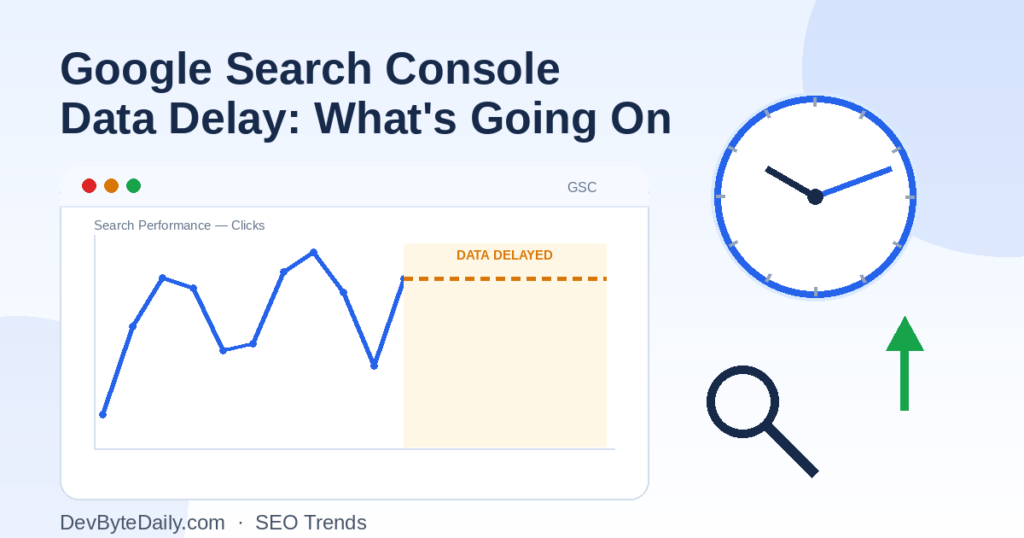
The Google Search Console data delay that started showing up in early October 2026 has left a lot of site owners staring at charts that just stop. If your clicks and impressions graph looks like it flatlined a few days ago, you are not imagining it, and you almost certainly did not do anything wrong.
Search Engine Roundtable first flagged the problem on October 11, 2026, reporting that the Performance report inside Google Search Console was running more than 64 hours behind normal. That is a serious gap for a report that usually updates within a few hours of a given day’s search activity.
What’s Happening With the Google Search Console Data Delay
Here is the short version. Starting around October 8, 2026, the day Google’s September 2026 spam update finished rolling out, the Performance report in Google Search Console began falling behind schedule. By the morning of October 11, Barry Schwartz at Search Engine Roundtable measured the lag at more than 64 hours, nearly three full days of missing or stale click and impression data.
By late morning that same day, the gap had narrowed to roughly 44 hours, according to the same report, suggesting Google’s systems were catching up but had not fully recovered. As of this writing, Google had not posted an official explanation for the Search Console data delay, and the Google Search Status Dashboard had not listed it as a confirmed incident either.
That last detail matters. The Search Status Dashboard tracks crawling, indexing, ranking, and serving issues, but reporting delays inside Search Console itself do not always show up there, even when they are real and widespread. So the absence of a dashboard alert does not mean nothing is wrong.
What exactly is lagging
Specifically, it is the Performance report, the tab that shows clicks, impressions, average position, and click-through rate by query, page, country, and device. This is the report most SEOs check daily, and it is also the one that feeds a lot of third-party rank tracking and reporting tools through the Search Console API. When it lags, every tool downstream of it lags too.
Other Search Console sections, like page indexing reports, sitemaps, and manual action notices, were not reported as part of this particular delay. That is actually a little unusual. Past Search Console slowdowns have more often hit the indexing side first.
Why Search Console Data Is Delayed Right After the September Spam Update
The timing here is not a coincidence worth ignoring, even though Google has not confirmed a direct cause. Google’s September 2026 spam update began rolling out globally on September 24, 2026, and Google’s own ranking update history says it took 13 days and 16 hours to complete, finishing around 1:00 a.m. PDT on October 8. That is notably longer than the three spam updates Google pushed earlier in 2026.
Large-scale ranking and spam-detection updates tend to put extra load on Google’s internal data pipelines. Reprocessing how billions of pages are scored and classified, then propagating those changes through ranking, indexing, and reporting systems, is a heavier lift than a routine day of crawling and serving. A reporting backlog showing up within days of the longest spam update of the year is a reasonable, if unconfirmed, explanation.
It is also worth separating this from the related story about manual actions. Several SEO consultants, including Marie Haynes, reported a noticeable jump in clients receiving manual action penalties in the weeks around the spam update, a trend consistent with Google tightening enforcement around low-quality and unhelpful content. That is a separate development from the reporting delay, but both point to the same underlying event: a large, slow-moving update that is still working its way through Google’s systems.
Confirmed fact vs. reasonable inference
To be precise about what is actually known:
- Confirmed fact: The Search Console Performance report was running 44 to 64+ hours behind as of October 11, 2026, per direct measurement from Search Engine Roundtable.
- Confirmed fact: The September 2026 spam update completed its rollout on October 8, 2026, three days before the delay was reported.
- Reasonable inference, not confirmed by Google: The spam update’s processing load contributed to the reporting backlog.
- Not yet known: Whether Google will post an official statement, and whether historical data gaps from this period will ever be backfilled.
Has This Happened Before? Fact vs. Speculation
Yes, and that history is useful context. A similarly serious Search Console delay happened in December 2025, where Google eventually confirmed the issue and fixed it, though it took a while for an official acknowledgment to show up. In that earlier case, and in similar incidents going back further, the pattern has been consistent: Google’s systems catch up over a period of hours to a few days, and the gap in the chart either fills in retroactively or, occasionally, stays as a permanent flat spot.
What’s speculation right now is any claim that this specific Google Search Console data delay signals a bigger ranking problem, a sign of an upcoming algorithm change, or evidence that your site specifically was targeted. None of that is supported by what has been reported so far. A reporting pipeline running behind schedule is a data-visibility problem, not proof of a ranking problem.
If you want to compare notes with other site owners, the Google Search Central Help Community and Search Engine Roundtable’s ongoing coverage are the most reliable places to check, rather than screenshots circulating on social media without dates attached.
How to Check If Your Site Is Affected
Before you assume the worst, confirm the Google Search Console data delay is actually hitting your property and not something else going on with your site.
Step 1: Check the date range in the Performance report
Open Search Console, go to Performance, and look at the most recent date shown in the graph. If the chart’s last data point is more than 24 to 48 hours behind today’s date, and your date range is set correctly, you are likely seeing the Google Search Console data delay rather than a site-specific issue.
Step 2: Cross-check with server logs or analytics
Compare Search Console’s apparent traffic drop against your actual server logs or an independent analytics tool. If organic sessions in Google Analytics (or another analytics platform) look normal for the same dates where Search Console shows a cliff, that is strong evidence the problem is reporting lag, not a real traffic loss.
Step 3: Check the Search Console API directly
If you or your team pull data through the Search Console API, query the same date range directly. API responses reflect the same underlying data as the UI, so if the API also shows missing rows for recent dates, that confirms the delay sits upstream of both the dashboard and the API, not in a display bug.
Step 4: Watch official channels
Check Google Search Central’s account on X and the Search Status Dashboard periodically. Historically, Google has acknowledged Search Console reporting delays publicly within a day or two once enough people flag them, even when the dashboard itself stays quiet.
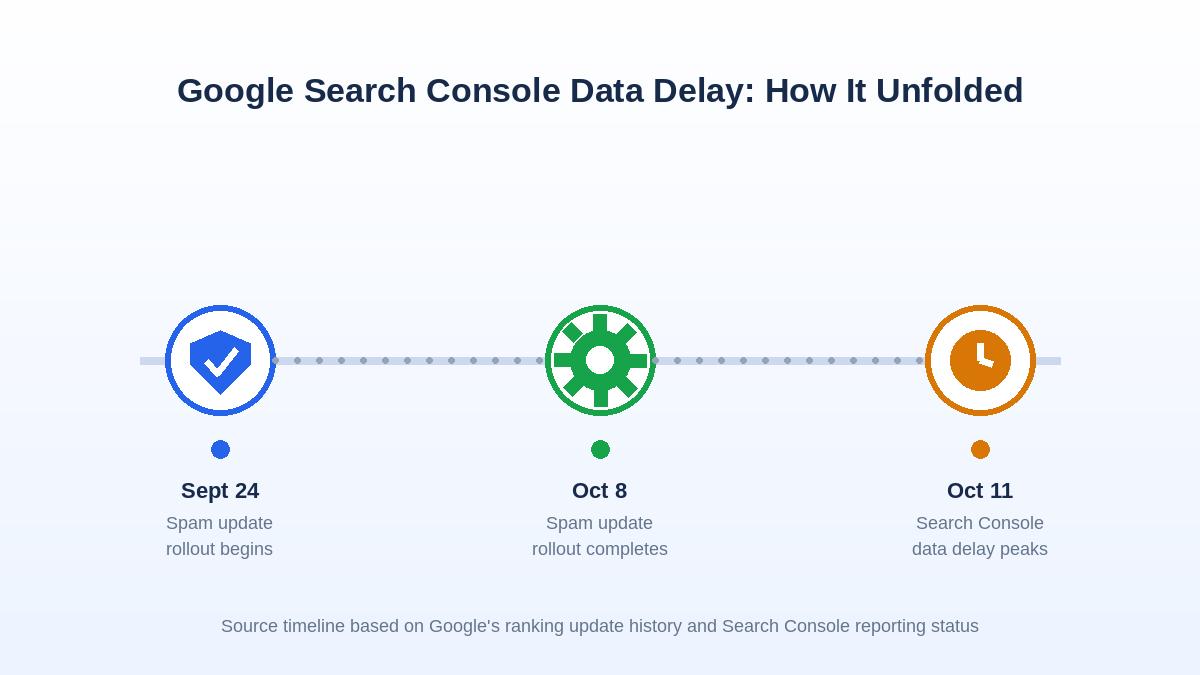
The Google Search Console data delay surfaced just three days after Google’s September 2026 spam update finished its 13-day rollout.
7 Smart Steps to Handle a Google Search Console Data Delay
Whether or not Google ever explains this particular Search Console reporting delay, the same playbook applies every time it happens.
- Don’t panic-edit your site. A missing data point is not evidence of a penalty, a ranking drop, or a technical SEO failure. Resist the urge to make reactive changes based on incomplete numbers.
- Pull a second data source. Analytics platforms, server logs, or rank tracking tools that query live search results (rather than relying on Search Console) can tell you whether real traffic actually changed.
- Note the exact delay window. Record which dates show missing or flat data for your property. This matters later if you need to explain a dip in a client report or internal dashboard.
- Hold off on monthly reporting until data stabilizes. If a client or stakeholder report is due during an active Google Search Console data delay, flag the gap explicitly rather than reporting numbers you know are incomplete.
- Check whether the gap backfills. Revisit the same date range three to five days later. In most past incidents, Google fills in the missing days once systems catch up, though this is not guaranteed.
- Keep monitoring Search Status Dashboard and X. Even though this delay was not listed as an official incident right away, Google has a track record of confirming reporting bugs once enough reports come in.
- Separate the reporting delay from the spam update’s actual impact. If your traffic genuinely dropped around the September spam update, that is a different issue from the current data delay and deserves its own investigation using indexing and crawl data, not just Performance report trends.
What Not to Do During a Reporting Delay
During a Google Search Console data delay, a few common reactions tend to make things worse rather than better.
- Don’t disavow links or submit a reconsideration request based solely on a dip that coincides with the delay window. Those actions should be driven by actual evidence of a manual action or confirmed spam issue, not a gap in charting.
- Don’t republish or drastically rewrite pages in a rush because a single week’s numbers looked bad. Content changes made on incomplete data are guesses, not decisions.
- Don’t assume the delay means you were specifically targeted. This has affected Search Console broadly, not one site or niche.
- Don’t rely on screenshots from social media as proof of what is happening. Check your own property and cross-reference with a primary source before concluding.
Who This Affects Most (and Who Can Mostly Ignore It)
The Google Search Console data delay matters most to a few specific groups. Agencies and consultants who send weekly or monthly performance reports need to flag the gap to clients proactively, before a client notices and asks first. Publishers and e-commerce sites that make day-to-day decisions off Search Console trends, like pausing campaigns or adjusting content calendars based on short-term dips, should pause those reactive decisions until the data stabilizes.
Teams running automated dashboards or alerts built on the Search Console API should expect false-positive drop alerts during the delay window and may want to temporarily suppress those notifications.
On the other hand, if you check Search Console occasionally rather than daily, and you are not making time-sensitive decisions from it, this is mostly a non-event. The data will very likely catch up, and a few days of lag will not meaningfully change a quarter-over-quarter or year-over-year view of your site’s performance.
Conclusion
The Google Search Console data delay reported in October 2026 is a reporting problem, not evidence of a ranking or quality issue with your site. It arrived within days of Google’s longest spam update rollout of the year, which is a reasonable explanation even though Google has not confirmed one. The practical move right now is simple: verify the delay is real using a second data source, document the affected date range, and hold off on any reactive changes until Search Console’s numbers stabilize.
Your next action: open Search Console today, check how far behind your Performance report actually is, and if it’s lagging more than 24 to 48 hours, cross-check that same window against your analytics platform before you report or act on the numbers.
FAQ
Is the Google Search Console data delay affecting every website?
The Google Search Console data delay appears to be a broad, platform-wide issue rather than something limited to specific sites, niches, or regions, based on reports from multiple independent SEOs checking different properties.
Will the missing Search Console data come back?
In most past incidents, yes, the gap eventually fills in once Google’s reporting pipeline catches up. It is not guaranteed for every incident, so it is worth checking back on the affected date range after a few days.
Is this delay related to the September 2026 spam update?
Google has not confirmed a direct link. The timing, with the delay surfacing three days after the spam update’s rollout finished, makes it a reasonable explanation, but it remains an inference rather than a confirmed fact.
Should I change my SEO strategy because of this delay?
No. A reporting delay is not a ranking signal. Any strategy changes should be based on verified, stable data, not on a temporary gap in one dashboard.
Where can I check if the delay has been officially acknowledged?
Check the Google Search Status Dashboard and Google Search Central’s account on X. Search Engine Roundtable also tracks these incidents closely and tends to post updates as they develop.


Leave a response