
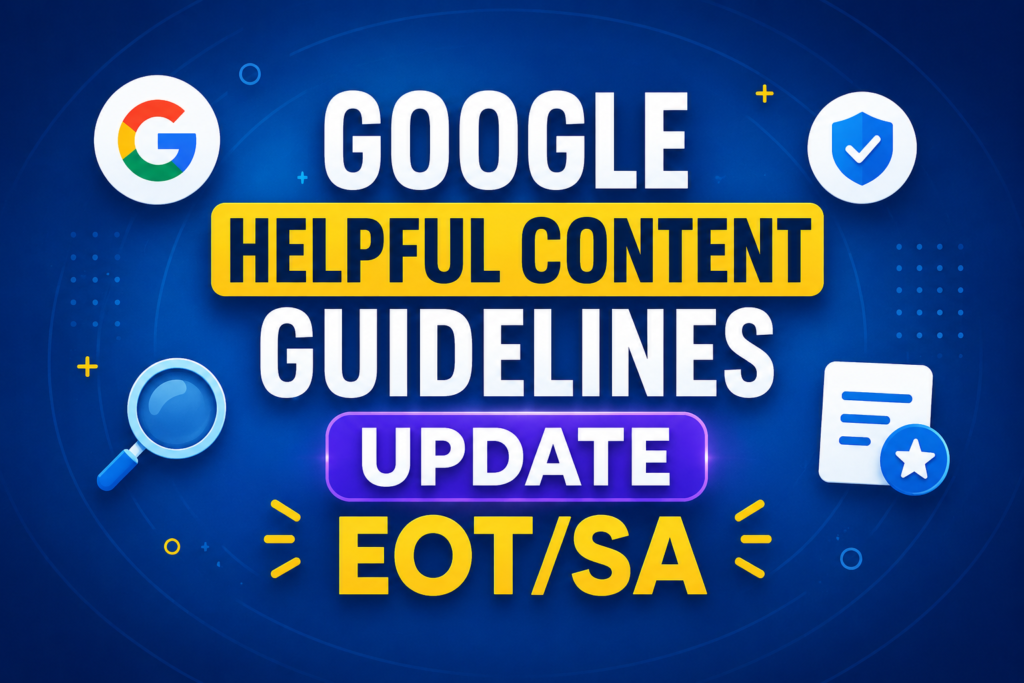
On October 1 and 2, 2026, Google quietly rewrote a chunk of its most important SEO document: the Creating Helpful, Reliable, People-First Content guide. No core update rolled out alongside it, no ranking volatility spiked because of it, and most site owners never noticed. But if you write, edit, or approve content for a website, this update matters more than most algorithm changes do, because it tells you exactly what Google’s human quality raters are now trained to look for.
The update adds a new definition of “main content,” introduces a four-part evaluation framework Google calls EOT/SA, and tightens the screws on fabricated author bylines, right as Google is also telling site owners to manually fact-check anything AI helped write. Here is what actually changed, why it landed now, and what to do about it.
What Google Actually Changed
Google’s helpful content documentation has existed since 2022, built around the question “is this content helpful to a real person?” The October update does not throw that out. Instead, it gets far more specific about how raters and, by extension, Google’s automated quality systems are supposed to judge the content on your pages.
Two additions stand out:
- A formal definition of “main content.” Google now spells out that main content is “any part of the webpage that directly helps the page achieve its purpose.” That includes your primary text, images, audio, and video, but also interactive features like calculators and tools, user-generated contributions such as reviews and forum replies, tabbed sections, and even page titles and headings.
- A new four-part quality framework: Effort, Originality, Talent/Skill, and Accuracy (EOT/SA). This gives raters a concrete checklist instead of a vague “is it good?” judgment call.
Alongside both changes, the Google Helpful Content Guidelines Update also added clearer language warning against fabricated author profiles. It reinforced the need for human fact-checking of AI-generated content before publication. These changes were not announced through a single major press release. Instead, they surfaced through close monitoring of Google’s documentation and were first reported by Search Engine Roundtable and Search Engine Journal.
Why “Main Content” Now Has an Official Definition
Google calling main content “one of the most critical factors for assessing page quality” is not new in spirit, but defining it this precisely is. If you’ve ever padded a thin page with an FAQ accordion, a related-posts widget, or a comment section and hoped it would read as “substantial,” this section closes that loophole. Decorative widgets, ads, and navigation don’t count as main content no matter how much space they take up on the page.
Practically, this means an audit of your top pages should start with one blunt question: if you stripped away the header, footer, sidebar, and ads, is there still a genuinely useful page left? For product pages, that might mean original specs and real usage notes instead of a manufacturer’s boilerplate description. For blog posts, it means the body text itself needs to do the work, not a slideshow of stock images wrapped around three sentences.
Here’s a concrete way to see the difference. A “best project management tools” page that lists ten tools with a one-line description copied from each tool’s own homepage has almost no main content, no matter how long the page is. The same page with first-hand screenshots, actual pricing comparisons you checked yourself, and notes on where each tool falls short has real main content, even if it’s half the length. Length was never the metric. Google is just saying so more directly now.
Breaking Down EOT/SA: What Raters Are Actually Checking
EOT/SA is the most useful part of this update because it turns “write good content” into four separate, checkable questions.
Effort asks how much real human work went into the page. Google’s own example of low effort is telling: “automatically generating pages from feeds or using generative AI to produce large amounts of text without manual oversight.” That’s a direct shot at the mass AI-content sites that scaled fast in 2024 and 2025. Original analysis, first-hand testing, and custom research or tools sit at the high-effort end.
Originality asks whether you’re saying something that isn’t already sitting on ten other sites. A rewritten version of the top three Google results for the same keyword is the definition of low originality, even if every sentence is technically unique.
Talent/Skill asks whether the content demonstrates the expertise the topic needs. Google is careful to note this isn’t the same as formal credentials for every piece of content. A recipe needs cooking know-how, not a nutrition science degree. A tax guide, on the other hand, needs real expertise behind it.
Accuracy asks whether the information is actually correct, with a much higher bar for what Google calls YMYL (Your Money or Your Life) topics: health, finances, and safety. For those, Google says content “must be highly accurate and consistent with established expert consensus,” not just plausible-sounding.
If you’re building any kind of content or data strategy around AI assistance, EOT/SA is a usable rubric you can run your own drafts through before they ever reach an editor.
The Fake-Author Crackdown
The update also adds direct language inside the “Who created the content” section: fabricating creator profiles, including AI-generated headshots, made-up names, or false credentials, counts as deceptive practice. Google frames this plainly as something that signals a low-quality, untrustworthy page to both human raters and automated systems.
This isn’t a hypothetical problem. Over the past two years, a wave of content sites invented “author” personas, complete with AI-generated headshots and fictional bios, to make thin or AI-written content look more credible. Google’s own search quality team has clearly seen enough of it to call it out by name in official guidance rather than leaving it to inference.
The fix here is boring but effective: use real bylines with real, verifiable backgrounds, and only claim the expertise a contributor genuinely has. If you publish guest content or use AI drafting tools with human editors, say so. Transparency protects you here more than a polished-looking fake author bio ever will.
Google Wants You to Fact-Check Your AI Content, Not Just Disclose It
The companion piece to all of this is Google’s reinforced guidance that AI-assisted content needs manual fact-checking and review before publication. This goes a step further than the “disclose AI use” conversation that’s dominated AI content guidelines for the past two years. Google is now explicit that using AI to draft content isn’t itself the problem; publishing AI output without a human verifying its accuracy is.
That distinction matters if you’re running any AI-assisted content workflow. A large language model can get facts, dates, statistics, and even product details wrong with total confidence. Google’s position is that the brand publishing the content, not the model that drafted it, owns the consequences of those errors.
How This Fits With the 2022 E-E-A-T Update
If EOT/SA sounds familiar, that’s because it’s a close cousin of E-E-A-T (Experience, Expertise, Authoritativeness, Trustworthiness), the framework Google’s quality rater guidelines added back in December 2022. E-E-A-T describes the qualities a creator or site needs. EOT/SA describes the qualities a specific piece of content needs to show. They’re meant to work together: a genuinely experienced author (E-E-A-T) still has to put real effort into an original, accurate piece of content (EOT/SA) for the page itself to earn a high-quality rating. One is about who’s writing. The other is about what actually ended up on the page.
Why This Landed Right Now
This update didn’t arrive in isolation. Google is roughly ten days into its September 2026 spam update, its longest rollout window of the year at a full two weeks, with a visible second wave of impact hitting sites on September 30. Separately, Chartbeat’s publisher network data shows Google search referral traffic down 40.2% year-over-year as of mid-2026, and DemandSphere’s tracking shows AI Overviews now appearing on the large majority of branded searches, up from roughly a quarter of them just weeks earlier.
Put together, the picture is consistent: Google is sending AI-generated summaries to more search results, publisher traffic is under real pressure, and in the middle of both trends, Google is tightening the documented bar for what counts as genuinely helpful content. Updating this guidance now, while actively enforcing a spam update and leaning harder on AI Overviews, is Google drawing a clearer line between content worth surfacing and content that’s just filling space. If you want to show up in AI-driven search results at all, the quality bar implied here is the one to clear.
What to Actually Do About It
You don’t need to rewrite your entire site this week. A focused pass through your highest-traffic and highest-intent pages is enough to start.
- Run a main-content audit. Open your top 20 pages by organic traffic and ask whether the primary text or media genuinely fulfills the page’s purpose on its own, without counting widgets, ads, or boilerplate.
- Score recent AI-assisted content against EOT/SA. If a page was drafted quickly from a template or a single AI prompt with no original input, it’s a candidate for a rewrite, not a quick polish.
- Audit your author bylines. Confirm every listed author is real, that their bio reflects actual background, and that any AI-generated images or invented credentials are removed immediately.
- Add a visible AI-use policy where relevant. If AI tools are part of your production process, a short editorial note on how content is researched, drafted, and reviewed builds exactly the trust signal Google is now describing explicitly.
- Build human fact-checking into your workflow, not as an afterthought, but as a required step before anything AI-assisted gets published, especially for YMYL topics.
A simple way to start: pick your five most-visited pages this week and run each one through all four EOT/SA questions out loud, with your editor or writer in the room. Does it say something nobody else is saying? Would you be comfortable putting your real name on it? Is every number and claim in it something you’d personally defend if a reader pushed back? If a page can’t clear those three questions, it’s not a Google problem yet, but it’s an editorial one worth fixing before it becomes one.
What This Update Doesn’t Do
It’s worth being honest about the limits here. This is a documentation update, not a confirmed ranking algorithm change, and Google has not said a specific new signal now scores pages against EOT/SA directly. There’s no new Search Console report, no new score you can check, and no guarantee that acting on this today moves rankings tomorrow.
What it does tell you, reliably, is what Google’s own quality raters are trained to flag, and rater guidance has historically shown up in ranking behavior over the following months, not overnight. Treat this as a preview of where the bar is heading, not a lever you can pull for an instant result.
The Bottom Line
Google rewriting its helpful content documentation without a press release is exactly the kind of update that rewards the site owners paying close attention and costs the ones who aren’t. The core idea hasn’t changed since 2022: write content that helps a real person. What’s new is how specifically Google is now willing to define “helpful,” “effort,” and “deceptive,” and that specificity gives you something concrete to check your own content against, long before the next core update does it for you.


Leave a response