

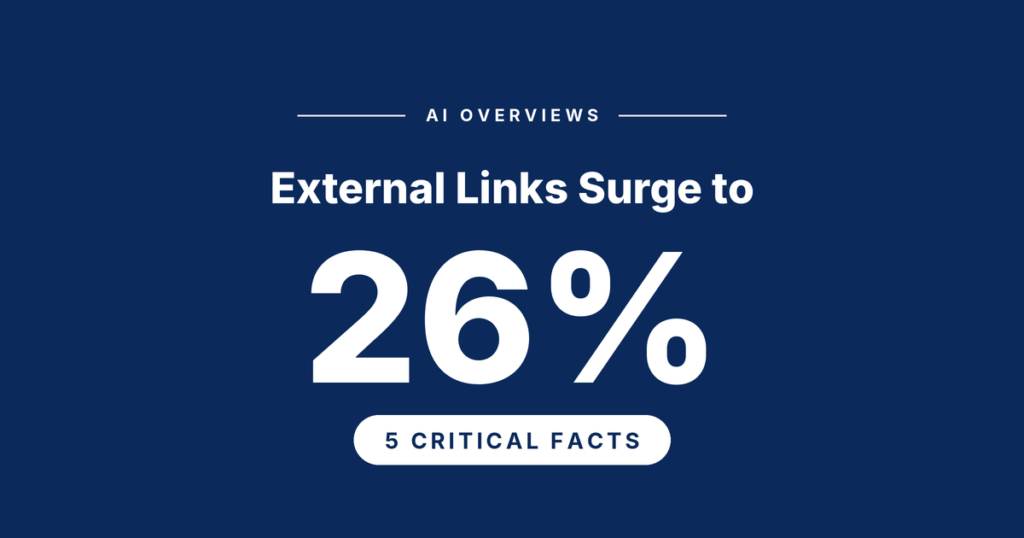
AI Overviews external links have climbed sharply since late August 2026, with one independent tracker showing the share of Google AI Overviews that include an external link has more than doubled in under a month. If you manage SEO, content, or marketing for a website, that sounds like good news: more links should mean more referral traffic. The real picture is more complicated, and a chunk of those “links” may never send a visitor to your site at all.
This matters right now because several SEO analytics firms are publishing conflicting readouts of the same trend, Google’s own Search Console still can’t confirm click-through rates for this traffic, and at least one widely shared screen recording shows an AI Overview link opening a Google AI Mode chat instead of a web page. Before you adjust your content strategy around “AI Overviews are sending more links now,” it’s worth understanding exactly what changed, what’s confirmed, and what’s still speculation.
What’s New: AI Overviews External Links Jumped to Roughly 26%
Google AI Overviews are the AI-generated summaries that appear above traditional organic results for many searches. For most of 2026, the share of those summaries containing a visible link to an outside website stayed low and mostly flat.
That changed in September. AI search analytics company Peec AI tracked the daily share of AI Overviews external links from August 25 through September 20, 2026, and published a chart showing the figure rising from near zero to 26.2% by the end of the window. The steepest jump happened around September 11, when the line moved almost vertically on the chart.
Search Engine Journal covered the data on September 25, 2026, and it was picked up quickly across the SEO community because it lines up with something Google has been promising publicly for months: more inline links inside AI-generated answers. Google’s own AI features documentation says people are “visiting a greater diversity of websites” because of AI Overviews, though Google has not published a figure to back that specific claim.
It’s worth separating what’s confirmed from what’s a single company’s dataset. Peec AI hasn’t disclosed its exact query sample, which markets it covers, which devices it tracked, or precisely how it defines an “external link” inside an AI Overview. Malte Landwehr, who shared the chart, noted that methodology adjustments on his end accounted for only “a small percentage” of the shift — but that leaves open the possibility that some of the jump reflects how Peec AI collects data rather than a pure Google-side change. Treat the 26% figure as a credible third-party signal, not a confirmed Google statistic.
Myth vs Fact: Does More Links Mean More Traffic From AI Overviews?
This is the question every publisher and SEO lead will ask the moment they see a headline like “AI Overviews links rise to 26%.” The honest answer is: not necessarily, and here’s why.
Myth: A rising share of AI Overviews that contain an external link means a rising share of AI Overviews that send clicks to websites.
Fact: Link presence and click volume are two different metrics, and nothing in the current data connects them directly. A chart showing more AI Overviews contain a link tells you about display frequency in one sample. It does not tell you how often users click that link, how many unique sites benefit, or whether the same handful of authority domains are getting cited over and over while everyone else stays invisible.
There’s a second wrinkle. Google’s Search Console help documentation is explicit that “clicking a link to an external page in the AI Overview counts as a click” in your Performance report, but it does not break that click out separately from ordinary web search clicks. You cannot currently isolate clicks that came specifically from an AI Overview external link from your total Search Console numbers. So even if the external-link share really did climb to 26%, you have no clean way inside Search Console to confirm whether that translated into more visits to your own site.
The practical takeaway: celebrate a rising external-link trend cautiously. It’s a leading indicator worth watching, not proof that your AI search traffic is about to improve.
The Catch: Some AI Overviews External Links Open AI Mode, Not Your Site
Here’s the part of this story that got less attention than the 26% statistic, and arguably matters more for publishers. On September 21, 2026, SEO practitioner Gagan Ghotra posted an 18-second screen recording showing an AI Overview with underlined, link-styled text. Clicking it didn’t open an external webpage. It opened a conversational AI Mode session inside Google Search.
In other words, some of what looks like a standard external link inside an AI Overview is actually a query-refinement element dressed up in the same blue-underline visual language as a real citation. Click it, and instead of landing on a publisher’s page, the user stays inside Google’s own interface and starts a back-and-forth AI conversation.
This isn’t a wild theory — it mirrors a pattern DevByteDaily covered previously with AI Mode’s follow-up question prompts, where Google routes users deeper into its own conversational layer rather than out to the web. The difference here is more subtle: these new elements are visually styled like ordinary citation links, which makes them easy to mistake for referral traffic opportunities when they’re actually retention tools for Google’s own AI Mode surface.
Google’s Search Console documentation confirms that query refinement links inside AI features do not count as clicks or impressions toward your site’s performance data, which matches what you’d expect if some AI Overviews external links never leave Google’s ecosystem. What we don’t yet know is how common this pattern is. Ghotra’s clip documents one search. Nobody has published data yet on what percentage of these link-styled elements route to AI Mode instead of an outside page, and Google hasn’t commented publicly on the behavior.
The practical lesson: don’t assume every underlined phrase inside an AI Overview represents a potential visitor to your site. Some portion of that 26% may be routing users deeper into Google’s own AI products instead.
Why Search Console Still Can’t Show You Real AI Overviews Click Data
Google Search Console rolled its dedicated generative AI performance report out worldwide on August 31, 2026, after testing it with a smaller group starting in June. It’s a genuinely useful addition — it lets you filter your Performance report by AI-related search appearances. But it comes with real limits that change how much you can trust any conclusion drawn from it.
The generative AI report currently shows impressions only. It does not show clicks or click-through rate specific to AI Overviews or AI Mode appearances. That means if you try to calculate “my AI Overviews CTR” by dividing your total site clicks by your AI-only impression count, you’re building a number that mixes two incompatible data sets. Your total clicks include ordinary blue-link traffic, AI Overviews external link clicks, and now potentially the new multimodal search traffic — all blended, with no reliable way to separate them yet.
Barry Schwartz, who reported on the data for Search Engine Land, specifically noted he could not find query-level data tied to this trend, and that the generative AI performance report continues to lack click and query detail months after its global launch. If a journalist actively investigating this story can’t extract clean click data from Google’s own tool, individual site owners shouldn’t expect to either, at least not yet.
This is a genuine measurement gap, not a conspiracy. Google has repeatedly said more granular reporting is coming, and the company did add a multimodal search type filter to the Performance report in late September 2026, a separate but related step toward more transparency about how AI-driven search behavior shows up in your data. Progress is happening. It’s just not finished, and that matters when you’re deciding how much weight to put on any single statistic about AI Overviews external links.
How to Audit Your Own AI Overviews External Links Exposure
You don’t need to wait for perfect Google data to start building your own picture. Here’s a practical, repeatable process you can run this week.
- Pull your AI-related queries from Search Console. Open the Performance report, filter by Search type, and check the “Web” breakdown alongside the generative AI performance report to see which queries are triggering AI-related search appearances for your site.
- Manually search your top 15-20 money queries. Run each one in regular Google Search while logged out, and note whether an AI Overview appears, whether it cites your domain, and whether that citation is a clickable external link or a text-only mention with no link at all.
- Check where each link actually points. Click through (or hover and inspect, where possible) any link-styled element inside the AI Overview. Confirm whether it opens an external page, a Google-hosted result, or an AI Mode conversation thread.
- Log citation presence without a link. Some AI Overviews reference a brand or source by name without a hyperlink attached. That’s a visibility signal worth tracking even though it won’t show up as a Search Console click.
- Compare month over month. Repeat this same query list every four to six weeks. A single snapshot tells you very little; a trend across several checks tells you whether your actual exposure is moving, independent of what any third-party industry chart claims.
- Cross-reference with your analytics’ referral data. Look for sudden spikes in direct or “(not set)” traffic around the dates when you notice new AI Overview citations. That correlation is imperfect, but it’s one more data point beyond Search Console alone.
This process won’t give you a perfect number either, but it will tell you something the industry-wide statistics can’t: what’s actually happening for your specific pages and queries.
What This Means for Your GEO and Content Strategy
None of this means you should ignore the trend. A rising share of AI Overviews external links, even an unconfirmed third-party figure, is a reasonable signal that Google continues to experiment with how much of the web it surfaces directly inside AI answers. Ranking in AI search still depends on the same underlying fundamentals: clear, well-structured answers to real questions, credible sourcing, and content that AI systems can confidently attribute to you.
What should change is how you report on this internally. If you’re updating a client or a leadership team on AI visibility, resist the urge to cite a single external statistic like “AI Overviews links are up 26%” as if it were your own performance data. Pair any industry trend with your own query-level audit from the previous section. That combination — broader market signal plus your own measured reality — is far more defensible than either one alone.
It’s also worth watching whether Google formalizes a clearer distinction between a real external citation link and an internal query-refinement element styled the same way. Right now, that visual overlap creates genuine confusion, and it’s reasonable to expect pushback from publishers and SEO tool vendors if Google doesn’t address it. Several industry voices have already flagged the ambiguity publicly, and pressure tends to produce documentation updates from Google’s Search Central team over time.
Finally, keep an eye on how your content is structured, since well-organized pages remain easier for Google’s systems to cite accurately, whether that citation becomes a clickable external link or not. A citation without a link still has brand value even if Search Console can’t measure it as a click today.
The rise in AI Overviews external links is real enough to take seriously, but it’s not the clean traffic win it might look like at first glance. A credible third-party tracker shows the external-link share climbing to roughly 26% through September 2026; Google continues to say it’s sending more diverse traffic to the web, and at the same time, at least one case shows a link-styled element routing users into AI Mode instead of out to a publisher’s site, all while Search Console still can’t give you a clean click-through number to check any of it against. Your next action: this week, run the six-step audit above on your own top queries, log what you find in a simple spreadsheet, and set a recurring reminder to repeat it in four to six weeks. That gives you a real, first-party answer about your own AI Overviews external links exposure, instead of relying on a single industry chart to tell you how you’re doing.
Frequently Asked Questions
Is the 26% AI Overviews external links figure an official Google statistic?
No. It comes from Peec AI, a third-party AI search analytics company, based on its own sample of tracked queries between August 25 and September 20, 2026. Google has not published a matching figure or confirmed this specific percentage.
Can I see exactly which AI Overviews external link clicks came to my site in Search Console?
Not yet with full precision. The generative AI performance report currently shows impressions only, without clicks or CTR broken out separately from your total Web search numbers.
Do all links inside an AI Overview lead to an outside website?
Not necessarily. At least one documented case shows a link-styled element opening an AI Mode conversation instead of an external page. How common this is remains unconfirmed.
Should I change my content strategy because of this data?
Treat it as a signal to monitor, not a reason for a major pivot. Run your own query-level audit alongside any third-party statistic before making strategic decisions.
Where can I verify Search Console’s rules on AI Overview clicks myself?
Google documents this directly in its Search Console Performance report help page, which explains how clicks, impressions, and AI-related search appearances are counted.

Leave a response