

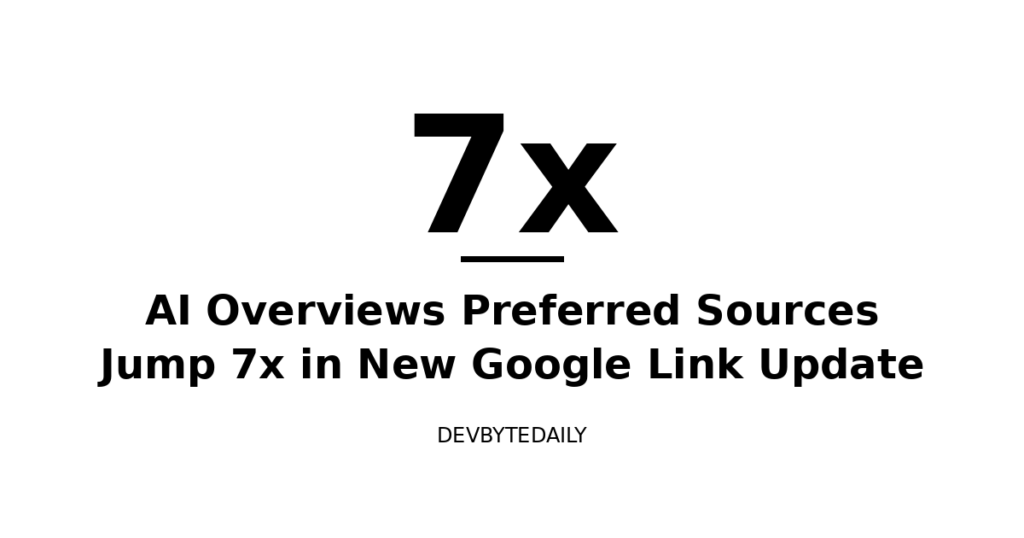
Google changed how AI Mode and AI Overviews display links again on October 15, 2026. The update gives AI Overviews Preferred Sources new visibility inside news carousels, adds a dedicated “top links” section for official pages, and redesigns the “Dive deeper” links with thumbnails. Google also said Preferred Sources usage has grown more than 7x since the start of the year. If you publish content Google might cite in AI answers, this changes where your link can show up and how often.
The announcement came from Hema Budaraju, Google’s VP of Product Management for Search, in a company blog post. Nick Fox, Google’s SVP of Knowledge and Information, posted a shorter summary on X the same day, noting that more than 400 publications now take part in Google’s AI news licensing pilot. Barry Schwartz covered the rollout for Search Engine Roundtable and pointed out that Google still has not added click data to its AI performance reports, despite five rounds of link changes since May.
What Changed in AI Mode and AI Overviews This Week
Google’s post describes five changes, and most of them touch on how AI Overviews and AI Mode decide which links to show and where to place them.
- More inline links now appear inside the text of AI responses, and Google says it is showing them higher in the response more often.
- A new top section highlights one or two official pages for queries where a person is trying to complete a specific task, such as checking an airline’s refund policy.
- News carousels with timely articles are rolling out to more countries and languages, and they now give extra visibility to a user’s Preferred Sources.
- The “Dive deeper” section at the end of some AI responses now shows image thumbnails and a more clickable layout.
- A test that started the week of the announcement makes creator and publisher names on video results in AI Mode clickable, linking to a Search profile page.
None of this is a full redesign. It is a set of incremental tweaks to where links sit and how they look, aimed at the same goal Google has stated since it first rolled out AI Overviews: get people who read an AI answer to click through to a source.
This is also not the first round of changes this year. Google made five similar link updates back in May 2026, adding subscription highlights, a “further exploration” section, creator attribution for social sources, more inline links, and desktop hover previews. The October update builds on that same foundation rather than replacing it, which is why Barry Schwartz’s headline called it an update “again.” For publishers, the pattern matters more than any single change: Google is iterating on AI link placement every few months, and each round tends to favor sites with clear structure and identifiable authorship over sites that rely on generic landing pages.
Where Preferred Sources Fits Into AI Overviews
Preferred Sources is not new on its own. Google first rolled it out for Top Stories in August 2025, letting searchers pick specific publications they want to see more often in news results. A searcher clicks an icon next to Top Stories, searches for sites they trust, and adds them to a personal list.
What is new is how heavily AI Overviews and AI Mode now lean on that same list. The news carousels inside AI answers pull from a person’s Preferred Sources, and Google’s blog post ties the carousel expansion directly to that feature. For publishers, this means a signal you could mostly ignore a year ago now has a direct line into generative search results.
AI Overviews Preferred Sources Usage Is Up 7x Since January
Google’s most concrete number in this update is the 7x growth figure. The company says the number of people actively using Preferred Sources has grown more than sevenfold since the start of 2026. That is a usage stat, not a traffic stat, and Google did not say how many total users that represents or which sites benefit most.
Still, a sevenfold increase in a personalization feature is hard to dismiss. It suggests more searchers are curating which publishers they see, and Google is now feeding that curated list directly into AI-generated answers through the carousel redesign. In my experience watching Google roll out personalization features, adoption numbers like this usually mean the company plans to lean on the feature more, not less, in future updates.
What this means for you: if your site has any kind of recurring news or update content, Preferred Sources is worth treating as a real distribution channel, not a vanity feature. A reader who adds you as a preferred source is telling Google, in a structured way, that they want to see more of your content, including inside AI Mode’s carousels.
How to Get Added as a Preferred Source
Google lets publishers link directly to the step where a reader adds them as a Preferred Source, and some sites add a “Preferred Source” button near their masthead or article byline. There is no ranking algorithm to game here. It is closer to a subscribe button than a technical SEO lever, so the honest path is to make the button visible and give readers a reason to click it, such as a short line explaining what they will see more of.
The New Top Links Feature Favors One or Two Official Pages
The feature most SEOs will care about is the new top section that highlights one or two links for task-based queries. Google’s example in its own post is an airline refund policy search, where the top section links straight to the airline’s official refund page instead of burying it further down the response.
This is an expansion of behavior Google already had for navigational-style queries, not a brand-new mechanism. What changed is how prominently those links now appear and how many query types trigger it. Google did not publish a list of eligible query categories or say how it decides which page counts as “official.”
What this means for you: if your site is the authoritative source for a specific task, such as a return policy, a pricing page, a store locator, or a support form, that page needs to be easy for Google to identify as the canonical answer. A clear page title, a direct heading that matches the task (“Request a refund,” not “Customer policies”), and a URL that is not buried four folders deep all help Google’s systems recognize the page quickly.
As a hypothetical example, imagine a mid-size software company with a refund policy buried inside a long “Terms and Billing” PDF. Under this update, Google is less likely to surface that page as a top link, because there is no standalone page with a direct heading answering the task. A competitor with a dedicated, plainly titled “Refund Policy” page is the more obvious candidate. This is a hypothetical scenario to illustrate the mechanism, not a reported case.
Dive Deeper Redesign and Creator Profile Links
The “Dive deeper” section, which appears after some AI responses with related articles, now shows image thumbnails instead of plain text links. Google frames this as making the section more clickable, though the company has not shared before-and-after click data to back that claim.
The creator and publisher profile test is narrower. It currently applies to video results inside AI Mode, where a creator’s or publisher’s name becomes a clickable link to a Search profile page describing their broader body of work. DevByteDaily has covered related publisher-identity moves before, including Google’s AI Contribution Pilot, which is the licensing program Nick Fox referenced when he mentioned 400-plus participating publications. These features point in the same direction: Google wants a clearer paper trail connecting content to the person or organization that made it.
Click Data Is Still Missing From AI Performance Reports
Here is the part that will frustrate most site owners reading this. Google’s AI performance reports in Search Console, which launched in June 2026, show impressions, pages, countries, devices, and dates for AI Overviews and AI Mode traffic. They still do not show clicks.
Barry Schwartz asked Google about this directly for his Search Engine Roundtable post, and the response was that Google is working with site owners to figure out which metrics are useful and will “introduce additional metrics over time.” That is the same language Google used earlier this year when it expanded AI search links without adding click data, and it is similar to what the company said back in July when DevByteDaily covered the AI dark traffic problem in detail.
Separately, Google’s SVP Nick Fox has said AI features in Search send billions of clicks to websites every week. That claim has no breakdown by site, query type, or AI surface, so you cannot check it against your own numbers. If you want to measure your real AI-driven traffic today, server log analysis and referrer-based GA4 segmentation remain more reliable than anything Search Console currently offers for this specific traffic type. DevByteDaily’s earlier look at how AI Overviews external link rates rose to 26% of responses covers the broader click and citation picture in more depth.
What this means for you: do not wait for Google to hand you AI click data. Build your own tracking now, even if it is imperfect, so you have a baseline once better reporting eventually arrives.
A Practical GEO Checklist for This Update
None of these changes require a technical overhaul. They reward sites that make their authority and intent obvious to an automated system reading the page quickly.
- Add a visible way for readers to select you as a Preferred Source, whether that is Google’s button or a plain link to the selection flow, and explain briefly what they gain.
- Audit your task-completion pages (refund policy, pricing, store hours, support contact) so each one has a direct heading, a short answer near the top, and a URL that is easy to crawl and reasonably shallow.
- If you publish video, check whether your channel is eligible for a Search creator profile, since that is the identity signal Google is now surfacing directly inside AI Mode.
- Keep structured data current on anything time-sensitive. News carousels favor freshness, and Preferred Sources only helps if your recent content is properly dated and indexed quickly.
- Set up your own click-tracking proxy for AI referral traffic now, rather than waiting for Search Console to add it.
Rank Math’s AI visibility tools and manual log analysis both help with the last point. If you have not reviewed your setup recently, DevByteDaily’s practical guide to ranking in AI search covers the fundamentals these new features build on.
FAQ: AI Overviews Preferred Sources and Link Changes
What are Preferred Sources in Google Search?
Preferred Sources is a Google Search feature that lets a searcher pick specific publications they want to see more often in Top Stories and, as of this update, in AI Mode and AI Overviews news carousels. Readers select sources through an icon next to Top Stories results.
Does Google show click data for AI Overviews yet?
No. As of this update, Search Console’s AI performance reports show impressions, pages, countries, devices, and dates, but not clicks. Google says it plans to add more metrics over time without a firm date.
How do I get my page shown as a top link in AI Mode?
There is no submission process. Google’s systems identify official pages automatically for task-based queries, so the practical step is making sure your relevant page has a clear, direct heading and sits at a reasonably shallow URL that is easy to crawl and understand.
Does adding a Preferred Sources button affect my rankings?
Google has not described Preferred Sources as a ranking factor. It affects personalized visibility for the specific searchers who add you, including inside AI-generated carousels, rather than your position in standard organic results.
Why This Matters and What to Do Next
Google keeps adjusting how AI Mode and AI Overviews surface links, but it is still not giving site owners the one metric that would make these changes easy to evaluate: clicks. Until that changes, treat each update as a signal about where Google wants attention to go, not proof of what is actually working for your site.
Add a Preferred Sources prompt where it makes sense on your site, clean up your task-completion pages so they read clearly to both humans and crawlers, and start tracking AI referral traffic yourself instead of waiting on Search Console. Revisit this once Google’s next round of link changes lands, which, based on this year’s pace, will likely be within a few months.

Leave a response