

If you have noticed more talk about penalties in SEO forums and on X this month, you are not imagining it. A Google manual action spike is being reported by experienced SEO consultants right after Google confirmed its longest spam update rollout of 2026. The update itself is official and dated, but the spike in manual actions is still anecdotal. Here is exactly what is confirmed, what is not, and what to do about it either way.
In short: Google’s September 2026 spam update finished rolling out on October 8, 2026, after roughly 13 days and 16 hours — far longer than any other 2026 spam update. Within days, well-known SEO consultants reported a noticeable rise in manual action requests, mostly tied to thin content, pure spam, and scaled content abuse. Google has not confirmed or commented on that trend. Below, we separate the verified timeline from the practitioner reports so you can judge your own risk.
What Happened: Google’s Record 13-Day Spam Update Just Ended
Google began rolling out its September 2026 spam update on September 24, 2026, warning site owners the process could take up to two weeks, and that warning turned out to be accurate. The Google Search Status Dashboard marked the rollout complete on October 8, 2026, at roughly 1:00 a.m. Pacific — a duration of about 13 days and 16 hours.
That is dramatically longer than every other spam update Google ran in 2026. March’s update finished in under 20 hours, and June’s took about two days. August’s took roughly two days and 16 hours. September’s update ran more than six times longer than any of those three, based on timestamps Google itself logged on the status dashboard.
Google Search Central described the update on LinkedIn as “a normal spam update” that applied globally across all languages. Barry Schwartz of Search Engine Roundtable, as reported by PPC Land, pointed out the obvious tension: it is hard to call a two-week rollout “normal” when three earlier updates the same year wrapped up in two days or less.
Google did not explain why this rollout took so much longer, and it declined to name a specific policy the update targeted. It did confirm that link spam was not the focus this time, which leaves scaled content abuse, site reputation abuse, and expired domain abuse as the more likely targets based on Google’s existing spam policies documentation.
The Google Manual Action Spike, Explained
A manual action is different from an algorithmic ranking drop. It is a penalty applied by a human reviewer at Google after a site is found to violate spam policies, and it shows up directly in the Manual Actions report inside Search Console. Unlike algorithm updates, a manual action usually requires you to fix the issue and file a reconsideration request before rankings can recover.
In the days right after the September update finished, several recognized SEO professionals reported an uptick in manual action cases. Marie Haynes, a consultant who specializes in manual action recovery, wrote on X on October 7, 2026, that she had seen “a big increase in requests for help with manual actions lately,” going from “essentially no requests” earlier in the year to “several per week” recently.
Haynes was careful to add context: the current volume is “not nearly as high as the pre-Penguin manual action era,” a reference to Google’s much more aggressive penalty period before 2012. She described the sites she is seeing as mostly legitimate, long-standing businesses hit for thin content, pure spam, or scaled content issues — not fly-by-night spam operations.
Daniel Foley Carter, another SEO practitioner, posted separately on October 7 that manual actions have been “appearing in so many places” over the last few months. He linked the rise to scaled content abuse and to teams cutting corners on quality while assuming AI tools would cover the gap. He said some affected sites lost 90% or more of their organic traffic almost overnight.
Is the Google Manual Action Spike Backed by Real Data?
This is where honesty matters. Google has not published any figures on manual action volume, and no third-party tool currently tracks manual actions the way rank trackers track positions. Everything reported so far is practitioner observation, not a confirmed Google metric.
Barry Schwartz manually reviewed roughly a dozen recent threads on Google’s own Webmaster Help Forums and found a repeated pattern: threads about thin content, “major spam” labels, and rejected reconsideration requests. That is a real, checkable data point, but a dozen forum threads is a small sample next to the millions of sites Google indexes.
Schwartz also tried something unusual: he asked ChatGPT and Gemini to review the same forum threads and estimate whether complaints had increased. Both tools agreed complaints were up, but neither found a “super big spike,” and the charts the two AI tools produced from the same source data did not match each other. That mismatch is itself a useful lesson — AI-generated charts are not a substitute for verified data, even when the underlying source material is real.
Separately, Diib published early traffic data from 32,569 websites with connected Google Analytics, gathered shortly after the spam update began. The median share of a site’s visits coming from unpaid Google search fell from 34% to 31%, and the share of sites seeing a 50% or larger traffic drop rose from 5% to 10%. Diib itself labeled this “an early read, not a verdict,” and it measures overall traffic impact, not manual actions specifically.
SEOmonitor added another wrinkle: several third-party rank trackers showed sudden ranking swings starting around September 26 that real searchers never actually saw, which it attributed to Google’s automated search queries returning incomplete or inconsistent results during the rollout. That is a reminder to treat any single tool’s volatility chart with caution during an active update.
Why Manual Actions May Be Rising Right Now
Even without an official Google statement, the timing and the pattern in these reports line up with changes Google has been making publicly all year. Three threads tie together fairly cleanly.
Scaled Content and Thin Pages Are the Common Thread
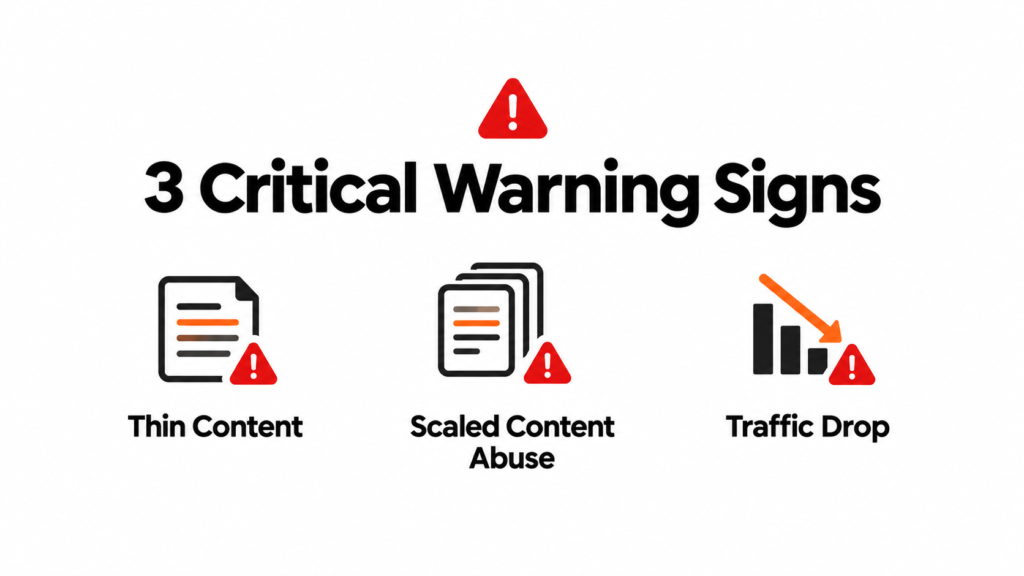
Every practitioner report above names the same culprits: thin content, scaled content abuse, and pure spam. Google’s spam policies have specifically called out mass-produced, low-value content — including AI-generated pages published at scale with little editorial oversight — as a manual action risk since the 2024 helpful content changes. A longer, more thorough spam update rollout is consistent with Google spending more time manually reviewing sites that match that pattern rather than resolving everything algorithmically.
Google has also pushed site owners toward stricter fact-checking and editorial review of AI-assisted content throughout 2026, which suggests quality enforcement generally, not just this one update, has gotten more hands-on. Teams that leaned on AI content tools without adding real editorial review are the most exposed group in every report cited above.
How to Check Whether You’re Affected
Do not wait for a traffic crash to find out. Checking takes a few minutes and tells you definitively whether you have a manual action, which is different from an algorithmic ranking change.
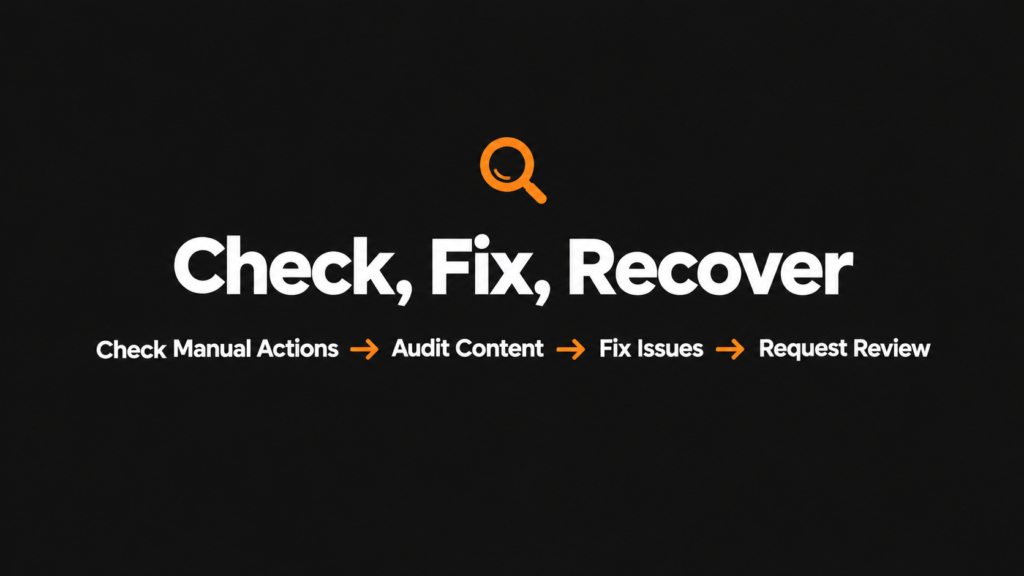
- Open Search Console and go to Security & Manual Actions > Manual actions. A clean site shows “No issues detected.”
- If an issue is listed, read the exact violation type Google names, such as thin content, scaled content abuse, or spam.
- Check whether the action applies site-wide or to specific URLs or sections — this changes your recovery scope significantly.
- Cross-reference the Performance report for a sharp, dated traffic drop that lines up with late September or early October 2026.
- If nothing shows in Manual Actions but traffic still dropped sharply, you are more likely looking at an algorithmic effect from the spam update itself, not a manual action.
How to Recover From a Manual Action in 2026
A manual action will not lift on its own, even after an algorithm update finishes rolling out. You have to fix the underlying issue and formally ask Google to take another look.
- Identify every affected page or pattern, not just the examples Google lists — manual reviewers usually sample a larger problem.
- Remove or substantially rewrite thin and scaled content, especially AI-assisted pages published without real editorial review or original value.
- Document what changed in plain language; your reconsideration request should explain the fix, not just claim compliance.
- Submit a reconsideration request through Search Console once the fix is live sitewide, not partially applied.
- Expect weeks, not days, for a response — manual reviews take longer than algorithmic recovery, and a rejected request means more work remains.
Our earlier coverage of the Google September 2026 spam update recovery steps walks through the broader algorithmic recovery process in more detail, which is useful background if your drop isn’t tied to a formal manual action at all.
What This Means for Site Owners Going Forward
Treat the Google manual action spike reports as an early warning signal, not confirmed fact. The underlying update timeline is fully verified through Google’s own status dashboard. The manual action trend layered on top of it is currently practitioner testimony from credible, named sources — which is worth taking seriously, but is not the same as Google-confirmed data.
The practical move is the same either way: audit your site for thin, scaled, or AI-generated content that lacks real editorial value, confirm your Manual Actions report is clean, and keep an eye on Google’s Helpful Content guidelines as they continue to evolve. Sites built on genuine expertise and original reporting have the least to worry about from either an algorithmic update or a manual review.
If you publish AI-assisted content at any scale, pair it with the editorial habits described in our guide to fact-checking AI content before publishing. That single habit addresses the exact pattern every practitioner cited in this piece flagged as the common thread behind rising manual actions.
FAQ: Your Questions Answered
Is the Google manual action spike officially confirmed by Google?
No. Google has confirmed the September 2026 spam update’s timeline through its Search Status Dashboard, but it has not commented on or confirmed any increase in manual action volume. That part of the story currently rests on reports from named SEO consultants and a small sample of public forum threads.
How do I know if I have a manual action versus an algorithmic drop?
Check Search Console’s Manual Actions report under Security & Manual Actions. If it lists an issue, you have a manual action. If it’s clean but traffic still dropped around late September or early October 2026, you’re more likely seeing an algorithmic effect from the spam update itself.
How long does manual action recovery usually take in 2026?
Expect the fix-and-review cycle to take several weeks at minimum. You need to resolve the underlying issue sitewide, submit a reconsideration request through Search Console, and then wait for a human reviewer to respond, which can take longer during periods of higher review volume like this one.
Does AI-generated content automatically trigger a manual action?
No, but AI-generated content published at scale without editorial review, fact-checking, or original value is consistently named in these reports as a common trigger. The risk comes from thin, low-value, mass-produced pages, not from using AI tools as part of a genuine editorial process.
Should I panic if I see a traffic drop right now?
No. First check the Manual Actions report, then check whether the drop lines up with the spam update’s rollout window. A drop without a listed manual action is more likely algorithmic, and several reports above note that even rank-tracking tools showed temporary noise during this rollout.
The confirmed facts here are narrow but useful: Google’s September 2026 spam update was the longest of the year, and it ended on October 8. Everything about a connected manual action spike is still developing. Your one concrete next step is to open Search Console today, check the Manual Actions report, and audit any thin or scaled AI content before assuming you’re in the clear.



Leave a response