

Google rewrote its URL structure guidelines on October 21, 2026. The update reworks the hyphens-versus-underscores advice, swaps the technical standard the page cites, and adds new sections on crawlability, case sensitivity, and parameters.
If you are wondering whether your existing URL strategy just became outdated, the short answer is no. Google’s core advice on hyphens and readable paths has not changed in substance. What changed is how the Google URL structure guidelines are organized, worded, and framed for crawl efficiency. A few of the additions, including new lines on case sensitivity, parameters, and multi-regional paths, are worth checking against your own site.
What Changed In Google’s URL Structure Guidelines
Barry Schwartz first flagged the change at Search Engine Roundtable on October 21, 2026, after comparing the live page against an archived copy from October 15. The page itself now carries a “last updated” date of October 21, 2026, confirmed directly on Google’s URL structure documentation.
The headline change is narrow. The section on separating words with hyphens instead of underscores was reworded, not reversed. But a side-by-side comparison of the old and new page shows a much larger rewrite sitting underneath that one headline edit.
The page title changed from “URL structure best practices for Google” to “URL structure best practices for Google Search.” A new introduction warns that Google Search will likely crawl a site inefficiently if its URLs do not meet the listed requirements. That is a firmer framing than the old version used.
Five new or renamed sections appeared: Requirements for a crawlable URL structure, Make it easy to understand your URL structure, Best practices, Use as few parameters as you can, and Be aware that URLs are case sensitive. Several guidance items moved out of the old “Resolve problems” section and into these new ones.
The Hyphens Vs Underscores Rewrite
The specific wording change is small but clarifies intent. The previous text said underscore-joined words were “already commonly used” in programming. The new text drops “already” and simply says underscores “are commonly used” to join related concepts, then adds a new contrasting clause: hyphens “clearly signal a word boundary.”
Google still recommends hyphens over underscores to separate words in a URL path, for the same reason it has given for years. Programming languages often use underscores to join variable names together, so a search engine parsing a URL cannot reliably tell where one word ends and the next begins. A hyphen removes that ambiguity.
This recommendation matches what Google’s Gary Illyes said eight days earlier, on October 14, in the first episode of a new Search Central video series called “Non-Canonical Cabinet.” Illyes, appearing alongside Google’s Cherry Prommawin, told viewers to separate keywords in a URL path with hyphens rather than underscores, according to Schwartz’s coverage of the video.
The timing suggests the documentation update followed the video, not the other way around. My take is that someone on the Search Central team tightened the written guidance to match what Illyes had just said on camera, which is a reasonable bit of internal housekeeping rather than a policy shift.
A New Standard: IETF STD 66 Replaces RFC 3986
One change that has nothing to do with hyphens is more interesting for anyone who builds URL validation logic. The old page cited RFC 3986 as the technical standard behind Google’s URL handling. The new page instead says Google Search supports URLs “as defined by IETF STD 66.”
STD 66 is the Internet Engineering Task Force’s standard track designation, and RFC 3986 is one of the documents that sits under it. In practice this is a citation upgrade rather than a behavior change. Google has not announced any new restriction on URL characters or encoding.
Two sentences that used to sit in the introduction, about unreserved characters and UTF-8 encoding, were removed from that spot and now appear later, inside a dedicated UTF-8 section. The content survived the edit. Its location in the page did not.
New Sections On Crawlability And Parameters
The most practical additions sit in the new “Use as few parameters as you can” and “Be aware that URLs are case sensitive” sections, neither of which existed on the page before October 21.
The case sensitivity section states plainly that Google treats /APPLE and /apple as two different URLs. That is not new information for anyone who has read Google’s crawling documentation before, but it had not previously been stated inside the URL structure guide itself. Sites that serve the same content at both a capitalized and lowercase path now have a clearer, more citable warning to point to when asking a developer to fix it.
The parameter guidance was reorganized into a recommended and not-recommended table format, and it gained a worked example involving a session ID parameter. The old “problematic parameters” bullet was folded into the broader “irrelevant parameters” guidance rather than standing alone.
Google also tightened its language on crawl inefficiency, stating that Googlebot “only needs” to see a representative sample of similar URLs, not every single variation a faceted navigation or tracking parameter can generate. That framing lines up with the advice in our own crawl budget audit for faceted navigation, which covers how parameter sprawl wastes crawl budget on exactly this kind of duplicate URL.
A few things were quietly dropped. The old advice that regular expressions in a robots.txt file can block many problematic URLs at once is gone. So is a line encouraging site owners to manually check their site for broken relative links. The “Resolve problems” heading itself was renamed to “Fixing crawling-related URL structure problems,” and its old infinite-path example was replaced with a plainer explanation of how parent-relative links can generate bogus URLs when a server returns the wrong status code for a missing page.
Why Google Updated The Documentation Now
Google rarely explains changes to its URL structure guidelines, and this one came with no announcement post or changelog entry beyond the page’s own “last updated” timestamp. Schwartz’s reporting treats it as routine housekeeping rather than a signal of a ranking change, and nothing in the edit mentions rankings at all.
That silence is typical. Google updates dozens of Search Central pages every year without a blog post to go with them, which is exactly why a reporter cross-checking an archived snapshot against the live page, as Schwartz did here, remains the most reliable way to catch a change like this one.
What this means for you: treat this as Google cleaning up and modernizing a reference document, not as a new ranking lever to chase. The safest response is to read the new sections, check your own site against the new case sensitivity and parameter guidance, and move on.
It is also worth noting the sequence. A new video series launched October 14, several other Search Central docs have seen similar light edits this year, and this URL page got its turn eight days later. Google’s documentation team appears to be working through a backlog of pages to align with what its own staff are saying in video and podcast appearances.
For site owners, the practical lesson is to stop waiting for a formal announcement before checking a page like this one. Google increasingly ships these updates quietly, through a timestamp change alone, and relies on sites like Search Engine Roundtable to notice and explain them.
What This Means For Multi-Regional And E-Commerce Sites
Two kinds of sites should pay closer attention to this revision than most: multi-regional publishers and e-commerce catalogs with heavy filtering.
The updated page keeps its country-specific examples, including a .de domain and a /de/ subdirectory for German content, and still recommends root-relative links over parent-relative ones to avoid what the old version called an infinite URL space. If you run country or language variants of the same site, this is the section to re-read, since it is the clearest statement Google provides on organizing those paths. Readers managing that kind of setup may also find our Search Console country filter audit useful for checking whether each regional path is actually being tracked correctly after a restructure.
E-commerce and media sites with faceted navigation, meanwhile, are the direct audience for the new “Use as few parameters as you can” section. Filter combinations for color, size, sort order, and price range can generate thousands of near-duplicate URLs from a single category page. The updated Google URL structure guidelines now state this risk more directly than the old version did, framing it as a crawl efficiency problem rather than a minor cleanup item.
Is URL Structure Still A Ranking Factor
This question keeps coming up, and the October 14 video answered it directly. Illyes described keywords in a URL or domain as an “incredibly small signal” for rankings, according to Schwartz’s report. He also said Google’s systems can detect spam patterns embedded in URLs.
That lines up with years of prior guidance from Google staff, including John Mueller, who has repeatedly said URL structure matters far more for crawlability and user experience than for direct ranking influence. The new documentation does not contradict that position anywhere.
Readable, well-organized URLs still help in indirect ways. A clean path helps users understand where a link leads before they click it, helps you organize internal linking logically, and helps Googlebot crawl a site efficiently rather than wasting requests on near-duplicate parameter combinations. None of that is new, and none of it means stuffing keywords into a slug will move rankings on its own.
This also fits the pattern we documented in our recent look at Google algorithm update rumors: small, unannounced documentation and system tweaks happen constantly, and most of them are not evidence of a broad ranking shift. A reworded URL structure page is a maintenance edit, not a new signal to chase.
A Practical Checklist For Your Site
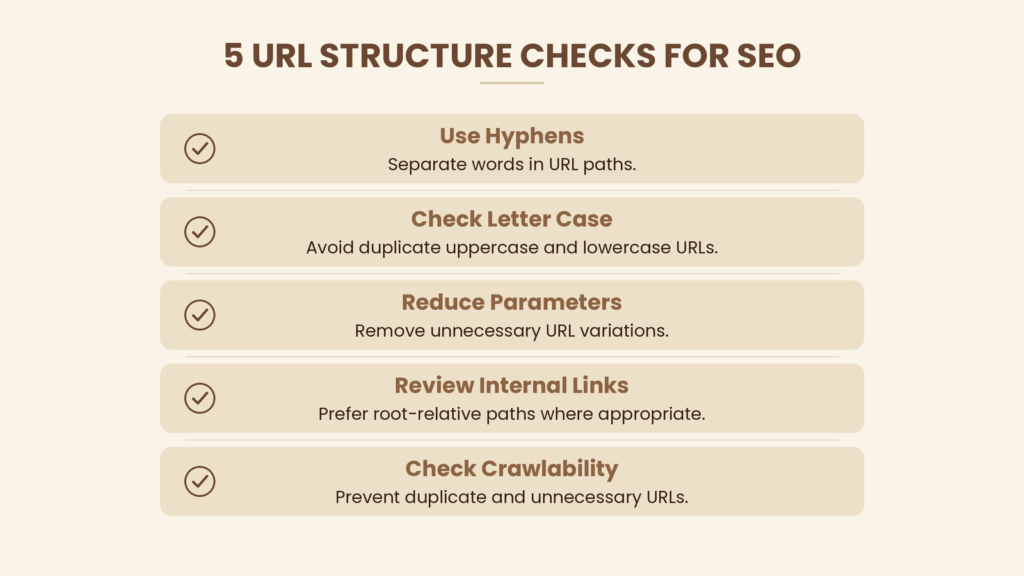
Rather than rewriting your entire URL strategy, work through the specific items this URL structure guidelines update actually touches.
- Confirm every new URL uses hyphens, not underscores, to separate words in the path.
- Check whether your CMS serves both a capitalized and lowercase version of the same path, and redirect one to the other if it does.
- Count the parameters on your most complex category or filter pages, and trim any that do not change the content a visitor sees.
- Review your robots.txt file if you relied on regex pattern blocking for problem URLs, since Google’s own example of that approach was removed from the page.
- Re-check any parent-relative links in your templates against the new guidance on root-relative URLs.
For a broader walkthrough of URL hygiene beyond this one documentation update, our URL structure SEO audit covers eight checks worth running on any site, and it still applies in full after this revision.
None of these checks require a full migration. Most sites can confirm compliance with the current Google URL structure guidelines in under an hour by spot-checking a handful of category, product, and archive pages rather than auditing every URL at once.
Why This Matters
An update to Google’s URL structure guidelines is normally a non-event. This one is worth ten minutes of attention because it bundles a long-standing recommendation with genuinely new technical detail on case sensitivity, parameters, and crawl inefficiency, all stated more directly than before.
What to do next:
- Read the updated page once, since several sections were renamed and moved.
- Fix any capitalization duplicates Google now calls out by name.
- Treat hyphens-versus-underscores as settled and move your attention to parameter cleanup instead, since that is where most real crawl waste happens.
FAQ: Google URL Structure Guidelines
Does URL structure directly affect Google rankings?
Only slightly. Gary Illyes described keywords in a URL as an “incredibly small signal,” and the October 21 documentation update does not change that position.
Should I use hyphens or underscores in URLs?
Use hyphens. Google’s updated guidance keeps this recommendation and adds that hyphens “clearly signal a word boundary,” while underscores can visually merge words together.
Do I need to change my existing URLs because of this update?
No. The update is a documentation rewrite, not a new requirement. Changing live URLs now would risk breaking existing rankings and links for a guideline that did not substantively change.
Does Google treat uppercase and lowercase URLs as the same page?
No. The updated guidelines state explicitly that Google treats a path like /APPLE and /apple as two separate URLs, which can create duplicate content if your server does not redirect one to the other.
Where can I read the original Google documentation change?
Google’s own URL structure best practices page shows the current text, and Search Engine Roundtable’s October 21 report documents what changed from the prior version.



Leave a response