
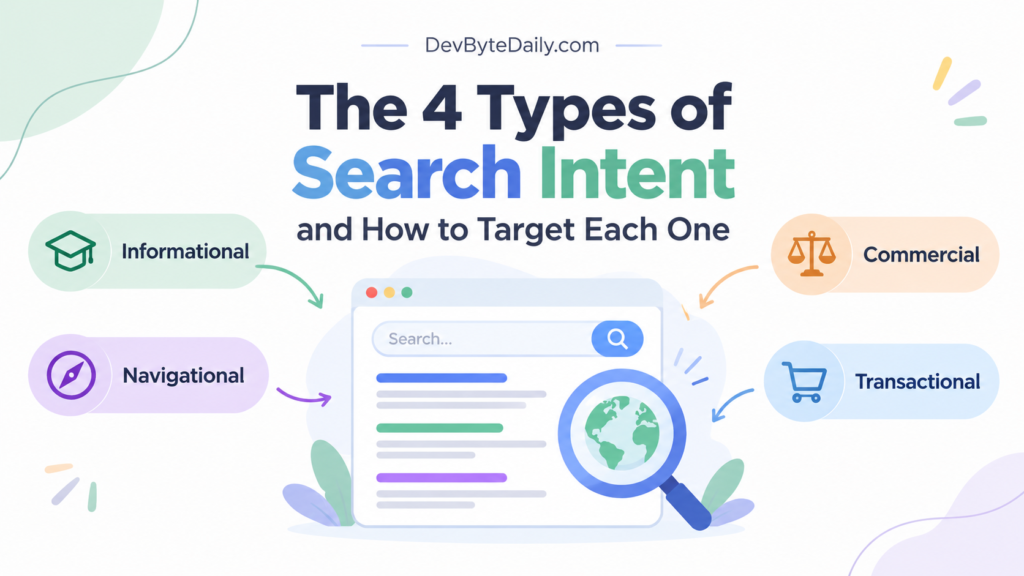
Search Intent is the reason behind a user’s search query. Someone searching “what is technical SEO” wants to learn, while someone searching “best SEO tools” is comparing options. A person searching for “Semrush login” already knows where they want to go.
The keyword may look simple, but the goal behind it changes everything.
This is why successful SEO is not just about finding keywords with search volume. You also need to understand what users expect when they type those keywords into Google. If your page answers a different question, offers the wrong format, or pushes a sales message when the user only wants information, it may fail to satisfy the search even if the keyword appears throughout the page.
Search Intent gives you a practical way to solve that problem.
SEO professionals generally group search intent into four main categories: informational, navigational, commercial, and transactional. These categories help determine what users want and what type of page is most appropriate for the query.
Let’s look at each type and, more importantly, how you can target it.
What Is Search Intent?
Search Intent describes the purpose behind a search query. In simple terms, it answers one question:
“What does this person actually want to accomplish?”
For example, consider these searches:
- “what is email marketing” → learning
- “Mailchimp login” → finding a specific website
- “best email marketing platforms” → comparing options
- “buy email marketing software” → taking action
The topic is similar, but the user’s stage in the journey is different.
That distinction matters because each search requires a different content experience.
Google’s current guidance emphasizes creating helpful, reliable, people-first content that satisfies the user’s purpose rather than producing pages primarily to attract search traffic. Google also specifically recommends evaluating whether visitors leave your content feeling they learned enough to achieve their goal.
So, Search Intent is not simply a keyword classification exercise. It is a way to understand the job your content needs to do.
Why Search Intent Matters for SEO
A common SEO mistake is choosing a keyword first and deciding what to write afterward.
That approach can create a mismatch between the query and the page.
Imagine a user searches for “best project management software for small teams.” If you create a basic definition of project management, you may technically mention the keyword, but you are not solving the user’s problem.
The searcher wants comparisons, features, pricing considerations, and practical differences between options.
Matching Search Intent helps you:
- Choose the right content format.
- Build more relevant pages.
- Avoid targeting keywords with the wrong page type.
- Create better internal linking paths.
- Align content with different stages of the customer journey.
- Improve the usefulness of your organic traffic.
Search intent can also be mixed. A keyword may produce informational and commercial results at the same time. SEO tools such as Ahrefs and Semrush therefore use SERP data to identify intent, rather than relying only on individual words in a query.
That means you should always look beyond the keyword itself.
1. Informational Search Intent
Informational intent means the user wants to learn something, understand a topic, or solve a problem.
These searches often contain words such as:
- What
- Why
- How
- When
- Guide
- Tutorial
- Meaning
- Benefits
- Examples
Examples of informational searches
- What is Search Intent?
- How does technical SEO work?
- Why is website speed important?
- How to create a sitemap
- SEO tips for beginners
The user is not necessarily ready to buy anything. Their immediate goal is information.
How to target informational intent
Create content that answers the question clearly and completely.
Blog posts, tutorials, guides, explainers, educational videos, and detailed resources can all work well for this type of query.
Start with the answer instead of forcing the reader through a long introduction. Then expand with examples, explanations, steps, and supporting details.
For example, if your target keyword is “how to optimize images for SEO,” your page could cover:
- Why image optimization matters.
- How to choose image formats.
- Image compression.
- File names and alt text.
- Responsive images.
- Common optimization errors.
- How to measure improvements.
The goal is not simply to mention the keyword repeatedly. The goal is to leave the reader with a useful answer.
Google’s people-first guidance similarly emphasizes substantial, complete information, original value, accuracy, and a satisfying experience rather than writing to a specific word count.
Best content formats
- How-to guides
- Tutorials
- Educational blog posts
- Definitions
- Step-by-step articles
- Beginner guides
- Research-based resources
2. Navigational Search Intent
Navigational intent means the user wants to find a specific website, brand, page, or destination.
They usually already know what they want.
Examples include:
- Facebook login
- Google Search Console
- Semrush pricing
- YouTube
- Nike official website
- Canva login
The searcher is not looking for a general explanation of the brand. They are trying to reach a particular destination.
How to target navigational intent
For branded searches, make sure your important pages are easy for search engines and users to identify.
A business should have clear pages for:
- Homepage
- Login
- Contact
- Pricing
- Products or services
- Locations
- About
- Support
Use descriptive titles and headings so users can immediately understand what each page offers.
For example, a SaaS company targeting “BrandName pricing” should have a dedicated pricing page rather than forcing users to navigate through a long blog article.
Internal linking also matters here. Clear navigation and descriptive links can help users move from informational content toward the exact destination they need.
Best content formats
- Homepage
- Brand pages
- Product pages
- Login pages
- Contact pages
- Pricing pages
- Support pages
The goal is simple: make the destination easy to find and easy to use.
3. Commercial Search Intent
Commercial intent sits between learning and buying.
The user is researching options before making a decision.
They may not be ready to purchase immediately, but they are getting closer.
Typical commercial searches include:
- Best SEO tools
- Best laptops for students
- Semrush vs Ahrefs
- Best email marketing software
- WordPress hosting reviews
- Canva alternatives
These searches often contain words such as:
- Best
- Top
- Review
- Comparison
- Vs
- Alternative
- Affordable
- Features
How to target commercial intent
Your content should help the user evaluate choices.
Instead of writing a generic article, give readers the information they need to make an informed comparison.
For example, a page targeting “best SEO tools for small businesses” could compare:
- Main features
- Ease of use
- Pricing
- Keyword research capabilities
- Competitor analysis
- Reporting
- Best use case
Be transparent about limitations. A comparison that only highlights advantages can feel promotional rather than useful.
This is especially important because Google recommends content that provides substantial value, original analysis, and information beyond what is obvious or simply rewritten from other sources.
Best content formats
- Comparison articles
- Product reviews
- Alternatives pages
- Buying guides
- “Best” lists
- Feature comparisons
- Case studies
Commercial content should help users answer:
“Which option is right for me, and why?”
4. Transactional Search Intent
Transactional intent means the user is ready to take a specific action.
That action might be purchasing a product, signing up for a service, downloading something, booking an appointment, or starting a trial.
Examples include:
- Buy running shoes online
- SEO software pricing
- Subscribe to email marketing software
- Download PDF editor
- Book hotel in Lahore
- Start free trial
The user has moved beyond general research.
How to target transactional intent
Give users a direct path to action.
A transactional page should make important information easy to find, including:
- Product or service details
- Pricing
- Key benefits
- Features
- Availability
- Reviews where appropriate
- Shipping or delivery information
- Clear calls to action
- Terms or conditions where relevant
Avoid turning a transactional page into a 2,000-word educational article unless the additional information genuinely helps the user make the decision.
If someone searches “buy wireless keyboard,” they probably want to see products, specifications, price, availability, and purchasing options.
They do not necessarily want an extended history of computer keyboards.
Best content formats
- Product pages
- Service pages
- Pricing pages
- Product category pages
- Booking pages
- Sign-up pages
- Checkout-oriented landing pages
The objective is to remove unnecessary friction between the search and the desired action.
How to Identify Search Intent Before Creating Content
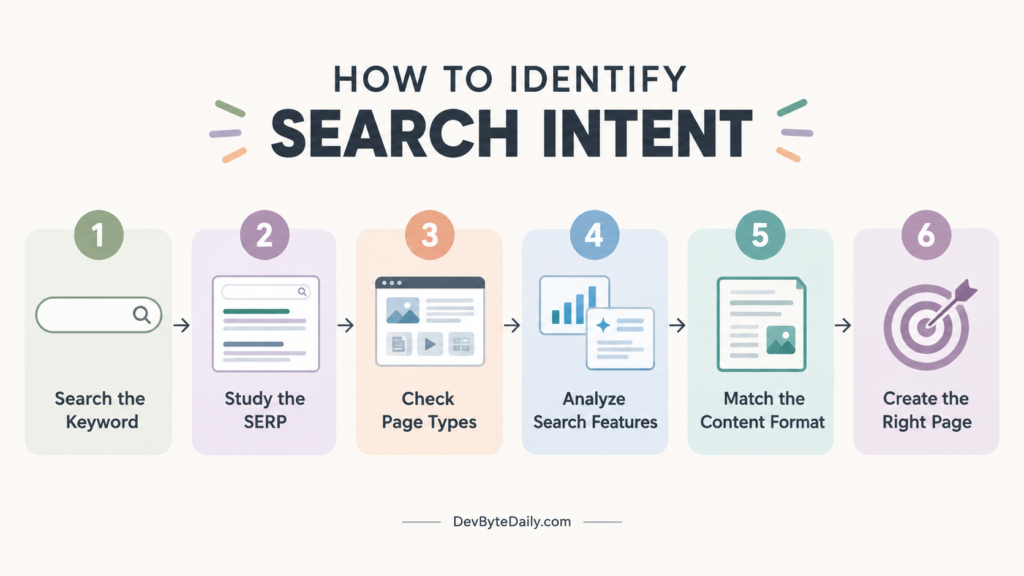
One of the easiest ways to understand Search Intent is to study the actual search results. Do not rely entirely on assumptions. Search the target keyword and examine the pages Google is showing.
Look at:
1. The content format
Are most results:
- Blog posts?
- Product pages?
- Category pages?
- Videos?
- Comparison articles?
- Brand pages?
The dominant format gives you a strong clue about what users expect.
2. The titles
Look for repeated patterns.
If many results use phrases such as “how to,” the query is probably informational.
If you repeatedly see “best,” “review,” or “vs,” commercial research may be dominant.
3. The SERP features
Look at what Google displays around the organic results.
Featured snippets, shopping results, local results, videos, images, and other search features can reveal what type of answer Google considers useful for that query.
4. The actual pages
Open several top-ranking pages.
Ask:
“What problem does this page solve?”
Then ask:
“Could my planned page satisfy the same need better or more completely?”
Semrush and Ahrefs both recommend using the SERP itself as an important source of evidence when determining intent, particularly because some keywords have overlapping or mixed intent.
One Keyword Can Have More Than One Intent
Search Intent is not always perfectly clean.
A query such as “coffee beans” could mean that someone wants to learn about coffee beans, compare brands, or purchase them.
Likewise, “SEO audit” could refer to:
- What an SEO audit is.
- How to perform one.
- Which SEO audit tools to use.
- Hiring an SEO agency.
- Purchasing an SEO auditing platform.
This is why keyword modifiers alone are not enough.
The SERP gives you additional context.
If Google shows a mixture of guides, comparison pages, and commercial landing pages, the keyword may have mixed intent. In that situation, your page can address the dominant need while naturally covering closely related needs.
Turn Search Intent Into a Content Strategy
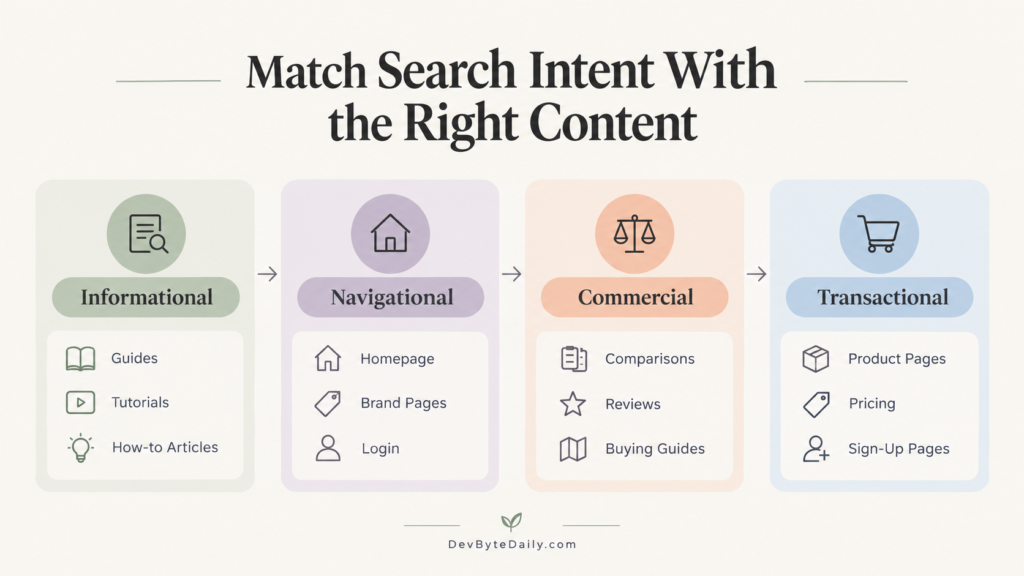
Once you understand the four types, you can use them to build a stronger content journey.
For example, an SEO software company could create:
Informational:
“What Is an SEO Audit and Why Does It Matter?”
↓
Commercial:
“Best SEO Audit Tools Compared”
↓
Transactional:
“SEO Audit Software Pricing”
↓
Navigational:
“BrandName Login”
Each page serves a different purpose.
The informational article attracts people who are learning. The commercial comparison helps users evaluate solutions. The transactional page supports users who are ready to act. The navigational page gives existing users a direct destination.
This creates a more intentional content ecosystem instead of publishing disconnected articles simply because keywords have search volume.
The Search Intent Traps That Hold Content Back
Some SEO problems are not caused by poor writing. They are caused by targeting the wrong intent.
Writing the wrong page type
A product page may struggle for an educational query because the user wants an explanation rather than a sales pitch.
Over-optimizing the keyword
Repeating the exact phrase does not compensate for failing to answer the user’s actual question.
Google’s current guidance explicitly says creators should focus on people-first content rather than content produced primarily to attract search-engine visits.
Ignoring the SERP
Keyword tools can provide useful intent classifications, but they should not replace your own review of the search results.
Forcing every keyword into a blog post
Not every keyword needs an article.
Some searches are better served by product pages, category pages, service pages, comparison pages, or other dedicated experiences.
Optimizing for rankings instead of the user’s goal
A page can contain all the expected SEO elements and still disappoint visitors.
Google’s guidance emphasizes that useful content should help people accomplish their goal and provide a satisfying experience.
A Simple Search Intent Workflow
Use this process before creating any SEO page:
Keyword → Search the SERP → Identify the dominant intent → Study ranking formats → Choose the right page type → Match the content → Add useful depth → Review performance
This workflow keeps keyword research connected to actual user needs.
It also prevents a common problem: creating a technically optimized page that answers the wrong question.
Questions Marketers Often Ask About Search Intent
Is Search Intent a ranking factor?
Search Intent itself is not presented by Google as a single ranking factor. Instead, Google’s systems aim to surface relevant, helpful content that satisfies users’ needs. Understanding intent helps you create content that better matches those needs.
How do I find the Search Intent of a keyword?
Search the keyword and examine the current results. Look at the dominant page types, titles, SERP features, and the actual content ranking for the query. SEO tools can provide intent classifications, but the live SERP provides important context.
Can a keyword have multiple types of Search Intent?
Yes. Some keywords have mixed intent. For example, a query may return both educational resources and commercial pages. Intent can also change as search results evolve.
Which Search Intent is best for SEO?
There is no universally “best” intent. The right intent depends on your business goal and the needs behind the query. Informational searches may support awareness, commercial searches may support evaluation, navigational searches help users reach known destinations, and transactional searches support actions such as purchases or sign-ups.
Should every Search Intent have a separate page?
Not always. If several closely related queries have the same underlying need and SERP, one strong page may satisfy them together. Create separate pages when the intent, audience need, or required content experience is meaningfully different.



Leave a response