


Content teams lean on AI content detectors to check whether a draft was written by a person or a chatbot. Many assume these tools return a clear, trustworthy verdict. That assumption is the myth this piece corrects. AI content detectors do not reliably tell AI-written text apart from human writing, and the evidence for that gap keeps growing in 2026.
This matters for anyone running a content operation. Agencies use detector scores to prove work was written by hand. Publishers use them to screen freelance copy before it goes live. Universities used them to accuse students of cheating, until the false positives got too costly to ignore.
The same scoring problem now showing up in higher education applies just as directly to marketing and SEO teams who treat a detector score as proof. It sits right alongside other AI visibility and measurement tools that promise more certainty than the underlying data supports.
The Myth: AI Content Detectors Can Reliably Spot AI Writing
The pitch behind most AI content detectors is simple. Paste in a paragraph, get back a percentage, and treat that number as settled fact. Marketing teams buy into this because it promises an easy gate: run every draft through a detector, reject anything that scores too “AI,” and move on.
The claim of near-perfect AI content detector accuracy shows up constantly in vendor marketing. It shows up on agency onboarding calls too, and in freelance job postings that require a “0% AI” score before payment. It is a tidy story. It is also not what independent testing finds.
Where the AI Content Detector Accuracy Claim Comes From
Detector vendors run their own benchmarks and publish strong numbers, often in the high 90s. Turnitin launched its AI writing detector in April 2023. It told customers the tool “identifies 97 per cent of ChatGPT and GPT3 authored writing, with a very low less than 1/100 false positive rate.” That figure comes from Times Higher Education’s coverage of the launch. Durham University professor Mike Sharples noted at the time that the false-positive claim had “not been independently verified.”
Originality.ai has published a similar self-run study claiming 99% accuracy on its own test set. Those tests are usually built on clean, unedited AI output from one or two models, checked against clearly human writing with no overlap between the two. Real content does not look like that.
Writers draft with AI assistance, edit AI output by hand, and mix in quotes and data. Many also write in a second language. Every one of those normal habits breaks a detector’s core assumptions. That is why a vendor’s own AI content detector accuracy claim rarely survives contact with real-world text once an outside researcher runs the same test.
What Independent Testing Shows About AI Content Detector Accuracy
The clearest early warning came from OpenAI itself. In January 2023, OpenAI launched its own AI Text Classifier and published its own accuracy numbers. The tool correctly flagged only 26% of AI-written text in testing, according to Search Engine Journal’s reporting on the shutdown. It also incorrectly labeled 9% of human-written text as AI-generated.
OpenAI pulled the tool in July 2023, citing its “low rate of accuracy.” It has not relaunched a public replacement.
A few months later, a Stanford research team led by James Zou went further. The team tested how that inaccuracy is distributed across different writers. Their study, published in the Cell Press journal Patterns, ran seven widely used GPT detectors against two sets of human-written essays.
One set was TOEFL essays from non-native English speakers. The other was Hewlett Foundation essays from native-English eighth graders.
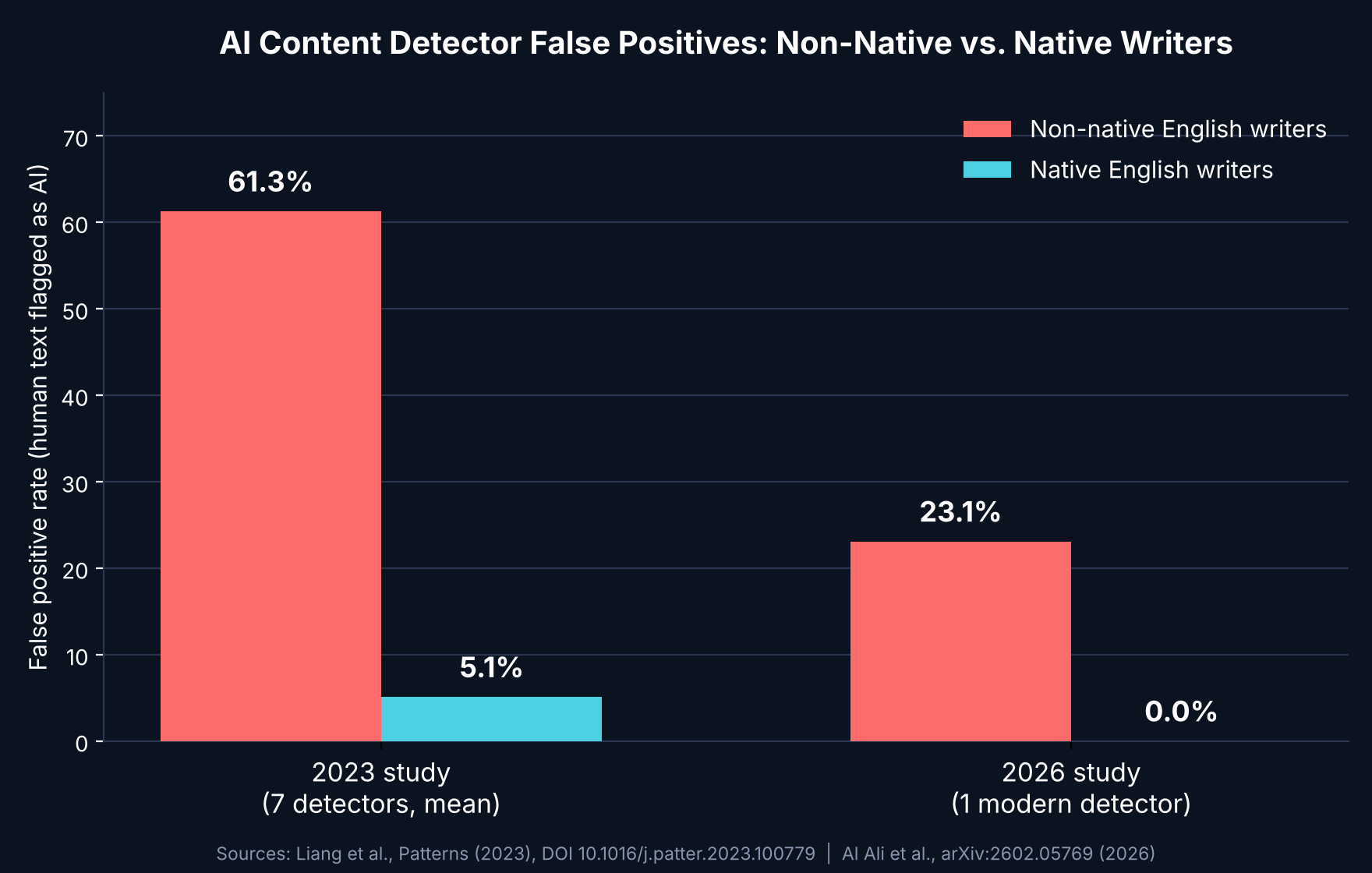
The gap was stark. The detectors flagged an average of 61.3% of the non-native essays as AI-generated, against just 5.1% of the native essays. One detector alone misclassified 89 of 91 TOEFL essays, a false-positive rate near 98%.
That bias has not fully disappeared. A February 2026 follow-up study, published on arXiv by Al Ali, Helcl, and Libovický, re-ran a modern commercial detector on the same English essay sets. The gap narrowed, from a 61.3%-versus-5.1% split down to 23.1% versus 0%. A native and non-native accuracy gap was still measurable three years after the original Stanford paper.
A separate international study backs up the same conclusion from a different angle. Led by Debora Weber-Wulff, it covered 14 detection tools, including Turnitin and PlagiarismCheck. It concluded the tools tested were “neither accurate nor reliable,” and that performance dropped sharply once text was lightly paraphrased.
Universities Are Walking Away From AI Detectors in 2026
Higher education adopted AI content detectors fastest. In 2026 it is also where the retreat from them is clearest. Washington State University canceled its contract for Turnitin’s AI Detection add-on in February 2026.
The provost’s office memo, which is publicly posted, ran the numbers on Turnitin’s own claimed 1-2% false-positive rate. Applied to the nearly 148,500 assessments the university processed in fall 2024, that rate implied roughly 1,485 wrongly flagged papers.
The same memo noted something sharper. From 2023 to 2025, a third of its Academic Integrity Hearing Board cases built on AI-detection evidence ended in a “not responsible” finding. In each of those cases, the detector score turned out to be the only evidence on the table.
Vanderbilt University reached a similar conclusion earlier, after Turnitin switched on AI detection for existing customers with less than a day’s notice in 2023. A claimed 1% false-positive rate across roughly 75,000 papers submitted that year implied around 750 students could be wrongly flagged. That is why Vanderbilt disabled the feature and now requires more than a detector score before opening any misconduct case.
The pattern has repeated widely since. The University of Waterloo turned off Turnitin’s AI detection campus-wide. Internal testing there reportedly scored entirely human-written work as “100% generated by AI.” Reporting attributed to the Financial Times in mid-2026 described Yale and Johns Hopkins restricting detector scores to informal, advisory use only. Neither school now accepts a bare score as standalone evidence in integrity cases.
Curtin University in Australia and the University of the Free State in South Africa both announced plans in 2026 to disable Turnitin’s AI detection feature. Both cited the same fairness and accuracy concerns. Several UK universities have taken comparable steps this year, and nearly every review lands on the same false-positive math.
None of these institutions claim AI writing assistance has disappeared from student work. They are making a narrower point. A single score from a tool with a documented false-positive problem is not strong enough evidence to end a career or a degree on its own.
What This Means for SEO Teams and Content Publishers
None of this means Google treats AI-written content as automatically penalized, and it never has. Google’s own guidance on AI-generated content has been consistent since 2023. Rankings depend on whether content is helpful, original, and reliable, regardless of whether a human, an AI tool, or some mix of both produced it. Google’s spam policies target content made at scale primarily to manipulate rankings, not content that happens to involve AI assistance.
That distinction gets lost when a content operation treats a detector score as a quality gate. If an agency promises a client “100% human, 0% AI” copy, and backs that promise with a detector score, it is making a claim the underlying tool cannot support. WSU and Vanderbilt stopped trusting those same scores for grading, for the same reason. A detector flags writing patterns, not authorship, and those patterns correlate loosely with second-language phrasing, formulaic industry writing, and even some native writers’ natural style.
Freelance platforms that gate payment on a “passing” detector score create the same false-positive risk Stanford documented. A non-native English freelancer, or a writer following a tight brief and style guide, is more likely to get flagged than someone writing loosely in idiomatic English. That risk exists independent of who actually wrote the piece.
Teams that still want a check should treat it as one signal among several, alongside plagiarism checks, fact verification, and editor review, rather than a single automated pass or fail. That same “signal, not verdict” approach applies to any content strategy built around AI search visibility.
Consider a typical in-house scenario. A content lead runs a freelancer’s keyword-optimized draft through a detector before publishing. The draft follows a tight brief, repeats target phrases for SEO, and was written by someone who learned English as a second language. None of that makes the draft AI-written.
But all three traits are exactly what pushes detector scores up, based on the writing patterns Stanford’s research identified. Rejecting the draft on score alone risks losing a capable writer over a tool quirk, not a real problem.
Where Detector Scores Still Have a Role
None of this makes AI content detectors worthless. Used correctly, they can still flag text worth a second look, the same way a spell-checker flags a word worth checking rather than issuing a final verdict. A detector score paired with an editor who actually reads the piece is a reasonable workflow step.
The failure mode is treating the score as a courtroom-grade verdict, rather than a prompt for human review. Universities made exactly that shift in 2026. Keep the tool for an informal first look, but drop it as standalone evidence for any decision that affects someone’s income, grade, or reputation. Content teams face the same stakes with freelancers and in-house writers, and the same fix applies.
It is also worth separating detector accuracy from AI content quality. A piece can score low on an AI detector and still be shallow, generic, or wrong. A piece can score high and still be accurate, well-sourced, and genuinely useful to a reader. The detector measures writing pattern, not the thing that actually affects whether content ranks or earns trust.
The same gap between a confident tool claim and the underlying data shows up elsewhere in AI search. We have covered it in which ChatGPT citation claims actually hold up and in what the data shows about llms.txt adoption. The lesson repeats: check the source behind a confident number before building a policy on it.
Frequently Asked Questions
Do AI content detectors ever give a reliable result?
They perform best on long, unedited, single-model AI output with no human revision. The moment a draft is edited, paraphrased, or translated, accuracy drops. That is exactly the condition most real-world content meets.
Does Google use AI detectors to rank or penalize content?
No. Google has said publicly that it evaluates content on helpfulness, originality, and reliability, not on how it was produced. It does not rely on third-party AI detection scores for ranking decisions.
Why do non-native English writers get flagged more often?
Detectors look for statistical patterns like word predictability and sentence variety. Writers composing in a second language often produce more uniform, lower-perplexity phrasing. That overlaps with patterns the models associate with AI-generated text.
Should agencies still mention AI content detector accuracy to clients?
Only with an honest caveat. Describing a detector score as a directional check is fair. Presenting it as proof of 100% human authorship repeats the same overclaim that got these tools pulled from university policy in 2026.
Is any AI detector getting meaningfully more accurate over time?
The 2026 follow-up research suggests some improvement. The native-versus-non-native false-positive gap narrowed from roughly 61 points to about 23 points between the 2023 and 2026 studies covered above. That is real progress, but a 23-point gap is still far from the near-perfect reliability most detector marketing implies.
Separating Hype From Reality
The myth holds up only if nobody checks the numbers. Look at OpenAI’s own 26%/9% figures, the Stanford Patterns study, the 2026 follow-up research, and a growing list of universities walking back their AI-detector policies. The pattern is consistent. These tools catch some obvious cases and miss or misfire on a lot of ordinary writing.
The practical takeaway for SEO and content teams is to stop using a single detector score as a pass-or-fail gate, especially for freelancers writing in a second language. Use it as one input into an editorial review. Document the limitation to clients and writers alike, and keep watching this space. Detection and generation models are both still moving, and today’s AI content detector accuracy numbers are a snapshot, not a settled fact.



Leave a response