

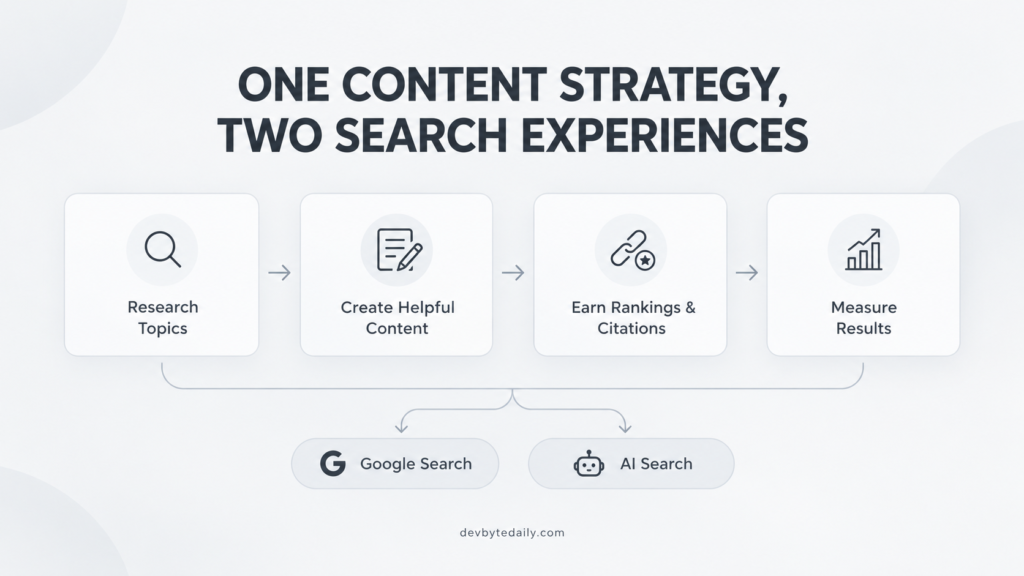
Most content teams still run two playbooks: one for Google Search and a second, newer one for AI answer engines like AI Overviews, AI Mode, ChatGPT, and Perplexity. That split creates duplicate work and inconsistent messaging. A content strategy for AI search does not need to replace your Google playbook. It needs to sit on top of it, using the same research and the same editorial calendar to serve both.
This is an evergreen, step-by-step guide, not a breaking news story. Google’s own Search Central team pushed another round of AI Mode and AI Overviews link changes this month, and Search Engine Land ran a widely discussed piece arguing that human experience is now a content asset in its own right. Both point the same direction: the mechanics of AI search keep shifting, but the editorial fundamentals underneath a good content strategy for AI search barely change at all.
Why One Content Strategy Can Serve Both Google and AI Search
Google’s AI Overviews and AI Mode are built on the same index, the same crawlers, and largely the same quality signals as classic web search. ChatGPT search and Perplexity lean more heavily on third-party retrieval, but they are still pulling from pages that rank, get cited, and carry clear authorship. A content strategy for AI search that treats these as separate audiences ends up duplicating briefs, approval steps, and measurement dashboards for no real benefit.
The teams getting cited consistently in AI answers are, in my experience, the same teams that already do traditional SEO well: clear topical ownership, original reporting or data, and pages built around a single clear answer. What changes is not the strategy itself. It is the discipline around specificity, sourcing, and update frequency that both systems now reward more visibly than before.
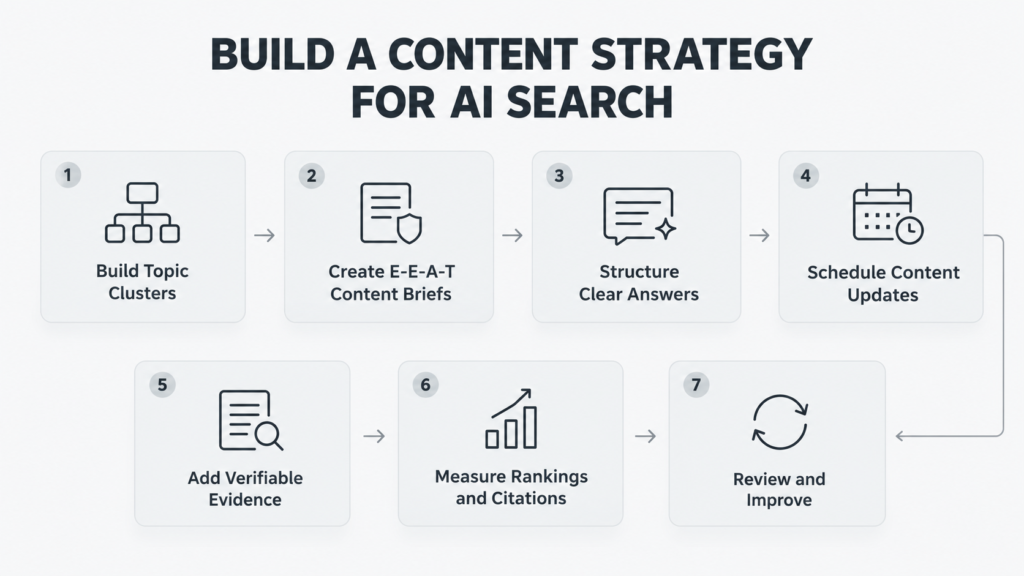
Step 1: Build Topic Clusters Instead of One-Off Keyword Lists
A keyword list tells you what to write. A topic cluster tells you how pieces connect, which is what both a Google crawler and an AI retrieval system need to understand your authority on a subject.
Start with one pillar page per core topic in your niche, then map five to fifteen supporting articles that each answer one specific sub-question. Link every supporting page back to the pillar, and link the pillar out to its best supporting pages. This internal structure does two jobs at once: it helps Google’s crawlers understand topical depth, and it gives an AI system more than one page to pull a confident citation from.
When you plan a content strategy for AI search this way, you are really building a map of what your site knows, not just what it has published. That map is what both ranking systems and retrieval systems use to decide whether you are a credible source on the topic.
Match each supporting article to a specific search intent rather than a single keyword variant. Our breakdown of the four types of search intent is a useful filter here: a cluster that mixes informational, commercial, and navigational intent on one page tends to confuse both a human reader and an AI system trying to decide which snippet of your page actually answers the query.
How to Prioritize Which Clusters to Build First
Rank candidate clusters by three factors: search demand, your team’s genuine first-hand expertise, and competitive gaps where existing content is thin or outdated. A cluster where you have real practitioner experience will outperform a cluster you can only research secondhand, because that experience shows up naturally in the specificity of your examples.
Step 2: Write Content Briefs That Build In E-E-A-T From the Start
E-E-A-T stands for experience, expertise, authoritativeness, and trust. Google added the first E for experience in its quality rater guidelines in late 2022, and the concept still anchors how both human raters and automated systems judge whether a page deserves to be cited, according to Google’s own guidance on creating helpful, reliable, people-first content.
The mistake most teams make is trying to retrofit E-E-A-T after a draft is written. It works far better as a brief requirement. A good content brief for a content strategy that works for AI search should specify, before a single word is written:
- Who is writing or being quoted, and what direct experience qualifies them
- At least one original data point, example, or test result that cannot be copied from a competitor’s article
- The single primary question the page answers, stated in one sentence
- Which existing pages on your site it should link to and receive links from
- What would make this page worth citing over the ten other articles already ranking for the same query
Our earlier piece on Google’s updated helpful content guidelines covers the policy side of this in more detail. The brief is where that policy actually gets applied.
Step 3: Structure Every Page So Both a Crawler and a Reader Can Parse It
AI answer engines tend to extract one clean paragraph, one list, or one table to generate a response. If your best answer is buried in paragraph six after three paragraphs of preamble, you are asking the system to do extra work it usually will not do.
Answer the core question in the first 100 to 150 words of every article. Use descriptive subheadings that match how a person would actually phrase the question, not generic labels like “Overview” or “Introduction.” Break out comparisons, steps, and criteria into lists or tables wherever that format genuinely helps a reader scan the page faster.
Formatting Choices That Help AI Systems Extract Accurate Answers
Keep paragraphs short, generally one to three sentences. Define any jargon the first time it appears. Put a single, unambiguous number or fact where a query is looking for one, rather than hedging across several sentences. This same structure also tends to improve dwell time and scroll depth in traditional analytics, so it is not a trade-off between the two audiences.
Step 4: Set a Realistic Update Cadence by Content Tier
Not every page needs the same attention. A practical content strategy for AI search sorts existing and planned content into three simple tiers and assigns a review cadence to each:
- Tier 1, evergreen pillars: review every 60 to 90 days, since these pages anchor your topical authority and get cited most often
- Tier 2, supporting guides: review every 6 months, checking for outdated steps, broken links, or new competitor angles
- Tier 3, news and time-bound posts: review once within 30 days of publishing to add developments, then archive or consolidate
AI systems appear to favor recently verified information more consistently than classic search does, which makes stale Tier 1 pages a bigger risk under a content strategy for AI search than they were under search-only SEO. Build the review cadence into your editorial calendar as its own recurring task, not as an afterthought when traffic drops.
Step 5: Diversify Proof Instead of Relying on One Author’s Voice
A single byline, however qualified, is a thinner trust signal than a page that draws on several forms of proof. Strong pages mix a named author’s direct experience with at least one outside data source, one practitioner quote, or one original example.
Our earlier guide on fact-checking AI-generated content before publishing is directly relevant here. Diversified, verifiable proof is also what makes a manual fact-check faster, because the claims are already traceable to a source.
Where a claim is sourced from an outside party, name the source and the organization in the sentence itself, and link on that attribution phrase. This habit matters more under a content strategy built for AI search, because attribution phrasing is often what an AI system echoes back in its generated answer.
Step 6: Measure Beyond Rankings
Measurement is where most teams let a content strategy for AI search quietly fall apart. Ranking position alone no longer tells the full story. A page can rank well and still lose clicks to an AI Overview that answers the question directly on the results page, a trend our earlier analysis of AI Overviews reaching the large majority of branded searches looked at in detail.
A content strategy for AI search needs a short, practical measurement set alongside your normal rank tracking:
- Impressions and clicks from Google Search Console, split by query type where possible
- Manual spot-checks of your own target queries in AI Overviews, AI Mode, ChatGPT, and Perplexity, logged monthly in a simple spreadsheet
- Referral traffic from AI platforms in your analytics, even where the volume is still small
- Branded search volume over time, since AI citation without a click often shows up first as a lift in brand searches rather than direct referral traffic
None of these replace Search Console or rank tracking. They sit next to them, because AI visibility and classic ranking visibility are now two different outcomes from the same content strategy.
Step 7: Build a Governance Loop, Not a One-Time Project
A content strategy for AI search fails quietly when it is treated as a single planning document instead of a repeating process. Set a monthly or quarterly review with the content lead, SEO lead, and one subject-matter contributor.
Check three things each time: which Tier 1 pages are due for review, which new AI-answer formats showed up in spot-checks, and which briefs need the E-E-A-T checklist tightened based on recent citation results. Document decisions in the same place every time, whether that is a shared doc or your project management tool, so the governance loop survives staff turnover.
What a Content Strategy for AI Search Looks Like in Practice
Picture a B2B software company with one pillar page on “expense management software” and nine supporting articles covering specific sub-questions: approval workflows, mobile receipt capture, integration with accounting tools, and similar topics. Under the old model, the SEO team would optimize these for Google rankings, and a separate GEO initiative would try to get the same pages cited in ChatGPT and AI Overviews, often rewriting the same paragraphs twice.
Under a single content strategy for AI search, the same nine briefs simply add three requirements: one named practitioner quote per article, one usage statistic from the company’s own product, and a logged review date for the Tier 1 pillar. Our SEO strategy template and our guide on practical strategies for ranking in AI search map onto this same structure, since the underlying framework does not change based on which engine reads the page.
The result is one set of briefs, one editorial calendar, and one measurement dashboard instead of two competing processes.
Common Mistakes to Avoid
Three mistakes come up repeatedly when teams try to retrofit a content strategy for AI search onto an existing content program.
First, treating “GEO” or “AI search optimization” as a separate department from content strategy, which duplicates briefs and splits ownership of the same pages. Second, chasing every AI platform’s latest quirk instead of fixing structural gaps like thin E-E-A-T signals or outdated Tier 1 pages. Third, measuring success only by rank position, which misses the growing share of value that comes from citations and brand lift rather than clicks.
Frequently Asked Questions
Is a content strategy for AI search different from regular SEO content strategy?
Not fundamentally. A content strategy for AI search builds on the same topic clusters, briefs, and structure that good SEO content strategy already uses, with added emphasis on clear attribution, verifiable sourcing, and more frequent updates to pillar content.
How often should a content strategy be reviewed for AI search changes?
Review the overall strategy quarterly. Review individual Tier 1 pillar pages every 60 to 90 days, since those are the pages most likely to be cited by AI answer engines and most damaged by going stale.
Do I need separate content for ChatGPT, Perplexity, and Google AI Overviews?
No. Write one well-structured, well-sourced page per topic. All of these systems reward the same underlying signals: a clear answer, credible sourcing, and up-to-date information, even though each one retrieves and formats that answer differently.
What is the single highest-impact change a small content team can make?
Rewrite content briefs to require one original data point, example, or named source per article before writing begins. This single change does more for a content strategy for AI search than almost any technical fix.
Why This Matters
AI answer engines are not going away, and neither is Google Search. A content strategy for AI search that tries to run two separate programs will burn time and budget on duplicate work. Build one editorial process with topic clusters, E-E-A-T-driven briefs, a realistic update cadence, and measurement that covers both citations and clicks.
Start by auditing your Tier 1 pillar pages this week. Flag any older than 90 days, add one original data point or named source to each, and set a recurring calendar reminder for the next review. That single step will do more for your visibility across both Google and AI search than any new tool or platform-specific tactic.



Leave a response