

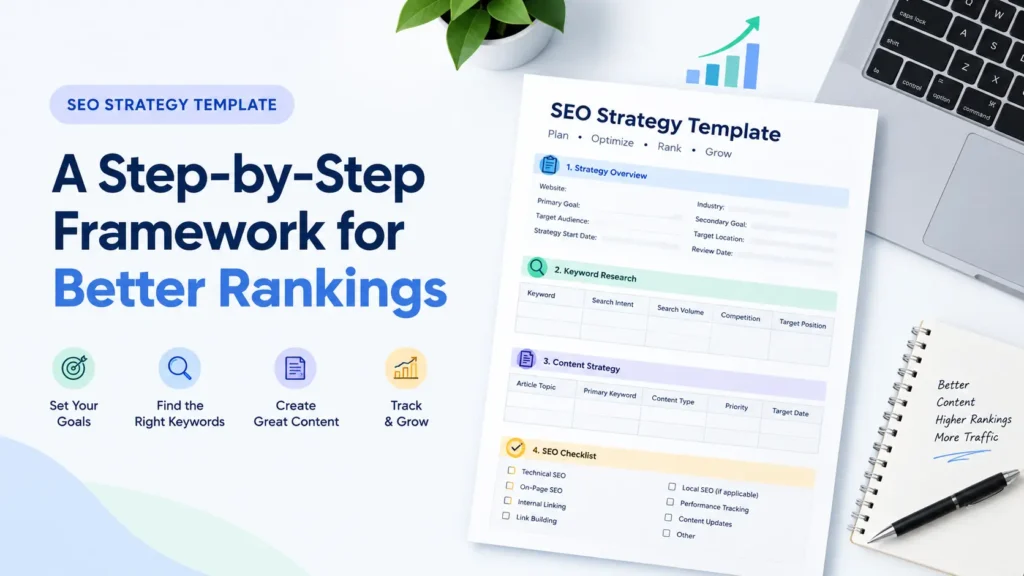
Creating an SEO strategy can feel complicated when you are dealing with keyword research, content planning, technical SEO, internal linking, backlinks, and performance tracking at the same time.
The good news is that you do not need a complicated system to get started.
A well-structured SEO strategy template can help you organize your goals, identify opportunities, prioritize tasks, and consistently improve your website’s visibility in search engines.
This guide provides a practical SEO strategy template that you can adapt to a blog, small business website, ecommerce store, or personal website.
Download the Free SEO Strategy Template
Ready to build your SEO strategy? Use our free SEO Strategy Template to organize your keywords, content plan, technical SEO tasks, internal links, link-building activities, and performance tracking in one place.
Click here to download SEO Strategy Template – DevByte Daily
What Is an SEO Strategy Template?
An SEO strategy template is a structured plan that outlines the activities you need to perform to improve a website’s organic search visibility.
Instead of randomly publishing articles or making SEO changes whenever you notice a problem, a strategy gives you a repeatable process.
A basic SEO strategy usually includes:
- SEO goals
- Website audit
- Keyword research
- Competitor analysis
- Search intent analysis
- Content planning
- On-page SEO
- Technical SEO
- Internal linking
- Link building
- Performance tracking
- Content updates
The exact strategy will depend on your website, industry, competition, audience, and business goals.
The important part is to create a system you can follow consistently.
Why Do You Need an SEO Strategy?
SEO is not usually a one-time task. Search engines continuously evaluate websites, competitors continue publishing content, and search behavior changes over time.
Without a strategy, it is easy to spend time on activities that have little impact.
For example, a website owner might publish 20 articles without researching keywords first. The articles may be well-written and technically optimized, but they may target keywords that are too competitive or do not match what people are searching for.
A strategy helps you answer important questions:
- What keywords should you target?
- Which pages should you create?
- Which existing pages need improvement?
- Who are your competitors?
- What technical problems need fixing?
- How should your pages be connected?
- Which SEO tasks should you prioritize?
- How will you measure progress?
Your goal should not simply be to “do SEO.”
Your goal should be to improve relevant organic visibility and attract the right visitors to your website.
| SEO Area | Main Task | Goal | Priority |
|---|---|---|---|
| SEO Goals | Define measurable objectives | Clear targets | High |
| Technical SEO | Find and fix technical issues | Better crawling/indexing | High |
| Keyword Research | Identify relevant keywords | Build keyword list | High |
| Competitor Analysis | Analyze competing pages | Find opportunities | High |
| Content Strategy | Plan useful content | Build topical coverage | High |
| On-Page SEO | Optimize important pages | Improve relevance | High |
| Internal Linking | Connect related pages | Improve site structure | Medium |
| Link Building | Earn relevant backlinks | Build authority | Medium |
| Local SEO | Optimize local presence | Improve local visibility | When applicable |
| Tracking | Monitor performance | Measure progress | High |
| Content Updates | Improve existing pages | Maintain rankings | Medium |
You can copy this structure into a spreadsheet and add columns for status, deadline, URL, keyword, owner, and notes.
1. Set Clear SEO Goals
Start by deciding what you actually want SEO to accomplish.
Your goal should be measurable rather than vague.
Instead of:
Improve SEO
Use something like:
Increase organic clicks from 500 to 1,000 per month within six months.
Other possible goals include:
- Increase organic traffic.
- Improve rankings for target keywords.
- Increase organic leads.
- Increase product sales from organic search.
- Generate more qualified visitors.
- Increase visibility for a specific topic.
- Improve rankings for existing pages.
Your SEO goals should support your broader business objectives.
If your website generates leads, traffic alone may not be enough. You should also monitor conversions.
2. Perform a Website SEO Audit
Before creating new content, understand the current condition of your website.
A basic SEO audit should examine technical, content, and usability factors.
Check:
- Indexing
- Crawlability
- XML sitemap
- Robots.txt
- HTTPS
- Broken links
- Redirects
- Canonical tags
- Duplicate content
- Page titles
- Meta descriptions
- Heading structure
- Image optimization
- Internal links
- Mobile usability
- Page performance
- Core Web Vitals
You can use Google Search Console and other SEO crawling tools to identify issues.
Do not try to fix everything at once.
Prioritize problems that can prevent search engines from properly crawling, indexing, or understanding important pages.
3. Conduct Keyword Research
Keyword research is one of the most important parts of your SEO strategy.
Start by identifying the words and phrases your target audience uses when searching for information, products, or services related to your website.
Create a keyword list containing:
- Primary keywords
- Secondary keywords
- Long-tail keywords
- Related questions
- Commercial keywords
- Informational keywords
- Local keywords when relevant
For a newer website, long-tail and lower-competition keywords can be particularly useful.
For example, instead of immediately targeting:
SEO
you might target:
SEO strategy template for small business
The broader keyword may have significantly more competition.
The more specific keyword gives you a clearer understanding of the searcher’s intent and may provide a more realistic ranking opportunity.
4. Analyze Search Intent
Finding a keyword is not enough.
You also need to understand why someone searches for it.
Search intent generally falls into several categories:
Informational Intent
The user wants information.
Examples:
- What is technical SEO?
- How does keyword research work?
- What is a canonical tag?
Commercial Investigation
The user is researching options before making a decision.
Examples:
- Best SEO tools
- Ahrefs vs Semrush
- Best SEO plugin for WordPress
Transactional Intent
The user is ready to take an action or make a purchase.
Examples:
- Buy SEO software
- Hire an SEO consultant
- WordPress SEO service
Navigational Intent
The user is looking for a particular website or page.
Examples:
- Google Search Console login
- Semrush
- Rank Math
Your content should match the intent behind the keyword.
If the search results are primarily detailed guides and you create a short promotional page, it may struggle to rank even if the keyword appears throughout the page.
5. Analyze Your Competitors
Competitor analysis can show you what Google considers relevant for your target keyword.
Search your target keyword and study the pages ranking on the first page.
Look at:
- Content depth
- Page structure
- Topics covered
- Search intent
- Title formats
- Examples
- Images
- Tables
- Internal links
- External references
- Unique information
- User experience
Do not simply copy the top-ranking pages.
Instead, identify opportunities to create something more useful, clearer, more complete, or more practical.
Ask:
What can my article provide that these pages don’t?
That question can lead to stronger content than simply trying to make your article longer.
6. Build a Content Strategy
Once you have your keywords and competitor research, organize them into a content plan.
Avoid publishing completely unrelated topics one after another.
Instead, build topic clusters.
For example, if your website focuses on SEO, you could create a cluster around technical SEO:
Pillar topic:
Technical SEO Guide
Supporting articles:
- Technical SEO Checklist
- XML Sitemap Guide
- Robots.txt Guide
- Canonical Tags Explained
- How to Fix Crawl Errors
- How to Fix Indexing Problems
- 301 Redirect Guide
- 404 Errors and SEO
- Core Web Vitals Guide
- JavaScript SEO
These articles can be connected through internal links.
This approach helps create stronger topical coverage than publishing random SEO articles.
7. Create High-Quality Content
Once you select a keyword, create content that genuinely satisfies the search intent.
A useful article should:
- Answer the primary question.
- Explain concepts clearly.
- Provide practical steps.
- Use relevant examples.
- Cover important subtopics.
- Address common problems.
- Provide original insights.
- Be easy to navigate.
- Avoid unnecessary repetition.
8. Optimize On-Page SEO
After writing the content, optimize the important on-page elements.
Focus on:
Title
Create a title that accurately describes the page and gives users a reason to click.
URL
Keep the URL short and descriptive.
For this article:
/seo-strategy-template/
is cleaner than a long URL containing unnecessary words.
Meta Description
Write a concise description that explains what the reader will find on the page.
Headings
Use headings to organize the content logically.
Keywords
Use your primary and related keywords naturally.
Do not repeat the same keyword unnecessarily.
Images
Use relevant images where they improve understanding.
Optimize image file sizes and use descriptive filenames and alt text.
9. Build a Strong Internal Linking Structure
Internal linking is particularly important when you start building multiple related articles.
Suppose you have these pages:
- SEO Strategy Template
- Keyword Research Guide
- Technical SEO Checklist
- On-Page SEO Guide
- Content Strategy Guide
You can connect them naturally.
For example, while discussing keyword research, link to your detailed Keyword Research Guide.
While discussing technical SEO, link to your Technical SEO Checklist.
The purpose isn’t to add as many links as possible.
The purpose is to help users and search engines discover related content.
Every time you publish a new article, review your existing content and look for relevant internal linking opportunities.
10. Build Relevant Backlinks
Backlinks can help establish your website’s authority, particularly when competing against established websites.
However, quality matters more than simply increasing the number of links.
Focus on earning links from relevant and trustworthy websites.
Potential approaches include:
- Publishing original research
- Creating useful resources
- Digital PR
- Guest contributions on legitimate, relevant websites
- Expert commentary
- Linkable guides
- Original statistics
- Useful tools or templates
Avoid buying large quantities of low-quality backlinks or participating in obvious link schemes.
A few genuinely relevant links can be more valuable than hundreds of irrelevant links.
11. Consider Local SEO When Relevant
If your business serves a specific geographical area, local SEO should be part of your strategy.
Optimize relevant information such as:
- Business name
- Address
- Phone number
- Business hours
- Service areas
- Location pages
- Google Business Profile
- Local citations
- Customer reviews
Local SEO isn’t necessary for every website.
If your website serves a global audience, focus your resources on other SEO areas instead.
12. Track Your SEO Performance
You cannot improve what you don’t measure.
Use tools such as Google Search Console and Google Analytics to monitor performance.
Important metrics include:
- Impressions
- Clicks
- Click-through rate
- Average position
- Organic users
- Organic sessions
- Conversions
- Engagement
- Indexed pages
Do not look at traffic alone.
For example, an article receiving 1,000 impressions and ranking around position 60 is in a very different situation from an article receiving 1,000 impressions and ranking around position 8.
The first objective is to improve its ranking.
Once a page reaches the first page, CTR optimization becomes more important.
13. Update Existing Content
SEO doesn’t end when an article is published.
Review your existing content periodically.
Look for:
- Outdated information
- Missing topics
- New search queries
- Poor-performing sections
- Broken links
- New examples
- Better internal linking opportunities
- Changes in search intent
Google Search Console can be particularly useful here.
If an article receives impressions for queries you did not originally target, those queries may reveal opportunities to expand the article.
For example, if your article ranks around position 15 for a related question, adding a useful section addressing that question may help strengthen the page.
| Week | Main SEO Activities |
|---|---|
| Week 1 | Keyword research + competitor analysis |
| Week 2 | Publish or improve content |
| Week 3 | Internal linking + technical SEO |
| Week 4 | Analyze Search Console + update content |
You can adjust this depending on your available time.
For a small website, consistency is more important than trying to complete dozens of SEO tasks every week.
Common SEO Strategy Mistakes to Avoid
Targeting Only High-Volume Keywords
High search volume does not automatically mean a keyword is a good target.
A lower-volume keyword with clear intent and manageable competition can generate more useful traffic.
Writing for SEO Plugins Instead of Users
SEO plugins can help identify basic optimization opportunities.
However, an article scoring 100/100 in an SEO plugin isn’t automatically better than an article scoring 85/100.
Don’t add awkward keywords, headings, or sentences just to increase a plugin score.
Publishing Without Internal Links
New articles should not become isolated pages.
Connect relevant articles together as your website grows.
Copying Competitors
Competitor research is useful for understanding search intent and content gaps.
It should not become a copy-and-rewrite exercise.
Chasing Word Count
A 2,500-word article isn’t automatically better than a 1,200-word article.
Write enough to comprehensively answer the searcher’s question.
Remove paragraphs that don’t provide value.
Changing Everything Too Quickly
SEO takes time.
If your website is relatively new, don’t publish an article today and completely rewrite it three days later because it hasn’t reached page one.
Give Google enough time to crawl, index, and evaluate your content.
SEO Strategy Checklist
Use this checklist before publishing an article:
- Primary keyword selected
- Search intent identified
- Keyword competition evaluated
- Top-ranking competitors analyzed
- Article provides original value
- One H1 used
- Logical H2/H3 structure created
- Primary keyword used naturally
- Related keywords included naturally
- SEO title optimized
- URL is short and descriptive
- Meta description written
- Images optimized
- Relevant internal links added
- Useful external references added where appropriate
- Content checked for accuracy
- Article reviewed for readability
- No unnecessary keyword stuffing
- No unnecessary filler
- Search intent fully addressed
- Page submitted for indexing when appropriate
How Long Does an SEO Strategy Take to Work?
SEO doesn’t have a fixed timeline.
A new website may need considerable time to build visibility and authority, especially when competing with established sites.
Instead of expecting immediate traffic, monitor your progress through stages.
For example:
Stage 1: Google discovers and indexes your content.
Stage 2: Your pages begin receiving impressions.
Stage 3: Pages move from very low positions toward the top 50.
Stage 4: Stronger pages reach positions 20–30.
Stage 5: Some pages reach the first page.
Stage 6: You optimize successful pages to improve CTR, traffic, and conversions.
This progression is more useful than expecting every newly published article to rank in the top 10 immediately.
Final Thoughts
A successful SEO strategy doesn’t require doing everything at once.
Start with the fundamentals: understand your audience, research realistic keywords, analyze search intent, create useful content, build topical coverage, improve internal linking, fix important technical issues, and monitor your results.
For a newer website, keyword selection and content strategy are particularly important. Instead of competing immediately for extremely broad keywords, look for specific topics where you can provide genuinely useful information.
Use the SEO strategy template in this guide as a working document rather than a one-time checklist. Review it regularly, track your progress, and adjust your priorities based on actual search data.
The goal is not to achieve a perfect SEO score.
The goal is to build a website that Google can understand, users find useful, and other reputable websites have a reason to reference.
That is the foundation of a sustainable SEO strategy.





Leave a response