


Cloudflare’s CEO told investors this week that helping websites deal with AI agents is turning into what he called “sort of the new version of SEO.” Matthew Prince made the comment on Cloudflare’s third-quarter 2026 earnings call, and Search Engine Journal reported the remarks on November 8, 2026. If you run a website, this matters because the company that touches a large share of the web’s traffic is now building a real business around AI agent monetization.
Prince said OpenAI already pays Cloudflare for signals that tell its crawler when a page has changed, so the crawler does not waste effort refetching pages that stayed the same. He expects other AI companies to sign similar deals soon. Neither company has said how much money is involved, when the payments began, or whether site owners see any of it. The remarks landed in the same week Search Engine Journal reported that Google’s own search volume still runs roughly five times ChatGPT’s, a reminder that AI agents are additive traffic for now, not a replacement for human search.
What Cloudflare’s CEO Actually Said About AI Agent Monetization
On the call, Prince said Cloudflare booked its first revenue from what it calls “Act 4” products, a line of tools built around a web that AI agents visit as often as people do, or more often. He gave no dollar figure for that revenue.
The headline numbers were easier to pin down. Cloudflare’s third-quarter 2026 earnings release shows total revenue of $782.5 million, up 39 percent year over year. Prince said on the call that Cloudflare “crossed $3 billion in annualized revenue” for the first time. A Goldman Sachs analyst asked when Act 4 products would show meaningful revenue on their own, and Prince answered that Cloudflare is already “recognizing significant amounts of revenue” from efficiency work it does for AI companies, pointing to the OpenAI relationship as an example.
A Wells Fargo analyst asked a more basic question: do Cloudflare’s customers actually want more AI agent traffic. Prince said it depends on the business. Some site owners want as many agents visiting as possible, because agents can drive sales or bookings. Others, in his words, “see them as a bane to their business and want to keep them away.” Traffic that gets blocked is not billed, so there is no financial reason for Cloudflare to push site owners toward one choice over the other.
The OpenAI Pilot Behind This AI Agent Monetization Push
The OpenAI relationship did not start with the earnings call. Cloudflare and OpenAI announced a research pilot on July 8, 2026, aimed at helping ChatGPT’s crawler find and judge web pages more efficiently.
Cloudflare published early results in an October 15, 2026 blog post. The pilot covered about 1 percent of Cloudflare’s total network, and the company said OpenAI discovered and indexed hundreds of millions of new web pages through the signals Cloudflare provided, many of them pages with few inbound links that a crawler might otherwise miss. Cloudflare also said it flagged wasted crawler effort, such as bots requesting files that do not exist, and single harmful pages on otherwise legitimate sites, rather than penalizing a whole domain over one bad page.
Cloudflare was careful to separate this from AI training. The blog post states plainly that “this research uses metadata about the web for search and discovery, rather than sharing page content for model training,” and that a discovery signal does not grant permission to access a page. Site owners keep control over who can crawl what, which is also the idea behind Cloudflare’s AI crawler data that debunks several llms.txt myths.
The post does not confirm that OpenAI pays for this specific pilot. The payment detail comes from the earnings call, not the research write-up, so it is worth keeping those two threads separate until Cloudflare or OpenAI says more.
Evidence that AI-mediated traffic is already reshaping the web is showing up elsewhere too. Reddit’s CEO Steve Huffman told investors, in remarks Search Engine Journal reported on October 30, 2026, that Google’s AI Overviews and AI Mode are the leading suspect behind a drop of more than one million weekly search referrals to Reddit during October. He said AI Mode specifically “does not drive traffic,” for Reddit or, as far as he knows, for anyone else. That is a different company and a different platform than Cloudflare and OpenAI, but it points at the same underlying shift: fewer humans clicking through, more machines reading pages on their behalf.
Why Prince Calls AI Agent Monetization “The New SEO”
Prince’s SEO comparison rests on a simple idea: agents, like search engines, decide which pages get seen, so getting an agent to notice your site is starting to look like a ranking problem again. But he also framed it as an economics problem that search never quite had at this scale.
His example: an AI agent asked to compare dinner options might pull menu data from a thousand restaurant sites to answer one person’s question. A human diner typically looks at two or three sites before deciding. That means 999 restaurants pay the cost of serving a crawler and get nothing back for it. Prince’s view is blunt: “It can’t be a free ride for all the agents that are out there.”
He also gave a case where free access makes sense. An agent planning a Hawaii vacation for a user, and disclosing that purpose to the sites it visits, might get free access anyway, because the request itself creates an opening for travel advertising. Prince thinks more agents will start identifying themselves and their intent, and that pricing will follow that intent rather than a flat per-crawl fee.
On traffic scale, Prince first estimated in August that nonhuman traffic could reach a thousand times human traffic within five years. On the November call he repeated that estimate and said he now expects it sooner, a figure also reported independently by ppc.land. Looking a decade out, Prince said he would “imagine that this becomes the largest part of Cloudflare’s business.”
How Pay Per Crawl Fits Into Cloudflare’s AI Agent Monetization Plan
Cloudflare already ships two tools that put this thinking into practice. The first, AI Crawl Control, is free on every Cloudflare plan. It shows a dashboard of which AI crawlers hit your site and how often, lets you set allow or block rules per crawler, and flags crawlers that ignore your robots.txt file. That last part matters, because not every AI crawler actually honors robots.txt, something we covered when we looked at the AI crawler blocking myth in more detail.
The second tool, Pay Per Crawl, is still in private beta. Site owners turn it on in their account settings, set a price, and choose which crawlers must pay to fetch pages. On the other side, AI companies verify their crawler identity, connect a Stripe account, find which pages are payable, and crawl them under that agreement. Two related products, Monetization Gateway and Pay Per Use, moved into their own beta on September 30, 2026, aimed at per-request charges and revenue sharing with publishers who opt in.
None of this is mature yet. Cloudflare has not published pricing benchmarks, and it is still unclear from public filings how many sites or AI companies have actually signed up to pay or get paid.
Who Should Pay Attention to AI Agent Monetization First
Not every site needs to act on this today, but a few types of business have the most to gain or lose from how it plays out:
- Ecommerce and travel sites, where agents already compare prices and availability on a shopper’s behalf, and where blocking an agent could mean losing a booking entirely.
- Local service businesses, such as restaurants and contractors, that get crawled repeatedly for menus, hours, or quotes with no guarantee any single crawl turns into a customer.
- Publishers and content sites, which depend on being discovered and cited correctly, and which stand to benefit most if Pay Per Use style revenue sharing ever reaches general availability.
Cloudflare’s Own Numbers Show the Shift Accelerating
Whatever the AI agent monetization story adds up to later, Cloudflare’s overall growth is already speeding up. Quarterly revenue, pulled from the company’s own SEC filings, has climbed every quarter in 2026, and the year-over-year growth rate has climbed with it.
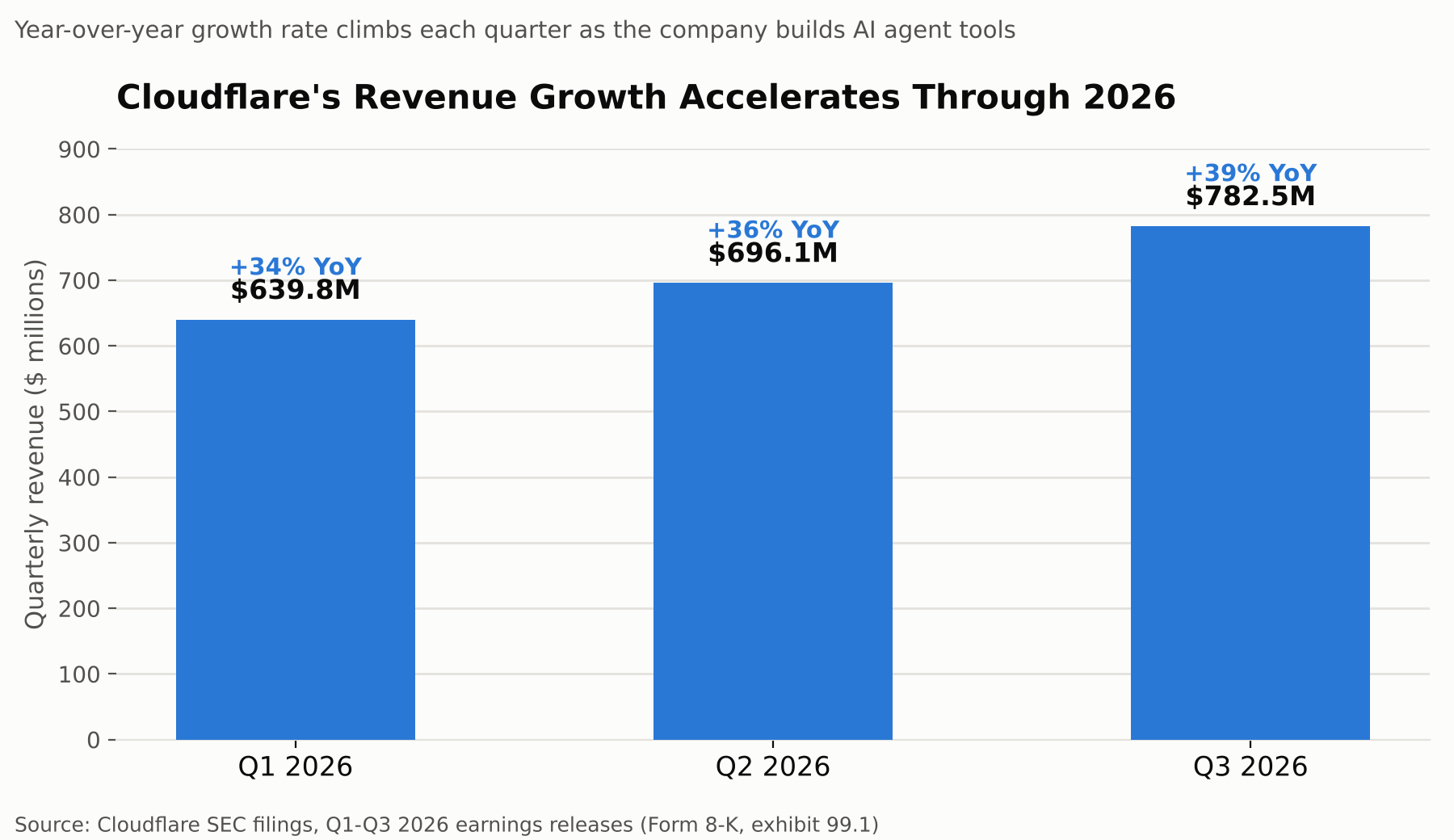
Cloudflare’s reported revenue growth accelerated through 2026 as the company leaned into tools built for an internet with more AI agent traffic. Source: Cloudflare SEC filings, Q1 to Q3 2026.
To be clear, Cloudflare has not broken out how much of that acceleration comes from Act 4 products specifically, and a lot of its business still has nothing to do with AI agents. The chart shows a company growing faster at the same time it talks up agent monetization, not proof that one causes the other. I would not read more into the correlation than that.
It is also worth setting this against what Google itself has been saying about AI and ranking fundamentals. Google’s John Mueller told interviewer David Iwanow, in remarks Search Engine Journal reported on November 2, 2026, that “technical SEO is going to remain very relevant” because AI systems “build on SEO” rather than replace it. Mueller’s point was about ranking in AI-generated answers, while Prince’s is about who gets to visit a page and who pays for that visit. They are different layers of the same stack, not competing claims.
Site owners who are already tracking how much of their traffic comes from bots instead of people have a head start here. If you have not run one recently, an AI dark traffic audit is the fastest way to see which crawlers are showing up and how often, before deciding whether to block, allow, or eventually charge any of them.
Status Right Now
Here is where things actually stand, separated from where Prince thinks they are going. Pay Per Crawl, Monetization Gateway, and Pay Per Use are all in beta, not general release. The OpenAI payment Prince mentioned is confirmed only through his own comments on an earnings call, not through a joint statement from either company, and the amount is not public. The research pilot that produced hundreds of millions of newly indexed pages covers roughly 1 percent of Cloudflare’s network, so it is a pilot, not a platform-wide rollout.
For most site owners, the practical move right now is to turn on AI Crawl Control, since it costs nothing and tells you which AI crawlers are already visiting, and to decide deliberately whether each one should be allowed, blocked, or left alone while the paid options mature. That is a smaller step than Prince’s “new SEO” framing suggests, but it is the one you can actually take today. Site owners who already deal with ad-funded AI surfaces should also watch how this interacts with Google’s own AI Mode monetization gap, since both companies are, in different ways, working out who pays whom for traffic that no longer looks like a human clicking a blue link.
Frequently Asked Questions
Is Cloudflare’s Pay Per Crawl available to every website right now?
No. Pay Per Crawl is in private beta, so only a limited set of Cloudflare customers can turn it on today. AI Crawl Control, the free monitoring and blocking tool, is available on every plan.
How much does OpenAI actually pay Cloudflare for crawl signals?
That is not public. Prince said on the earnings call that OpenAI pays for the page-change signals Cloudflare provides, but neither company has disclosed an amount or a start date for the payments.
Does AI agent monetization mean traditional SEO stops mattering?
No. Google’s John Mueller said technical SEO remains relevant because AI systems still build on it. AI agent monetization is mostly about access and payment at the infrastructure level, a different layer from ranking and relevance.
Should I block AI crawlers or let them in?
It depends on your business. Prince said some Cloudflare customers want more agent traffic because it drives bookings or sales, while others want it kept away entirely. Start by auditing which crawlers already visit your site, then decide per crawler.
What is Cloudflare’s Act 4?
Act 4 is Cloudflare’s internal name for products meant to build a new business model for an internet with heavy AI agent and bot traffic. The company reported its first Act 4 revenue in Q3 2026 without giving a specific figure.



Leave a response