

Facebook added a new tool on October 13, 2026, that lets people type what they want to see more or less of in their Feed and Reels. Meta calls it “Your Algorithm,” and it uses large language models to turn plain-language requests into ranking signals. For anyone running a Facebook Page or buying ads on Meta, this is worth understanding now, not after reach numbers start moving.
The Facebook Your Algorithm feature is not a redesign of News Feed. It is a new layer of control that sits next to the ranking system Facebook already uses. Instead of guessing at a person’s interests only from likes, comments, and watch time, Facebook is now asking people to say what they want in their own words.
For anyone who manages a business Page, runs ads on Meta, or writes about platform changes for a living, the timing matters. Facebook has spent years tuning its ranking around engagement signals that brands could at least influence indirectly, through posting frequency, format, and timing. A typed, personal preference is a different kind of input, one that sits entirely outside a Page admin’s view.
What the Facebook Your Algorithm Feature Actually Does
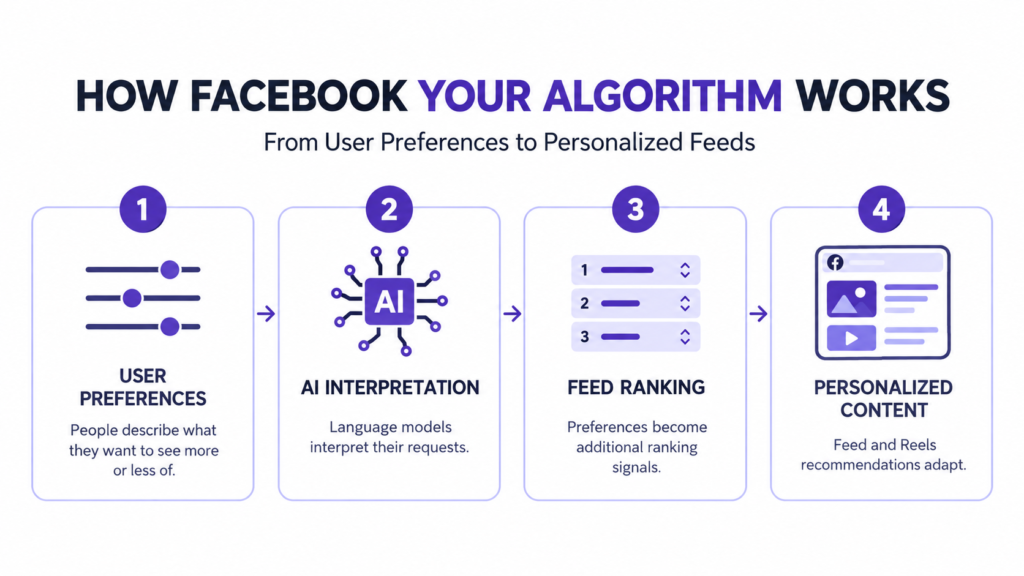
According to Meta’s own announcement, the feature gives users a dedicated space, reached through the three-dot menu on any post, “to tell us exactly what you’re into.” From there, people can add and manage topics directly.
There is a second piece. When someone taps “Interested” or “Not interested” on a post, Facebook may now follow up with a question. The person can answer in free text, describing what they want to see more or less of, instead of picking from a short list of options.
Meta says recommendations update within the same session once someone adds a preference. The company frames this as a shift from an algorithm that only watches what you do to one you can also talk to.
The three-dot menu itself got a visual refresh so these controls are easier to find on every post. That is a small interface change, but it matters because it puts the new controls in front of far more people than a settings page tucked away in the app would.
The AI Layer Behind the Feature
Meta’s existing Feed ranking already infers interests from engagement signals such as likes, comments, shares, and how long someone watches a video. According to PPC Land’s reporting on Meta’s announcement, large language models now sit in that pipeline so the system can interpret intent, tone, and context from typed requests, not just match keywords.
Meta has not published test results or explained exactly how a typed request is weighted against other signals. That is a real gap. My take is that this matters less for how the feature works today and more for how much trust marketers should put in their own guesses about why reach moves after this rolls out.
It is worth separating two things Meta has not said. One is how heavily a typed preference outweighs years of accumulated engagement history for the same person. The other is whether a single preference entry applies narrowly, to one topic, or broadly, to an entire category of content that happens to resemble it. Until Meta publishes more detail, Page owners are left inferring both from reach data alone, which is a slower and noisier way to learn the rules.
Why the Facebook Your Algorithm Feature Matters for Marketers
Here is the part that should get a Page manager’s attention. Typed preferences are an explicit signal, and they are invisible to anyone outside the person who typed them. If a chunk of an audience quietly asks Facebook for less of a certain topic, a brand’s content could lose reach with no notice in Page Insights beyond the drop itself.
That is a meaningfully different kind of signal than engagement. A low like count is visible and explainable. A typed request to see “less promotional content” or “less political news” is not something a Page admin can see or respond to directly.
Meta has not said how long a typed preference lasts. That detail matters more than it might seem. Threads’ comparable feature, “Dear Algo,” applies for 72 hours before it fades, according to coverage of that rollout. If Facebook’s version persists indefinitely instead of expiring, it could act as a standing filter on a Page’s distribution rather than a temporary adjustment.
Meta also introduced rules in 2025 that penalize reused or recycled content in the Feed. Those rules are automatic and content-based. A user-driven preference layer adds a second, personal filter on top of that, which means two Pages posting similar content could see different outcomes depending on what individual audience members have typed.
What This Means for Organic Reach
In my experience watching platform rollouts like this, the first few months after launch are the hardest to read. Reach dips that would normally get blamed on “the algorithm changing” could now be a direct result of real people asking for less of what a Page posts. That is useful information if a brand can get it, and frustrating if it cannot.
What this means for you: if you manage a Facebook Page, track reach and engagement closely over the next one to two months rather than reacting to a single week’s numbers. Isolate whether the dip is tied to specific post types, since a user-driven preference signal would likely hit certain formats or topics harder than others.
Ad Targeting: What We Still Don’t Know
Meta’s announcement, as reported by PPC Land, covers Feed and Reels recommendations only. It does not say whether the text people type into “Your Algorithm” is used anywhere in ad selection, stored for other purposes, or kept entirely separate from ad systems.
That is an important open question for anyone running Advantage+ campaigns or relying on Meta’s automated targeting. If stated preferences eventually feed into how Meta understands a user’s interests more broadly, Advantage+ targeting could get sharper over time. If the data stays walled off from ad systems, as Meta’s handling of Meta AI conversation data for sensitive topics suggests is possible, it would have no effect on targeting at all.
For teams building out always-on or lifecycle-based Meta ad programs, this is a detail worth watching rather than acting on today. Our recent look at customer lifecycle strategy for Meta Ads covers how those campaigns depend on Meta’s targeting signals, and a change like this one, if it ever extends into ad systems, would sit squarely inside that picture.
Feed and Reels are also where most ad impressions actually appear on Facebook. So even if ad selection itself does not change, a shift in which organic content a person sees could still change the environment their ads show up next to.
A Broader Industry Shift Toward User-Shaped Feeds
Facebook is not alone in moving this direction. LinkedIn rebuilt parts of its own Feed ranking earlier in 2026 around large language models, saying in its engineering blog that the update was meant to make the Feed adapt to a member’s current interests rather than leaning mainly on past engagement, according to Social Media Today’s coverage of that change. LinkedIn also said it would downrank repetitive, click-driven posts and recycled thought leadership.
That is a different mechanism than what Facebook just shipped, since LinkedIn’s change was mostly automatic rather than something a user types in by hand. But the direction is the same across platforms: ranking systems built on large language models that can interpret nuance in content and, increasingly, in direct user input, instead of relying on blunt engagement counts alone. Marketers managing a Facebook Page and a LinkedIn company page in the same week are now dealing with two different flavors of the same underlying shift.
How the Facebook Your Algorithm Feature Fits a Bigger Pattern
Facebook is not the first Meta app to get this kind of control. Instagram introduced its own “Your Algorithm” feature for Reels in December 2025, then expanded it to Feed and Explore in June 2026. Threads has run a related feature called “Dear Algo” for some time, letting people describe what they want to see less of in a conversational way.
Bringing the same idea to Facebook completes the set across Meta’s three major apps. It also lines up with a broader shift in how big platforms are approaching recommendation systems. Streaming services have offered “more like this” and “not interested” controls for years. Meta is now applying a conversational version of that same idea to social feeds, powered by the same class of language models behind chatbots and AI assistants.
There is a regulatory backdrop here too. The European Union issued a preliminary finding in July 2026 under the Digital Services Act concerning engagement-driven recommender systems. Meta has not tied this announcement to that finding or to any other regulatory requirement, but giving users more visible control over ranking is the kind of change regulators scrutinizing recommender systems tend to welcome.
What To Do Now If You Run a Facebook Page
None of this calls for an overreaction. It does call for a few concrete habits over the next few weeks.
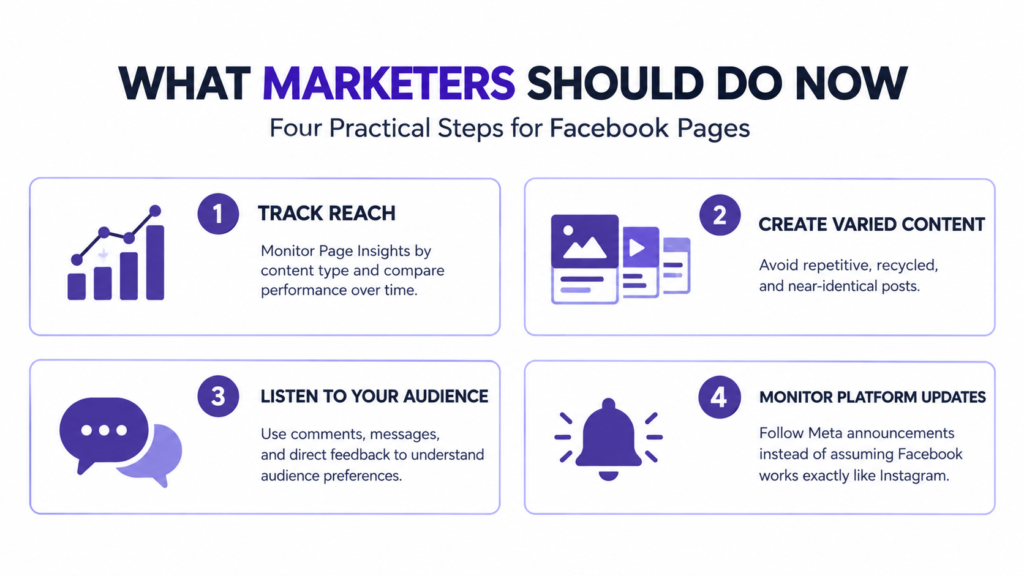
First, keep an eye on Page Insights at the content-type level, not just the Page level. If Reels reach holds steady while static image posts slide, that is a more useful signal than a single blended number.
Second, avoid leaning harder into reused or templated posts right now. Between the 2025 penalty for recycled content and a new layer where users can explicitly ask for less of something that feels repetitive, the risk of posting near-duplicate content has gone up, not down.
Third, treat comment sections and direct feedback as more valuable than usual. If people are willing to type out what they want more or less of inside Facebook’s own interface, they are very likely also willing to tell a brand directly in comments or messages. That qualitative feedback is now arguably closer to what is shaping the algorithm than it has been in years.
Fourth, do not assume this feature behaves identically to Instagram’s version just because they share a name. Instagram’s rollout took roughly six months to go from Reels-only to covering Feed and Explore. Facebook’s version could expand, or get adjusted, on a different timeline.
A Practical Note on Timing
Meta’s announcement does not include a country list, a completion date, or numbers on how many users have access so far. That means some Page admins may not see any shift at all for weeks, simply because the feature has not reached their audience yet. Patience, paired with close tracking, is the right posture here rather than a quick strategy overhaul.

FAQ: Facebook Your Algorithm Feature
When did Facebook roll out the Your Algorithm feature?
Meta announced it on October 13, 2026, through its official newsroom. The company describes the rollout as underway but has not published a completion date.
Does the Facebook Your Algorithm feature affect ad targeting?
Meta has not said so publicly. Its announcement covers Feed and Reels recommendations, not ad systems, and the company has not confirmed whether typed preferences are used for ad personalization.
Is this the same as Instagram’s Your Algorithm feature?
It shares the name and the basic idea, but Meta’s Facebook post does not reference the Instagram version directly. Instagram’s feature launched for Reels in December 2025 and expanded to Feed and Explore in June 2026, so Facebook’s rollout is following a similar pattern with its own timeline.
Will Page owners be able to see what people are typing about their content?
No. Typed preferences are private to the person who enters them. A Page admin would only see the downstream effect, such as a reach change, not the actual feedback behind it.
Should I change my Facebook content strategy right now?
Not based on this alone. Watch reach by content type over the next month or two, keep content varied rather than repetitive, and treat this as one more reason to pay attention to direct audience feedback.
Why This Matters
The Facebook Your Algorithm feature hands people a direct, typed line into how their feed is ranked, which is a genuinely new kind of signal for Page owners to account for. It will not replace engagement metrics, but it adds a layer that does not show up in any dashboard. Watch reach at the content-type level over the next couple of months, keep an eye on whether Meta says anything about how long a preference lasts, and treat this as one more argument for posting varied, non-repetitive content rather than leaning on templates.



Leave a response