

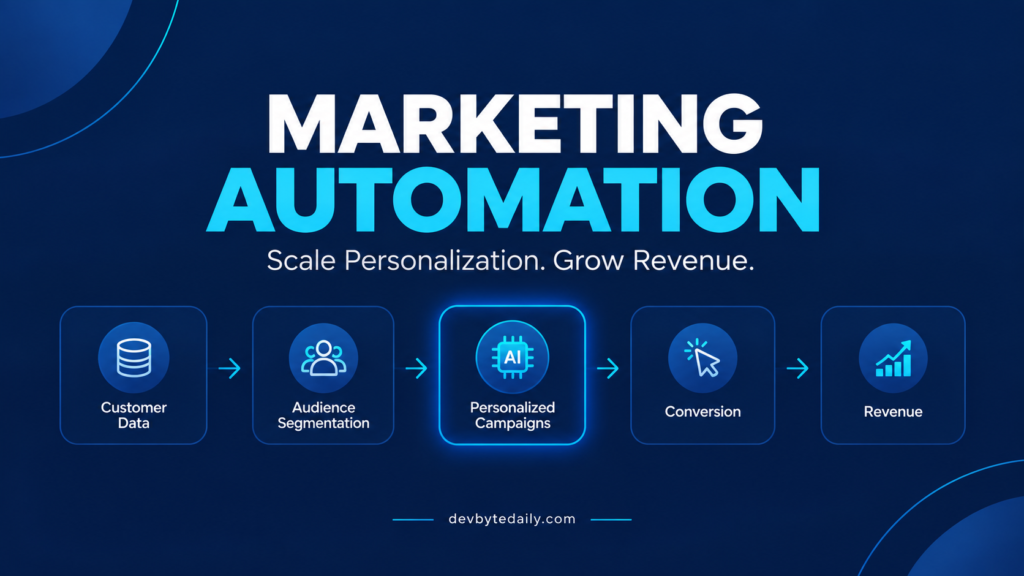
Marketing automation is no longer just about sending emails at a scheduled time. Today, businesses can use automation to understand customer behavior, personalize marketing messages, nurture leads, and move prospects through the buying journey with less manual work.
The real value of Marketing Automation comes from connecting the right data with the right action. Instead of treating every customer the same, businesses can create experiences based on what people actually do.
Whether you run an online store, SaaS business, agency, or content website, a well-planned automation strategy can save time while creating more opportunities to generate revenue.
What Is Marketing Automation?
Marketing automation is the use of software to handle repetitive marketing tasks based on customer information, actions, or predefined conditions.
For example, imagine someone visits your website and signs up for a free guide. Instead of manually following up with that person, an automated workflow can immediately send a welcome email.
If the person opens that email and later visits your pricing page, another action can be triggered. The system might send a product-focused email or notify the sales team.
This creates a connected customer journey without requiring someone to monitor every interaction.
Common Marketing Automation activities include:
- Email campaigns
- Lead nurturing
- Customer segmentation
- Lead scoring
- Welcome sequences
- Abandoned cart reminders
- Product recommendations
- Customer onboarding
- Retargeting campaigns
- Renewal and re-engagement emails
The important point is that automation should not simply make marketing faster. It should make marketing more relevant.
Why Marketing Automation Matters for Revenue Growth
Growing a business often creates a familiar problem: more customers mean more marketing work.
A small team might manage customer emails manually when the business has a few hundred contacts. But that approach becomes difficult when the database grows into thousands or millions of customers.
Marketing Automation allows businesses to create repeatable processes that continue working as the audience grows.
For example, instead of manually sending a welcome email to every new subscriber, you create the workflow once.
New subscriber → Welcome email → Educational content → Product information → Conversion opportunity
The same process can run every day.
This doesn’t mean every customer receives identical communication. Good automation uses customer data to determine which message makes sense for each person.
The Revenue Connection
Automation can influence revenue at several stages:
Attract → Engage → Nurture → Convert → Retain → Upsell
A business can use automation to move prospects through these stages while keeping communication timely and relevant.
It can also reduce the number of leads that disappear simply because nobody followed up.
That is one of the biggest reasons automation matters: consistency creates opportunities.
How AI Is Changing Marketing Automation
Traditional automation usually follows fixed rules.
For example:
If someone downloads an ebook, send Email A.
AI-powered systems can take a broader view of customer behavior.
They can analyze signals such as previous purchases, website activity, email engagement, product interests, and interactions with campaigns.
Instead of relying only on one trigger, AI can help marketers identify patterns.
For example, two customers might download the same guide. One never returns to the website. The other visits the pricing page three times and watches a product demonstration.
A basic workflow might treat them identically.
A smarter system can recognize that their intent may be different and adjust the next step accordingly.
Traditional Automation vs AI-Powered Automation
| Traditional Automation | AI-Powered Automation |
|---|---|
| Fixed rules | Data-driven decisions |
| Static segments | Dynamic segments |
| Scheduled messages | Behavior-based timing |
| Manual lead scoring | AI-assisted scoring |
| Basic reporting | Pattern analysis |
| Repetitive workflows | Adaptive workflows |
AI doesn’t remove the need for marketers.
In fact, human judgment becomes even more important. Marketers still need to define the strategy, brand voice, customer experience, and business goals.
AI simply helps them work with more data and make faster decisions.
7 Ways to Use Marketing Automation
There are countless ways to automate marketing, but businesses should start with practical use cases that solve real problems.
1. Automate Lead Nurturing
Not every person who visits your website is ready to buy.
Some visitors need more information before making a decision. Others may be comparing several products or simply researching their options.
Lead nurturing keeps the conversation going.
A simple workflow might look like:
New Lead → Welcome Email → Helpful Content → Product Education → Offer → Sales Follow-Up
The exact sequence depends on your audience, but the principle remains the same.
Give people useful information before asking them to buy.
2. Personalize Email Campaigns
Sending the same email to your entire database rarely produces the best experience.
Marketing Automation allows you to divide customers into meaningful groups.
For example:
- New subscribers
- Returning customers
- High-value customers
- Inactive subscribers
- Trial users
- Recent purchasers
- Customers interested in a specific product
Each group can receive different messages.
Personalization doesn’t always require complicated technology. Sometimes something as simple as using purchase history or content interests can make an email feel much more relevant.
3. Improve Lead Scoring
Sales teams don’t have unlimited time.
When hundreds of leads enter the funnel, sales representatives need a way to determine which prospects deserve attention first.
Lead scoring assigns value to customer actions.
For example:
- Downloading a guide → low score
- Opening several emails → moderate score
- Visiting pricing pages → higher score
- Requesting a demo → very high score
AI can make this process more flexible by identifying combinations of behaviors associated with stronger buying intent.
The result is a better connection between marketing and sales.
4. Recover Abandoned Carts
Ecommerce businesses lose potential sales when customers add products to their carts but leave before completing checkout.
Automation can bring those customers back.
A simple sequence could send:
After 1 hour: Friendly reminder
After 24 hours: Product reminder
After 48 hours: Helpful message or incentive
The timing and number of messages should depend on the business and customer behavior.
The goal isn’t to pressure people. It’s to remove friction and remind interested customers that they still have an unfinished purchase.
5. Automate Customer Onboarding
Marketing shouldn’t stop after someone becomes a customer.
The first few days after a purchase can have a major impact on the customer’s experience.
An automated onboarding sequence can explain:
- How to get started
- Where to find important features
- How to contact support
- What customers should do next
- Where to find educational resources
For SaaS companies, onboarding can guide new users from account creation to their first successful result.
That can improve engagement while reducing repetitive questions for support teams.
6. Re-Engage Inactive Customers
Some customers don’t leave because they dislike your business. They simply stop paying attention.
Automation can identify inactive users and launch a re-engagement campaign.
For example:
Inactive customer → Reminder → Useful content → Personalized offer → Final re-engagement message
If the customer responds, they can return to the normal journey.
If they remain inactive, businesses can reduce communication rather than continuing to send unwanted emails.
7. Automate Reporting and Optimization
Marketing generates huge amounts of data.
Without automation, marketers can spend hours collecting information from different platforms and putting it into reports.
Automated dashboards can bring important metrics together.
These may include:
- Leads generated
- Conversion rates
- Email engagement
- Customer acquisition cost
- Revenue
- Campaign performance
- Customer retention
AI can then help identify unusual patterns or areas that deserve attention.
The important shift is from collecting data to using data to make decisions.
Marketing Automation for Personalization
Personalization is one of the strongest reasons to invest in automation.
But personalization doesn’t mean adding someone’s first name to an email and calling it a day.
Real personalization considers context.
A customer who bought a laptop may be interested in accessories. Someone who repeatedly reads articles about a particular service may be closer to making a purchase. A trial user who hasn’t completed onboarding may need help rather than another promotional email.
Automation allows businesses to respond to these differences.
A useful personalization framework is:
Customer Data → Behavior → Intent → Personalized Action → Response
The more useful the data, the more relevant the experience can become.
However, businesses should also respect privacy and customer preferences. Collect only the information you genuinely need, explain how customer data is used, and provide appropriate communication controls.
How to Build a Marketing Automation Strategy
Buying an automation platform isn’t a strategy.
Before choosing tools, understand what you want automation to accomplish.
Step 1: Choose One Business Goal
Start with a specific outcome.
For example:
- Generate more qualified leads
- Increase ecommerce conversions
- Improve customer retention
- Reduce manual marketing work
- Increase repeat purchases
Avoid trying to automate everything at once.
Step 2: Map the Customer Journey
Write down what normally happens from the first interaction to the purchase.
For example:
Visitor → Lead → Engaged Lead → Customer → Repeat Customer
Then identify where people usually drop out.
Those points often reveal the best opportunities for automation.
Step 3: Find Repetitive Tasks
Look for activities your team performs repeatedly.
Good candidates include:
- Welcome emails
- Follow-ups
- Lead notifications
- Customer onboarding
- Abandoned cart reminders
- Renewal reminders
- Re-engagement campaigns
If a task happens frequently and follows a predictable pattern, it may be a strong candidate for automation.
Step 4: Connect Your Data
Your automation becomes more useful when important customer information can move between systems.
Depending on your business, that could include:
Website + CRM + Email Platform + Ecommerce + Analytics + Advertising
Keep your data clean and consistent. A sophisticated workflow cannot fix inaccurate customer information.
Step 5: Test Before Scaling
Launch a small workflow first.
Watch what happens.
Check whether customers receive the correct messages, whether triggers work properly, and whether the workflow produces the expected business result.
Then improve it.
Once the process works, expand automation to other parts of the customer journey.
Common Marketing Automation Mistakes
Automation can create problems when businesses focus more on technology than customer experience.
Automating Too Much
Just because something can be automated doesn’t mean it should be.
Some conversations require empathy, creativity, or human judgment.
Keep those interactions human.
Sending Too Many Messages
A customer shouldn’t receive five emails simply because five different workflows triggered at the same time.
Create communication rules and frequency limits to prevent this.
Using Poor Data
Bad data leads to bad personalization.
If customer information is outdated, incomplete, or duplicated, your automated campaigns can quickly become irrelevant.
Regularly review your database and integrations.
Forgetting the Human Voice
Automation should not make your brand sound robotic.
Write messages the way a real person would communicate. Keep them clear, useful, and appropriate for the situation.
Measuring Only Engagement
High email opens don’t automatically mean high revenue.
Look beyond clicks and opens.
Ask whether automation generated better leads, more conversions, higher customer value, or stronger retention.
How to Measure Marketing Automation Success
The right metrics depend on your goals.
If your objective is lead generation, focus on qualified leads and conversion rates.
If your objective is ecommerce growth, focus on purchases, revenue, repeat orders, and customer lifetime value.
Some useful metrics include:
| Metric | Why It Matters |
|---|---|
| Conversion Rate | Shows how effectively prospects become customers |
| Qualified Leads | Measures lead quality |
| Customer Acquisition Cost | Shows the cost of acquiring customers |
| Revenue per Campaign | Connects campaigns with financial results |
| Customer Lifetime Value | Shows long-term customer value |
| Retention Rate | Measures customer loyalty |
| Workflow Conversion Rate | Shows whether automation works |
The best measurement framework connects automation activity to actual business outcomes.
A workflow that saves ten hours but doesn’t improve customer experience or business performance may need to be redesigned.
Frequently Asked Questions
What is Marketing Automation?
Marketing Automation uses software to automatically perform repetitive marketing tasks based on customer behavior, data, or predefined triggers. Common examples include email campaigns, lead nurturing, segmentation, onboarding, and follow-ups.
How does Marketing Automation increase revenue?
It can increase revenue by improving lead follow-up, nurturing prospects, personalizing customer journeys, recovering abandoned purchases, encouraging repeat sales, and helping marketing teams focus on high-value opportunities.
Is Marketing Automation useful for small businesses?
Yes. Small businesses can start with simple workflows such as welcome emails, lead follow-ups, appointment reminders, or customer onboarding.
The key is to automate processes that save time and support a measurable business goal.
Does AI replace marketers?
No. AI can analyze data and support automated decisions, but marketers still need to define strategy, messaging, positioning, creativity, and customer experience.
What should I automate first?
Start with a repetitive process that has a clear business impact. Welcome sequences, lead nurturing, abandoned-cart reminders, customer onboarding, and re-engagement campaigns are good starting points.
Is Marketing Automation expensive?
Costs vary depending on the platform, number of contacts, features, and business requirements. Businesses should evaluate the expected return rather than choosing a tool based only on price.



Leave a response