
Google Ads has never been completely manual. Behind the scenes, machine learning has been helping with bidding, targeting, and ad delivery for years. But today’s AI tools are taking that automation much further.
AI for Google Ads can help advertisers find better opportunities, adjust bids, match ads with relevant searches, test creative variations, and understand campaign performance at a scale that would be difficult to manage manually.
That doesn’t mean marketers can switch everything to automatic and forget about it. The best results still come from combining Google’s automation with good strategy, accurate conversion data, strong creative, and relevant landing pages.
So, what can AI actually do for your Google Ads campaigns—and how should you use it without giving up control?
Let’s break it down.
What Is AI for Google Ads?
In simple terms, AI for Google Ads means using Google’s machine-learning and generative-AI systems to automate and improve different parts of an advertising campaign.
Traditionally, advertisers spent a lot of time deciding which keywords to target, how much to bid, which audiences to reach, and which ad variations to show.
AI changes that process.
Rather than manually making every decision, advertisers provide Google’s systems with information about their goals, customers, conversions, products, and website. Google’s algorithms can then use those signals to make predictions and optimize campaigns in real time.
For example, AI can help determine:
- Which users are more likely to convert
- How much to bid for a particular auction
- Which search queries are relevant
- Which ad assets should be combined
- Which landing page may better match a search
- Where additional conversion opportunities may exist
Google’s Performance Max campaigns use AI across bidding, targeting, creative optimization, and budget allocation. Google has also introduced AI Max for Search campaigns, which adds AI-powered features to existing Search campaigns.
The important distinction is this:
AI handles more of the execution, while marketers remain responsible for the strategy.
How AI Is Changing Google Ads
The biggest change isn’t simply that Google Ads now uses more automation.
It’s that advertisers no longer need to predict every possible path a customer might take.
Think about traditional keyword targeting.
A marketer might create a list of hundreds of keywords and manually organize them into tightly themed ad groups. That’s still useful in many situations, but AI-powered systems can now look beyond a fixed keyword list and evaluate broader signals around search intent and conversion likelihood.
The same idea applies to bidding.
Instead of manually changing bids throughout the day, automated bidding systems can evaluate auction-time signals and adjust bids according to the campaign’s selected goal.
This creates a different role for the advertiser.
You spend less time making tiny bid adjustments and more time asking bigger questions:
Are we attracting the right customers?
Are those customers actually converting?
Is the campaign profitable?
Does the landing page deliver what the ad promised?
Those questions matter more than ever.
7 Practical Ways to Use AI for Google Ads
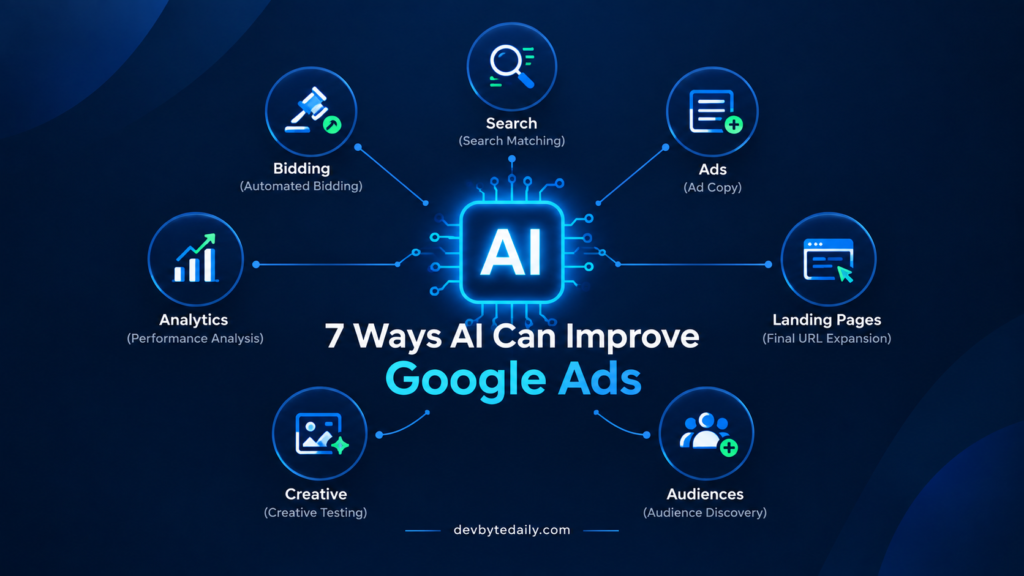
1. Automate Bidding Decisions
One of the most useful applications of AI is automated bidding.
Google’s Smart Bidding systems use machine learning to adjust bids based on the likelihood of a conversion or conversion value.
Depending on the campaign, advertisers can choose strategies such as:
- Maximize Conversions
- Maximize Conversion Value
- Target CPA
- Target ROAS
Instead of setting individual bids manually, you give Google a goal and allow the system to make auction-level decisions.
That can save a huge amount of time, especially for accounts with significant traffic and conversion volume.
But there’s a catch.
AI is only as good as the conversion signals it receives.
If your account counts low-value actions as conversions, Google may optimize toward those actions rather than the results you actually care about.
Before relying heavily on automated bidding, make sure your conversion tracking is accurate.
2. Find More Relevant Search Opportunities
Keyword research has traditionally required advertisers to anticipate what potential customers might type into Google.
AI can make that process more flexible.
Google’s AI Max for Search campaigns include AI-powered search-term matching designed to help advertisers reach relevant searches beyond traditional keyword targeting.
This can be particularly useful when customers use unexpected wording or when there are many different ways to express the same intent.
For example, someone looking for accounting software might search for:
- Small business accounting software
- Online bookkeeping tools
- Software for managing business finances
- Best accounting platform for startups
A rigid keyword strategy could miss some of these variations.
AI can help identify relationships between searches and your campaign’s broader intent.
Still, broader reach doesn’t mean you should stop monitoring search terms. Regular reviews remain important for finding irrelevant traffic and adding appropriate exclusions.
3. Create More Ad Variations
Writing multiple headlines and descriptions for every campaign can become repetitive.
Generative AI can help speed up that process.
Google’s advertising tools can generate additional text assets using information from your existing ads, keywords, landing pages, and website.
For marketers, this creates more room for testing.
You might provide different messaging angles around:
- Price
- Features
- Benefits
- Convenience
- Trust
- Speed
- Customer results
AI can then help create variations that fit those themes.
However, don’t publish every AI-generated suggestion without reviewing it.
Your ads still need to sound like your brand.
Check every generated asset for accuracy, unnecessary claims, awkward wording, and outdated information.
AI should make your creative process faster, not make your brand sound generic.
4. Match Users With More Relevant Landing Pages
Getting someone to click your ad is only the beginning.
What happens after the click often determines whether that traffic becomes a lead or customer.
This is where landing-page relevance becomes important.
Google’s AI Max includes Final URL expansion, which can help direct users to a more relevant page on a website when Google’s system predicts that another page may better match the user’s search.
Imagine an agency offers:
- SEO services
- Technical SEO
- Local SEO
- Ecommerce SEO
A user searching specifically for ecommerce SEO may have a better experience landing directly on the ecommerce SEO page rather than the agency’s general services page.
AI can help make that connection.
But your website still needs a logical structure.
If your pages are thin, confusing, or poorly organized, automation won’t magically fix the underlying problem.
5. Discover Potential Customers
AI can analyze large amounts of user and campaign data to identify patterns associated with conversions.
Performance Max, for example, uses machine learning to help find potential customers across Google’s advertising inventory.
Advertisers can also provide audience signals that help Google’s systems understand the types of customers they want to reach.
Useful signals can include:
- Existing customer lists
- Website visitors
- Previous purchasers
- High-value customer segments
- Relevant interests
- Search themes
These signals should guide the system rather than be treated as a complete description of every person you want to reach.
The more useful context you provide, the better equipped the system is to understand your business.
6. Test Creative at Scale
Creative testing used to mean manually creating several ads, running them, comparing results, and repeating the process.
AI can make this much easier.
Performance Max can combine different advertiser-provided assets and use Google’s systems to determine which combinations are more likely to perform well across different placements.
This makes the quality and variety of your assets increasingly important.
Instead of uploading several nearly identical headlines, think about different customer motivations.
For example:
Headline angle 1: Save Time
Headline angle 2: Reduce Costs
Headline angle 3: Improve Results
Headline angle 4: Get Expert Support
Now AI has meaningful variations to work with.
The goal isn’t simply to create more content.
It’s to give the system better choices.
7. Understand Campaign Performance Faster
AI isn’t only useful for running campaigns.
It can also make campaign analysis easier.
Google continues to add AI-powered tools that help advertisers identify trends, troubleshoot issues, and understand account performance.
For example, Google’s Ask Advisor provides a conversational way to explore account information and receive recommendations within Google Ads.
This can help reduce the time spent digging through large amounts of campaign data.
But there’s an important distinction.
AI can identify patterns.
You still need to decide whether those patterns matter.
A campaign might generate more conversions while producing less revenue. Another campaign might have a higher CPA but attract customers with much higher lifetime value.
Numbers need business context.
That is where experienced marketers still have an important advantage.
AI Max vs. Performance Max
The names can be confusing, but these products serve different purposes.
| Feature | AI Max | Performance Max |
|---|---|---|
| Main focus | Search campaigns | Multiple Google channels |
| Search | Yes | Yes |
| YouTube | No | Yes |
| Display | No | Yes |
| Discover | No | Yes |
| Gmail | No | Yes |
| Maps | No | Yes |
| AI bidding | Yes | Yes |
| Creative optimization | Yes | Yes |
AI Max is designed to enhance Search campaigns, while Performance Max is built to optimize across Google’s wider advertising inventory.
So the choice isn’t really about deciding which AI product is “better.”
It depends on what you’re trying to accomplish.
Best Practices for AI-Powered Google Ads
AI works best when you give it good inputs.
Start With Accurate Conversion Data
Before increasing automation, make sure Google understands what a valuable conversion actually looks like.
Give AI a Clear Goal
Don’t optimize simply for traffic if your real objective is revenue or qualified leads.
Build Better Creative
Give AI different messaging angles rather than dozens of minor variations.
Keep Your Website Organized
Relevant pages and clear site structure make automated landing-page decisions more useful.
Monitor Performance Regularly
Automation doesn’t eliminate campaign management. It changes what campaign management looks like.
Test Before Scaling
When introducing major AI features, use experiments where appropriate rather than changing everything at once.
Common AI Google Ads Mistakes
AI can be powerful, but it isn’t a substitute for good marketing.
Here are some mistakes worth avoiding.
Mistake 1: Trusting Automation Blindly
Automation still needs oversight.
Review campaign performance, search terms, assets, and conversion quality regularly.
Mistake 2: Using Poor Conversion Signals
If Google receives bad data, it can make bad optimization decisions.
Mistake 3: Giving AI Weak Creative
AI cannot turn poor messaging into a strong brand strategy.
Mistake 4: Ignoring Landing Pages
More clicks won’t help if visitors leave your website immediately.
Mistake 5: Focusing Only on CPA
A cheap conversion isn’t necessarily a valuable conversion.
Look at revenue, lead quality, profit, and customer value where possible.
Frequently Asked Questions
What is AI for Google Ads?
AI for Google Ads refers to Google’s machine-learning and generative-AI features that automate tasks such as bidding, search matching, targeting, creative optimization, and campaign analysis.
Does AI replace Google Ads managers?
No. AI can automate many repetitive tasks, but marketers still need to define business goals, monitor performance, manage creative strategy, and evaluate the quality of conversions.
What is AI Max in Google Ads?
AI Max is a set of AI-powered features for Search campaigns. It can help expand search-term matching and optimize text assets and landing-page selection.
Is Performance Max powered by AI?
Yes. Performance Max uses Google’s AI across bidding, targeting, creative optimization, and other campaign decisions across Google’s advertising inventory.
Can AI write Google Ads?
Yes. Google’s generative features can create additional text assets based on information from your ads, keywords, landing pages, and website. Advertisers should review generated content before using it.
Is AI useful for small Google Ads accounts?
It can be, but advertisers should first focus on accurate conversion tracking, clear goals, strong landing pages, and sufficient campaign data.


Leave a response