
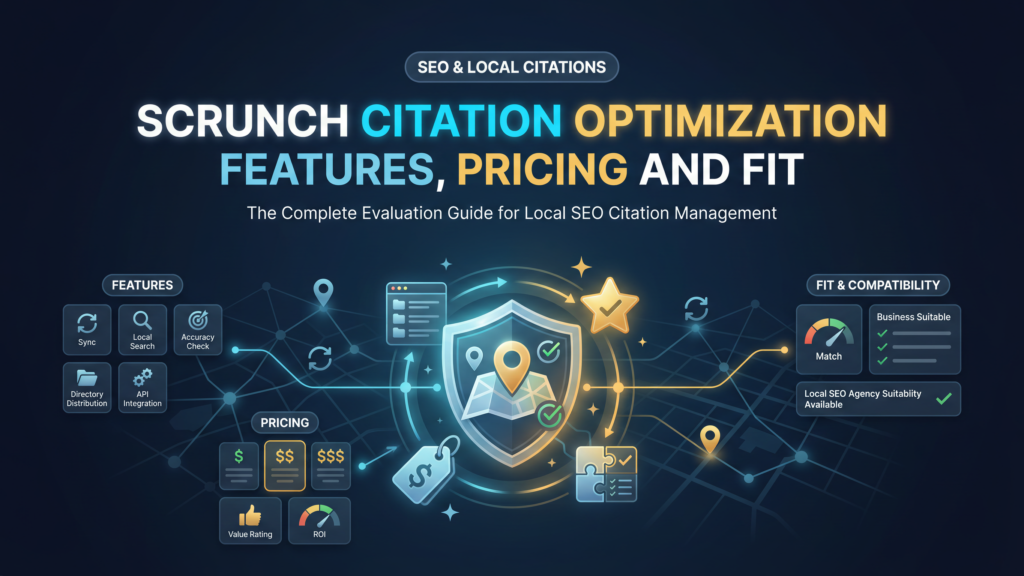
AI chatbots now answer plenty of commercial questions without sending anyone to a search results page. That shift has created a new problem for marketers: you can rank well in Google and still have no idea which websites an AI assistant is quoting when it recommends your competitor instead of you. Scrunch Citation Optimization, launched on November 12, 2026, is built to answer exactly that question. It is a genuinely new feature, not a rebrand of an existing product, and it comes from Scrunch, the AI-visibility company that Sitecore acquired earlier in 2026. The short verdict: it is a useful, narrow tool for brands that already track AI citations, but it is not a general-purpose SEO platform, and it is priced and built for teams that can act on what it finds.
What Scrunch Citation Optimization Actually Does
Scrunch already tracks how often a brand’s prompts get answered by tools like ChatGPT, Perplexity, Gemini, Google AI Overviews, Google AI Mode, and Microsoft Copilot. Citation Optimization adds a layer on top of that tracking. For every prompt a brand monitors, it pulls out the third-party pages, publishers, review sites, forums, comparison pages, anything an AI model cited when building its answer, and ranks them.
The ranking uses what Scrunch calls an Influence Score. It multiplies the share of AI responses that cite a given source by the number of unique prompts that source shows up in. A page that gets cited often, across many different questions, scores higher than one that appears once in a narrow answer. The idea is to separate sources that are genuinely shaping AI recommendations from ones that just happen to show up occasionally.
From there, the tool shows three things side by side: sources that already mention your brand, sources where a competitor is cited instead of you, and sources that mention neither but carry enough influence to be worth a pitch. Scrunch then drafts outreach based on the source, the specific opportunity it represents, and information the brand has pre-approved. The company says it is working on integrations with Noble, Stacker, and Getfluence to automate more of the actual outreach and placement work, though those integrations were still described as in development at launch.
In plain terms: instead of telling you that you have an AI visibility problem, it tries to tell you which ten web pages would move the needle if you could get mentioned on them, and it gives you a starting point for the pitch.
Imposter Detection: The Companion Feature
Citation Optimization launched alongside a second, smaller feature called Imposter Detection. It flags sites that AI assistants are citing as if they were a brand’s official source, when they are not. Scrunch’s own research, published as the Scrunch Imposter Study, found that 17% of Fortune 500 companies had an impostor website cited in AI answers across the same six platforms the main product tracks. In three out of four of those cases, the AI presented the impostor site as the brand’s own. Scrunch estimates that AI assistants serve more than a million answers a year that cite sites impersonating real brands.
That is a believable number given how AI answer engines work. They often summarize whatever ranks or reads as authoritative on a topic, with less friction than a human clicking through a search result and noticing a site looks off. Imposter Detection does not remove the impostor site itself. It surfaces the suspected page and gives the brand steps to start a takedown request, which still has to be pursued through the usual channels, hosting providers, trademark complaints, or the AI platform’s own reporting process.
How Scrunch Citation Optimization Fits Into Sitecore’s Bigger Push
This launch did not happen in isolation. Sitecore announced MarketingIQ the day before, at the same Sitecore Symposium event in Orlando, and Citation Optimization’s data is designed to feed directly into it. MarketingIQ is positioned as the layer that connects brand knowledge and AI search insight to actual content and campaign execution across the SitecoreAI suite. Sitecore CEO Eric Stine drew a clear line between the two products when he said MarketingIQ is free, but Scrunch is not. That distinction matters for budgeting: you do not get Citation Optimization simply by being a Sitecore customer.
Sitecore also leaned on its own research to justify the investment. Its “The New Shape of Search” report found that more than 40% of AI sessions involved neither a prior open-web search nor a follow-up click out to the open web, compared with 21.5% of traditional search sessions that stayed entirely self-contained. If that holds up across more data, it means a growing share of brand discovery happens inside the AI answer itself, with no referral traffic at all, which is the exact gap Citation Optimization is trying to close by working the sources instead of waiting for clicks.
Scrunch Citation Optimization Pricing: What You Actually Get
Scrunch sells two tiers, Core and Enterprise, and Citation Optimization is layered on top rather than being a separate product line with its own published price.
Core runs $250 a month on monthly billing with a 7-day free trial. It covers one brand, five seats, five sub-brands, five competitors and their sub-brands, three AI search trend topics, and one AI agent traffic domain. Usage caps are 15,000 AI responses tracked per month, 10 citation targets per month, 10 pages optimized, 10 pages generated per month, and 100 fact-checked pages per month. It covers eight AI platforms: ChatGPT, Perplexity, Gemini, Google AI Overviews, Google AI Mode, Microsoft Copilot, Grok, and Meta AI. Claude is not included at this tier. Support is email and self-serve onboarding only.
Enterprise is custom-priced and billed yearly. Nearly every Core limit becomes unlimited or custom, including citation targets, competitors, brands, seats, and sub-brands, and Claude becomes available as an add-on. Enterprise also adds API access, Data Studio, SAML and OIDC single sign-on, security review and custom contract terms, a dedicated customer success manager, strategy calls, and executive reporting.
What none of the public pricing pages state is a specific dollar figure for Citation Optimization itself. Based on how Scrunch structures its plans, and Stine’s comment that the feature is not free, the realistic assumption is that it ships as part of the existing Core and Enterprise tiers rather than as an extra line item, though a buyer should confirm that directly with sales before assuming it is included at no additional cost.
Who Scrunch Citation Optimization Is For
This tool makes the most sense for a specific kind of team. If you already pay for Scrunch, or you are an enterprise brand evaluating AI visibility platforms and have a PR or content team that can actually act on outreach recommendations, Citation Optimization closes a real gap. It is also a reasonable fit for agencies managing AI visibility for several clients at once, since the Influence Score gives a defensible way to prioritize which of dozens of possible outreach targets to chase first instead of guessing.
It is also worth a look for brands in categories where impersonation is a live risk, financial services, health and wellness, and anything selling physical products with counterfeit exposure. The Imposter Detection stats suggest this is not a theoretical problem for large companies, and a tool that flags it automatically beats finding out from a customer complaint.
Who It Isn’t For
Citation Optimization is not a fit for a solo marketer or small business running one website, for a few reasons. The Core plan’s 10 citation targets a month is a small allowance once you are tracking more than a handful of prompts, and $250 a month is a real line item for a team that is not already budgeting for AI visibility monitoring separately from its SEO tools. It also assumes you have somewhere to send the outreach the tool drafts, a PR function, a partnerships person, or at minimum someone with time to pitch publishers and review sites one at a time. Without that, the output is a prioritized list with nobody to act on it.
It is also not a replacement for the brand monitoring most marketing teams already run through Ahrefs or Semrush. Our comparison of Ahrefs and Semrush’s AI brand monitoring updates covers tools built to tell you how often and how favorably you are mentioned across AI platforms. Scrunch’s Citation Optimization does something narrower and more operational: it tells you which specific third-party pages to pitch next, and helps draft the pitch. The two approaches overlap on detection but diverge on what happens after you see the data, so a team using both is not duplicating effort so much as splitting monitoring from action.
Scrunch also does not promise to get you cited. It ranks opportunities and helps you start outreach. Whether a publisher or reviewer actually updates their page, links back to you, or mentions you more favorably is still down to the pitch landing and the relationship behind it, the same as always with digital PR.
Getting Started: What To Check Before You Buy
Before signing up, confirm three things directly with Scrunch’s sales team rather than assuming them from the pricing page. First, ask whether Citation Optimization and Imposter Detection are included in Core today or gated to Enterprise, since the public pricing page does not spell that out and the company’s own messaging suggests the feature carries added cost. Second, check the real per-prompt cost once you add the brands, competitors, and sub-brands you actually need to track, since Core’s caps on seats, competitors, and citation targets are tight enough that most mid-size brands will land closer to a custom quote than the listed $250. Third, ask who on your team will receive and act on the outreach drafts the tool produces, because a subscription without an owner for that workflow will sit unused.
If you are earlier in evaluating AI search visibility generally, start by reading Scrunch’s own pricing and plan details directly, since third-party coverage of the November 12 launch did not include a line-item price for the new features.
| Strengths | Real limits |
|---|---|
| Influence Score gives a concrete, ranked list instead of a vague “improve AI visibility” recommendation | No published price specific to Citation Optimization; Core’s $250/month base does not clearly include it |
| Imposter Detection catches a documented, measurable problem (17% of Fortune 500 brands affected) | Core plan caps out at 10 citation targets and 10 optimized pages a month, thin for anything beyond a single brand |
| Drafts outreach pitches instead of leaving you to write cold emails from scratch | Outreach still has to be sent and followed up on by a real person; the tool does not close the loop |
| Covers 8 major AI platforms at Core tier, with Claude available as an Enterprise add-on | Claude coverage is not included until Enterprise, a gap for teams that care specifically about Claude citations |
| Feeds directly into Sitecore MarketingIQ for brands already on Sitecore AI | Most value is available only if you also adopt the wider Sitecore/Scrunch stack |
Table: Scrunch Citation Optimization’s main strengths weighed against its real limits, based on Scrunch’s published pricing and the November 12, 2026 launch coverage.
Is It Worth Adding To Your Stack
Scrunch Citation Optimization earns its place if you are already serious about AI search visibility and you have the people to act on what it surfaces. The Influence Score is a genuinely useful way to cut through a long list of possible citation sources, and Imposter Detection addresses a specific, documented risk rather than a hypothetical one. Those are real strengths, not marketing claims.
But it is not a tool to adopt casually. The public pricing, $250 a month at Core with tight usage caps, or a custom Enterprise quote, sits on top of whatever you already pay for SEO and brand monitoring tools, and the feature’s own launch messaging suggests it is priced separately again on top of that. If your team cannot staff the outreach the tool recommends, you are paying for a prioritized list and nothing more. My take is that this fits mid-size and enterprise brands with an existing digital PR or partnerships function more than it fits a lean marketing team still building its first AI search strategy. Start by asking Scrunch for a line-item quote on Citation Optimization specifically, and confirm Claude coverage before you commit, since that gap stood out as the clearest limit in what the company has published so far.


Leave a response