

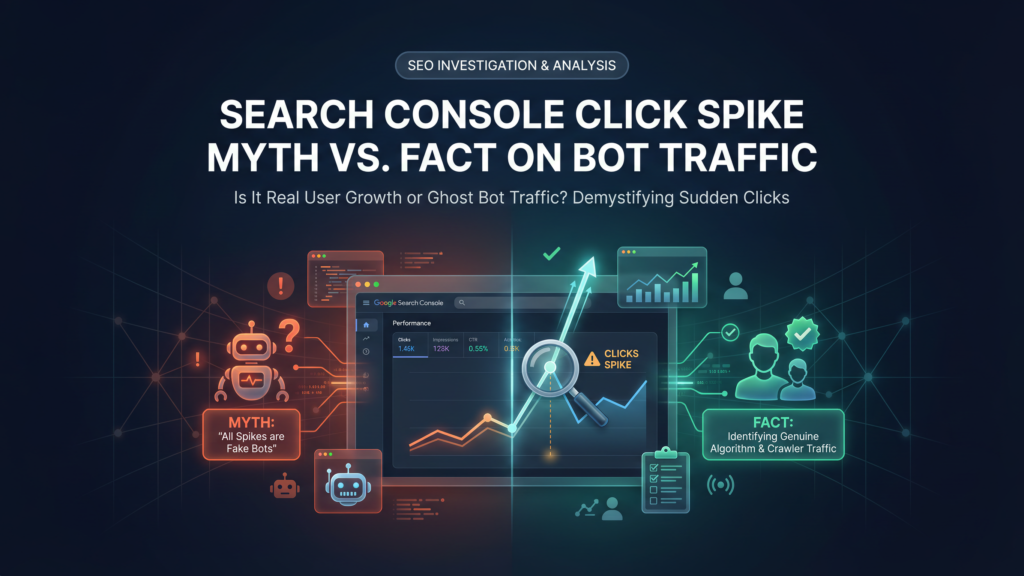
Search Console is the one analytics tool most SEOs trust without a second thought. In early November 2026, that trust took a hit. The myth going around is simple: a Search Console click spike always means more real people found your site in Google Search. The fact, confirmed by the SEOs who first spotted the pattern, is that a chunk of those clicks came from bots, and Google has never claimed to filter every one of them out.
This is not a theoretical debate. Between October 31 and November 2, 2026, several unrelated sites saw their Search Console clicks jump by two to six and a half times their normal baseline, while impressions and average position barely moved. Anyone reporting on that data without checking it closely would have told a client their rankings had improved. They would have been wrong.
The Myth: Every Click in Search Console Is a Real Visitor
The assumption behind this myth is reasonable on the surface. Search Console pulls its numbers directly from Google’s own search logs, not from a third-party script that can be blocked or misfire. Site owners treat a clicks graph the way they treat a bank statement: a plain record of what happened, with no reason to doubt it.
That assumption has a gap. Search Console counts a click whenever Google’s systems register someone or something following a search result link to your page. It does not promise that every one of those somethings is a human being with intent to read your content.
Most of the time, this gap is small enough to ignore. Rank checking tools, SEO browser extensions, and research bots generate a steady trickle of non-human activity that Google has always tried to screen out. The myth only becomes a real problem when that trickle turns into a wave, which is exactly what happened in the first days of November.
What Actually Happened to Search Console Clicks in November 2026
Search Engine Land first flagged the pattern, and Barry Schwartz wrote it up at Search Engine Roundtable on November 3, 2026. Local SEO consultant Joy Hawkins posted a clicks chart showing a sharp vertical jump with flat impressions, and said the click-through-rate pattern made her “fairly confident it’s bot traffic.” Glenn Gabe confirmed he saw it on a few properties, though most of his client sites showed nothing unusual.
Two days later, Marie Haynes published a detailed breakdown at Search Engine Journal on November 5, 2026, after running her own monitoring system across the sites she tracks. The numbers she published are worth sitting with, because they show exactly how a Search Console click spike can look like growth while being something else entirely.
One multi-location service business averaged roughly 50 clicks a day. On November 2, it logged 327, a 6.5x jump, with desktop clicks alone spiking 14.1 times over baseline. Ninety-one percent of those extra clicks landed on desktop, spread across 120 different city and service pages that had shown zero clicks all week. A second regional service site went from about 16 clicks a day to 66, a 4.1x jump concentrated the same way. A technical question-and-answer site saw its Canadian traffic jump from roughly 11 clicks a day to 75, entirely from 23 reworded variations of a single question, while its US traffic stayed flat.
The click-through rates attached to these spikes were the real tell. One page on the first site logged 9 clicks on 13 impressions, a 69.2 percent CTR at an average position of 15.5. Another logged 5 clicks on 11 impressions for a 45.5 percent CTR at position 53.8. Real searchers do not click a result sitting on page two at anywhere close to that rate. Automated activity does.
Why the Click Numbers Didn’t Match Reality
Haynes’s analysis points at a structural reason this is easy to miss. On a site pulling 18,000 daily impressions, an extra 275 automated impressions is only a 1.5 percent bump, invisible on an impressions chart. But layer those same automated requests onto a 50-click baseline, and the click count more than doubles. The spike shows up loudest exactly where a site has the least existing traffic to dilute it.
The article lists several working theories rather than a confirmed single cause: scraper tools and headless browsers clicking through results on pages two through six, CTR manipulation networks warming up browser profiles by clicking decoy results, AI research agents opening candidate URLs while answering a user’s question, or a temporary gap in Google’s own bot-click filtering. None of those theories have been confirmed by Google, and the uncertainty is part of the story, not a flaw in the reporting.
What is confirmed is the shape of the data. The spike concentrated in positions roughly 11 through 55, the range where a result is just far enough down the page that a real searcher almost never scrolls to it but a script checking every URL on a results page would still fetch it. It hit specific countries and devices unevenly rather than lifting a site’s traffic evenly. And it reversed within days, which matters more than almost anything else in this story.
The Fact: Google Has Never Promised to Filter Out Every Bot Click
This is where the myth runs into Google’s own long-standing position. Back on April 21, 2020, John Mueller addressed the same underlying question directly on social media, when asked whether Google filters out rank-tracker requests from Search Console data. His answer: “We do filter out a ton of these, but I imagine you’ll always end up with some of the requests in your stats.”
Read that sentence carefully. It is not a promise of clean data. It is an admission that Google catches most automated traffic and lets some through, by design or by limitation, and that site owners should expect it. The Search Console Performance report documentation describes what the report measures but stops short of guaranteeing that every logged click reflects an actual human visit.
As of this writing, Google has not issued a public statement specifically addressing the November 2026 spike. Schwartz said he reached out to Google for comment and had not received a response by the time his article published. That silence is normal. Google rarely comments on individual anomaly reports, and it does not need to, because the data told its own story within days.
By November 4, Hawkins reported her numbers were “back to normal.” Gabe said the same. No site owner changed a page, fixed a technical issue, or did anything differently between October 31 and November 4. The clicks simply arrived, inflated reports for roughly three days, and left. That pattern, appearing and disappearing with zero corresponding change on the site’s end, is close to the cleanest evidence available that the cause was external and automated rather than a real shift in search visibility.
How to Spot a Search Console Click Spike That Isn’t Real Traffic
You do not need Haynes’s custom monitoring system to catch this yourself. A few checks inside the standard Search Console interface cover most of what matters.
Start with the relationship between clicks and impressions. Real traffic growth usually drags both numbers up together, even if not in perfect proportion. A clicks line that spikes while impressions stay flat is the single biggest warning sign, and it is visible on the default Performance report chart without any extra setup.
Next, check average position against CTR. Open the Pages tab, turn on the Average CTR and Average Position columns, and sort by clicks. A page holding position 15 or lower with a CTR above 10 percent deserves a second look, since that combination almost never happens with real searcher behavior at scale.
Then look at concentration. Filter by country and by device, one at a time, using the top-bar filters. If a spike traces back almost entirely to one country, one device type, or a narrow set of pages that normally get little or no traffic, that concentration is itself a signal, because real organic growth is rarely that lopsided.
Finally, cross-check against a second data source. Compare the suspicious Search Console window against real user sessions in GA4 or your server logs for the same dates. If Search Console shows triple the clicks but your actual site analytics show nothing unusual, you have your answer. This is the same instinct behind treating any single data source with some skepticism, which is also why DevByteDaily’s breakdown of poisoned SERP data in rank tracking tools is worth reading alongside this one. Both stories are examples of automated traffic quietly distorting a number that SEOs are used to trusting at face value.
Search Console has had more than one data integrity wrinkle this year. DevByteDaily’s earlier look at a Search Console reporting delay covered a separate issue where the data itself lagged behind schedule rather than being inflated. Different cause, same lesson: treat a sudden change in Search Console as a prompt to investigate, not a number to repeat in a report without a second look.
What This Means for How You Report on Search Console Data
None of this means Search Console is broken or untrustworthy as a tool. It remains the only source that shows exactly how Google logs your site’s impressions, clicks, and average position, and nothing else gives you that view. The myth being busted here is narrower: that every number inside it is automatically a faithful record of human behavior, with no exceptions and no noise.
Marie Haynes’s recommendation is the right instinct for anyone managing client reporting. Annotate the early November 2026 window in your own tracking so that a future comparison does not get skewed by a spike nobody can explain yet. Do not rewrite a page, change a technical setting, or claim credit for a jump that arrived and left without any corresponding action on your end.
The broader habit worth building is treating any sudden, unexplained swing in a single metric as a question before it becomes an answer. A click spike with flat impressions is unusual enough to investigate. A click spike with flat impressions, concentrated on pages that normally get no traffic, at CTRs no real searcher produces, is close to a textbook case of automated noise. Learning to spot that pattern quickly is a more durable skill than memorizing this one incident.
What To Watch Next
Watch for whether Google eventually comments publicly on the cause of the November spike, since an official explanation would clarify whether this was external bot activity, a filtering gap, or something else entirely. Watch your own Search Console data in the days around any future reported anomaly, using the position and device filters covered above, rather than waiting for a write-up to tell you whether you were affected.
Keep an eye on the position 11 to 55 range specifically. That is where this spike concentrated, and it is also the range most SEOs check least often, since it sits below what most dashboards treat as “ranking well” but still shows up in the data. Finally, watch whether similar spikes recur around other known Search Console events this year, including the separate AI report logging errors the product has seen in August and November. A pattern of recurring data anomalies, even unrelated ones, is itself useful information about how closely to double-check any single report before acting on it.
Myth vs. Fact: Search Console Click Spikes
| Myth | Fact |
|---|---|
| A rising click count in Search Console always means more real visitors found your site. | Google has said since 2020 that it filters out “a ton” of automated requests, not all of them, so some clicks in your stats are never from real searchers. |
| The November 2026 click spike proved affected sites were ranking better in Google Search. | Impressions and average position stayed essentially flat on the affected sites. Only clicks jumped, which points to automated activity rather than a visibility gain. |
| A high CTR on a page ranking at position 15 or lower reflects genuine searcher interest. | Real searchers rarely click a result that far down a results page at a high rate. A CTR above 10 percent at a low position is a red flag for automated clicking. |
| Fixing an unexplained Search Console click spike requires a content or technical change. | The November spike reversed on its own within about three days, with zero site changes made, confirming it was traffic noise rather than a real problem to fix. |
| Search Console numbers can always be reported to a client at face value. | Experienced SEOs cross-check a sudden Search Console swing against GA4 real-user sessions or server logs before repeating the number in a report. |
Frequently Asked Questions
Did Google confirm the November 2026 Search Console click spike was caused by bots? No. Google has not issued a public statement naming the exact cause. Barry Schwartz said he contacted Google for comment and had not heard back by publication. The bot-traffic explanation comes from the click-through-rate patterns and the fact that the spike reversed without any site changes, not from an official Google confirmation.
Does this mean Search Console data is generally unreliable? No. Search Console remains the most direct view of how Google logs your site’s search performance. The lesson is narrower: a small amount of automated traffic has always been part of the data, by Google’s own admission, and that share can occasionally spike enough to distort a short reporting window.
How do I check whether my own site was affected by a similar spike? Compare your clicks and impressions trend lines for the same dates. If clicks jumped while impressions stayed flat, open the Pages tab with Average CTR and Average Position visible, sort by clicks, and look for pages at position 10 or lower with an unusually high CTR.
Should I disavow links, change content, or file anything with Google if I see this? No. There is nothing to disavow and no on-page problem to fix. The appropriate response is to document the anomaly, exclude it from trend comparisons if it is large enough to matter, and keep watching your actual conversion and engagement metrics, which automated clicks will not move.
Is this the same issue as the Search Console Generative AI report logging errors from earlier in 2026? No, they are separate incidents. The AI report logging errors involved Google undercounting impressions in the Generative AI performance report on specific dates in August and November. The click spike covered here affected the standard Performance report’s click counts and is believed to involve external automated traffic rather than a Google logging bug, though Google has not confirmed either incident’s root cause in full detail.


Leave a response