

Google rewrites the title tag on most pages it indexes, often replacing the exact text a site owner wrote. The company’s own Search Central documentation on title links confirms this happens when a title looks incomplete, outdated, inaccurate, or repeated across a template. A widely cited 2025 study on Search Engine Land put the rewrite rate at 76 percent of pages checked, up from an earlier estimate near 61 percent in 2023.
You cannot force Google to use your exact title tag every time. You can cut the odds of a title tag rewrite by fixing the specific triggers Google has documented: half-empty titles, stale dates, mismatched headings, and boilerplate repeated across pages. This guide covers why title tag rewrites happen, what the current data shows, and a practical checklist for reducing title tag rewrites on a WordPress site. This is an evergreen, data-backed guide rather than breaking news, built on Google’s documentation as it currently stands and on independently gathered data about how often rewrites happen in practice.
Why Google Rewrites Title Tags At All
Understanding a title tag rewrite starts with understanding what Google is actually trying to do: show searchers the most accurate, useful headline for a result, even when the page’s own code disagrees with that goal.
Google’s Search Central documentation, last updated in December 2025, lays out the automated process behind title links, the clickable headline Google shows in search results. The system pulls from several sources: the <title> element, the page’s main heading, the og:title tag, prominent on-page text, anchor text pointing to the page, and WebSite structured data.
When Google decides the <title> element does not serve the query well, it builds the title link from one of those other sources instead. The documentation lists specific triggers: a half-empty title that starts with a separator and little else, an obsolete title that still shows a year the page has since updated, a title that does not match the page’s actual content, and boilerplate titles repeated across near-identical pages on the same site.
Google also rewrites titles when a page has no single clear heading, when the title is written in a different language than the body content, or when the site name appears twice, once in the title link and once in the result’s separate site name label. None of this is new behavior. What changed, as of the latest documentation update, is how precisely Google now explains it.
In practice, this means a title tag rewrite is rarely arbitrary. An ecommerce category page titled only “Shop Now | Sitename” is a half-empty title by Google’s own definition. A blog post still carrying “Best Tools for 2024” in its title tag while the body text and publish date say 2026 is an obsolete title. A support article whose H1 reads one way and whose title tag reads another is an accuracy mismatch. Each of these has a documented fix, which the checklist later in this guide works through one at a time.
How Often Google Rewrites Title Tags: What Recent Data Shows
Official documentation explains the mechanism. Independent data shows the scale. SEO consultant John McAlpin’s 2025 study, published on Search Engine Land, tracked how Google handled title tags across YMYL and non-YMYL pages, high and low search volume terms, and both informational and commercial search intent.
The headline number: Google changed 76 percent of the title tags McAlpin tracked in the first quarter of 2025. That is a jump from the roughly 61 percent rewrite rate reported in an earlier 2023 study by SEO writer Cyrus Shepard.
The breakdown by intent gets more specific. On commercial-intent pages, about 32 percent of original titles included the target keyword, and Google kept that keyword in place roughly 31 percent of the time, close to a wash. On informational pages, only about 6 percent of original titles carried the target keyword at all, and nearly 94 percent of the titles Google rewrote ended up with no keyword in either version.
YMYL pages (health, finance, safety, and similar topics) saw a 76 percent change rate too, but the study found Google somewhat more conservative about stripping keywords outright on those pages compared with general informational content.
My practitioner read on this: keyword presence in a title tag is a weaker predictor of whether Google keeps it than a lot of SEO advice assumes. Clarity and accuracy appear to matter more for whether Google touches a title tag at all than keyword placement does.
Google’s AI Headline Test Adds a New Wrinkle in 2026
Title tag rewriting itself is not new. Google has pulled from on-page text and anchors for years. What is newer, and worth separating out clearly, is a different test Google confirmed earlier in 2026: AI-generated headline rewrites in regular search results, not just in Discover.
Search Engine Journal reported in March 2026 that Google described this test as “small and narrow,” and that the rewritten headlines carried no visible disclosure marking them as changed. Independent SEO consultant Brodie Clark, quoted in that reporting, said some of the AI-rewritten headlines distorted an article’s meaning rather than simply shortening it.
This is a separate mechanism from the standard title tag rewrite described above. A standard title tag rewrite pulls wording that already exists somewhere on the page. The AI headline test can generate phrasing that does not appear in the source article at all.
Google has not announced an opt-out for either behavior, and the company said a wider rollout of the headline test “may not use generative AI” without specifying what would replace it. I would treat this one as a test to watch rather than something to optimize for directly right now. The fixes below target the long-standing rewrite triggers, which remain the bigger and more controllable factor for most sites.
A Step-By-Step On-Page SEO Checklist to Reduce Title Tag Rewrites
None of these seven steps guarantee Google keeps your exact title tag. They target the specific triggers behind most title tag rewrites, which is the closest thing to a documented lever site owners actually have. Work through them in order, since the first few catch the most common causes of a title tag rewrite on a typical WordPress site.
1. Match your title tag to your visible H1
Google treats the main heading as a strong signal for what a page is actually about. When the title tag and the H1 say noticeably different things, that mismatch is one of the “inaccurate title” triggers Google lists. Keep them aligned in meaning, even if the exact wording differs.
2. Keep titles in the 50 to 60 character range
Very short titles read as incomplete to Google’s system, and very long ones get truncated or replaced anyway. McAlpin’s study found titles in a moderate length range were less likely to get swapped out than titles at either extreme.
3. Move the brand name to the end, or drop it
Brand removal accounted for the majority of rewritten titles in the 2025 data, roughly 63 percent of changes. On pages where the query is not brand-specific, lead with the topic and place the brand after a separator, or leave it off templated pages entirely.
4. Audit templated pages for duplicate titles
Category pages, tag archives, and paginated listings often generate near-identical titles that differ only by a number or filter. Google’s documentation calls this “micro-boilerplate,” and on WordPress it usually traces back to a theme or SEO plugin template applied site-wide with no page-specific overrides.
5. Update titles that still reference an old year or season
A title tag that says “2024 Guide” on a page Google can see was updated in 2026 is a textbook obsolete-title trigger. This is a quick fix: search your site for old year references in titles and update them alongside the content itself.
6. Make the main heading visually and structurally clear
Google’s documentation specifically names “no clear main title” as a rewrite trigger, usually when several headings on a page look equally prominent. Use one true H1 per page, and keep it visually distinct from any subheadings around it.
7. Request reindexing after you fix a title
Google needs to recrawl a page before a corrected title tag can replace a flawed title link, and that can take days to weeks on its own. Submitting the URL through Search Console’s URL Inspection tool speeds that up. If a page is also stuck as crawled but not indexed, our crawled but not indexed fix checklist covers that problem separately.
Where WordPress Sites Usually Lose Title Control
On WordPress specifically, three patterns show up again and again in site audits.
First, SEO plugin title templates get set once and forgotten. A title template such as “%title% %sep% %sitename%” applied globally can create the duplicated brand and boilerplate patterns Google already flags for a title tag rewrite on archive and tag pages.
Second, themes that auto-generate an H1 from the post title sometimes diverge from a manually edited SEO title field, creating exactly the title-versus-heading mismatch Google’s documentation warns about.
Third, bulk content updates change body text and headings without touching the stored meta title, leaving an outdated title tag sitting next to a freshly updated page, a near-perfect match for Google’s “obsolete title” trigger.
None of these three patterns are hard to find once you know to look for them. A quick export of post titles against their H1 text, sorted by last-modified date, usually surfaces most of the pages at risk of a title tag rewrite within an hour or two of work.
Running pages through a structured, prompt-based review, the kind covered in our guide to on-page SEO with ChatGPT, can surface these mismatches faster than checking templates one by one. Pairing that with Google’s helpful content guidance on giving each page a distinct purpose also reduces the near-duplicate titles that trigger rewrites across a site. Grouping related pages through a proper keyword clustering framework before you assign titles helps avoid that overlap in the first place.
Why Google Changes Titles: The Reasons Behind the Rewrite
Breaking McAlpin’s 2025 data down by cause, rather than by outcome, shows where most title tag rewrites actually come from. The chart below groups every title tag rewrite in the study into one of three causes.
Brand name removal accounted for about 63 percent of changed titles. Clarity rewrites, where Google rephrased a vague or confusing title, made up roughly 30 percent. Length adjustments, trimming an overly long title or expanding a too-short one, accounted for about 8 percent.
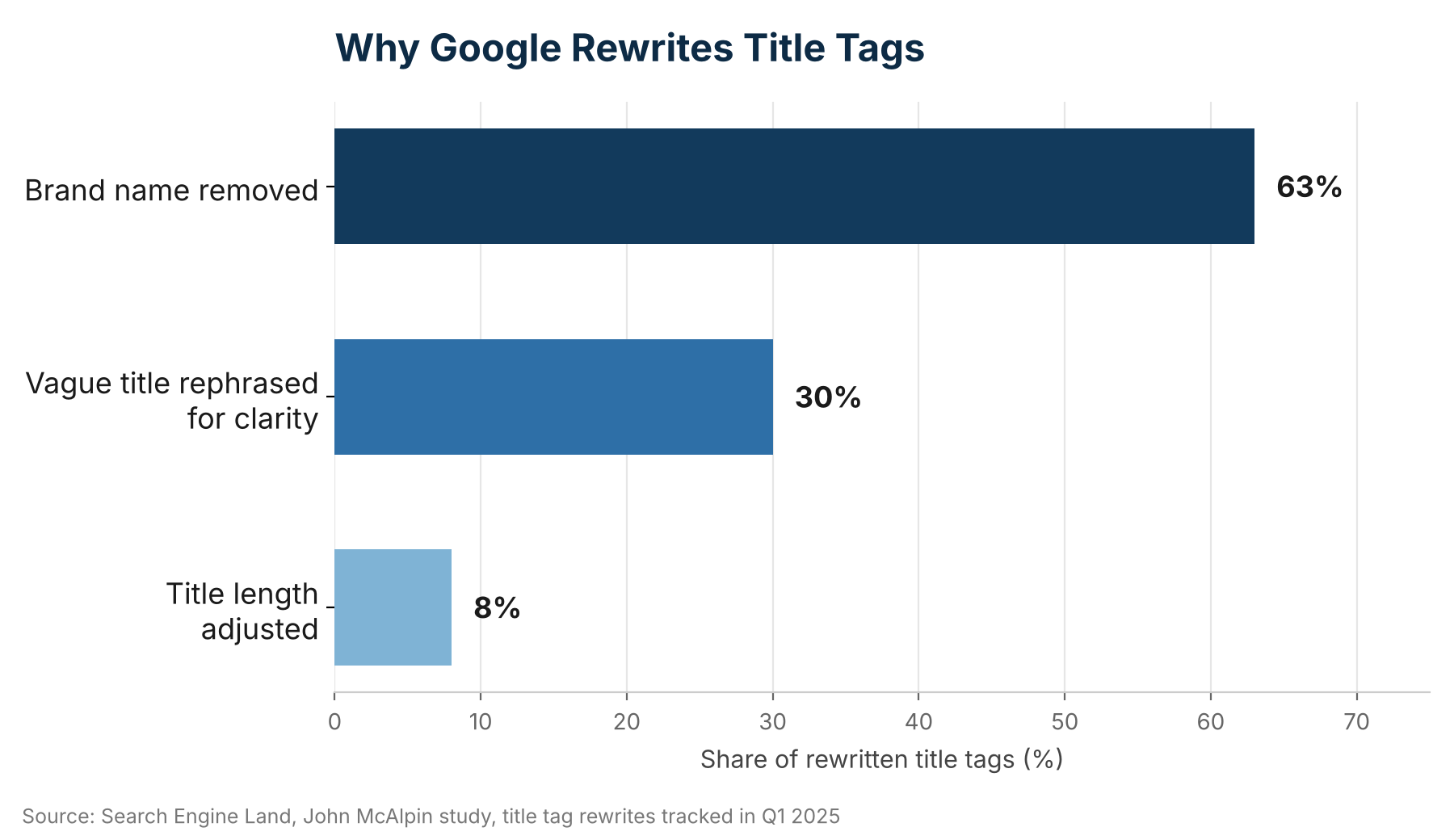
The pattern holds a practical lesson. Branding and vagueness cause far more title tag rewrites than length ever does. A title running ten characters over an ideal length is less likely to get rewritten than one carrying an unnecessary brand name or a vague phrase like “Our Products.”
Common Questions About Title Tag Rewrites
Does a title tag rewrite hurt my rankings?
No. Google’s documentation treats the title link as a display element, separate from the ranking signals a page earns from its content. A title tag rewrite can affect click-through rate in the search results, but it does not change where the page ranks.
Can I force Google to always use my exact title tag?
Not reliably. Google’s documentation gives recommendations, not guarantees. Fixing the documented triggers, like mismatched headings, stale dates, and duplicate boilerplate, reduces the odds of a rewrite, but Search Central offers no setting that disables rewriting outright.
Is the AI headline test the same thing as standard title tag rewriting?
No. Standard title link rewriting pulls from text that already exists on the page. The AI headline test Google confirmed in 2026 can generate wording that does not appear in the source article at all, and it currently has no public opt-out.
How Much Title Control You Actually Have
Title tag rewrites are not a penalty, and they are not random either. Google’s own documentation names specific, fixable triggers, and the 2025 data shows those triggers, not keyword stuffing or length alone, drive most of the changes Google makes.
The realistic goal is not zero rewrites. It is removing the easy, avoidable reasons Google has for touching your title tag: the mismatched heading, the leftover year, the brand name crowding out a non-brand query, the duplicate template applied across fifty category pages.
Work through the checklist above on your highest-traffic pages first, request reindexing after each fix, and recheck how your titles appear in search a few weeks later. That is about as much direct control over a title tag rewrite as currently exists, and in my experience it is more control than most sites actually put to use.
Treat the title tag the same way you would treat any other on-page element you do not fully control, like a featured snippet or an AI Overview citation. Make the on-page signal as clean and unambiguous as possible, document what you changed, and give Google’s systems time to catch up before judging whether a fix worked.





Leave a response