
Marketing used to require hours of research, content creation, customer segmentation, reporting, and campaign management. Today, artificial intelligence can automate many of these repetitive tasks while helping marketers make faster, data-driven decisions.
This AI Marketing Guide explains how businesses can use AI to streamline marketing workflows, personalize customer experiences, improve content production, and scale campaigns without simply adding more manual work.
The goal is not to replace marketers. It is to give them better systems, better insights, and more time for strategy and creativity.
What Is AI Marketing?
AI marketing uses artificial intelligence to analyze information, automate marketing activities, generate content, predict customer behavior, and personalize interactions.
Instead of manually performing every marketing task, businesses can create systems that use AI to assist with research, segmentation, content development, customer support, campaign optimization, and analytics.
For example, an AI-powered workflow can identify a website visitor, determine their likely interests, recommend relevant content, and trigger a personalized email sequence.
This approach combines artificial intelligence, automation, customer data, and marketing strategy into one scalable system.
Businesses can also combine AI marketing with broader digital marketing strategies to create more efficient customer acquisition systems.
Why AI Marketing Matters for Business Growth
The biggest advantage of AI is not simply producing content faster. It is the ability to process large amounts of information and support decisions at a scale that would be difficult to manage manually.
AI can help marketing teams:
- Automate repetitive workflows
- Analyze customer behavior
- Generate content ideas
- Personalize emails and landing pages
- Identify high-value leads
- Improve campaign targeting
- Summarize large datasets
- Predict customer actions
- Provide faster customer support
- Optimize marketing resources
Marketing automation platforms already combine CRM data, workflows, personalization, lead scoring, and AI-powered features to help businesses operate at scale.
The important distinction is that automation executes the process, while strategy determines what the process should accomplish.
Key Takeaway:
AI should remove repetitive work, not remove human judgment. The strongest marketing systems combine machine efficiency with human creativity, positioning, and oversight.
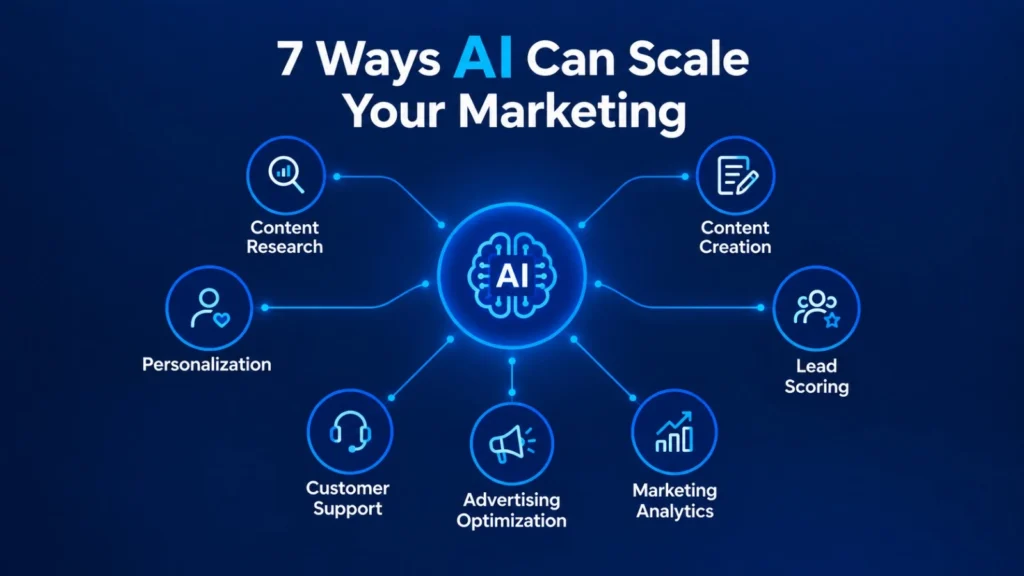
7 Ways to Use AI Marketing
1. Automate Content Research
Research often consumes more time than writing.
AI can help marketers analyze search queries, customer questions, competitor topics, existing content, and audience interests. Marketers can then use these insights to create stronger content briefs.
For SEO, AI can help organize topics into clusters, identify missing subtopics, and generate questions that deserve direct answers.
However, AI-generated research still requires human verification. Google’s current guidance emphasizes useful, original content and makes clear that generative AI does not exempt content from search quality and spam policies.
2. Scale Content Creation
AI can accelerate first drafts for:
- Blog outlines
- Social media posts
- Email campaigns
- Product descriptions
- Ad variations
- Video scripts
- FAQs
- Meta descriptions
The best workflow is not AI → publish.
Instead, use:
AI draft → human editing → fact checking → brand review → optimization → publish
This process protects your brand voice while allowing your team to produce more content.
3. Personalize Customer Journeys
Traditional marketing often sends the same message to an entire audience.
AI allows businesses to create more relevant experiences based on customer behavior, interests, previous interactions, and funnel stage.
For example:
| Customer Action | AI-Powered Response |
|---|---|
| Read beginner articles | Recommend related beginner content |
| Downloads an ebook | Start a nurturing sequence |
| Visits the pricing page | Trigger high-intent follow-up |
| Abandons checkout | Send a recovery message |
| Becomes a customer | Start onboarding workflow |
This turns marketing from a collection of isolated campaigns into an ongoing customer journey.
4. Improve Lead Scoring
Not every lead deserves the same amount of sales attention.
AI-assisted lead scoring can evaluate signals such as:
- Pages visited
- Email engagement
- Company information
- Previous purchases
- Content downloads
- Form submissions
- Product interest
The marketing team can then prioritize prospects who show stronger buying intent.
This becomes especially useful as a business grows because manual lead qualification becomes increasingly difficult.
5. Automate Customer Support
AI chatbots and customer agents can handle repetitive questions around the clock.
They can answer questions about:
- Pricing
- Product features
- Shipping
- Returns
- Documentation
- Account processes
- Basic troubleshooting
The best implementation creates a human handoff for complex or sensitive requests.
That means AI handles predictable conversations while employees handle situations requiring judgment or empathy.
6. Optimize Advertising
AI can help marketers test and analyze multiple advertising variables, including:
- Headlines
- Descriptions
- Audiences
- Creative variations
- Landing pages
- Offers
- Campaign timing
Instead of relying on one advertisement, marketers can create multiple controlled variations and use performance data to determine which combinations deserve more budget.
AI becomes particularly valuable when campaigns generate enough data to reveal patterns that are difficult to identify manually.
7. Automate Marketing Analytics
Reporting often creates a hidden productivity problem.
Marketing teams may spend hours collecting numbers from different platforms before they can actually interpret performance.
AI can help summarize:
- Traffic trends
- Conversion rates
- Campaign performance
- Customer acquisition costs
- Email engagement
- Revenue attribution
- Content performance
The result should be a shift from “What happened?” to “What should we do next?”
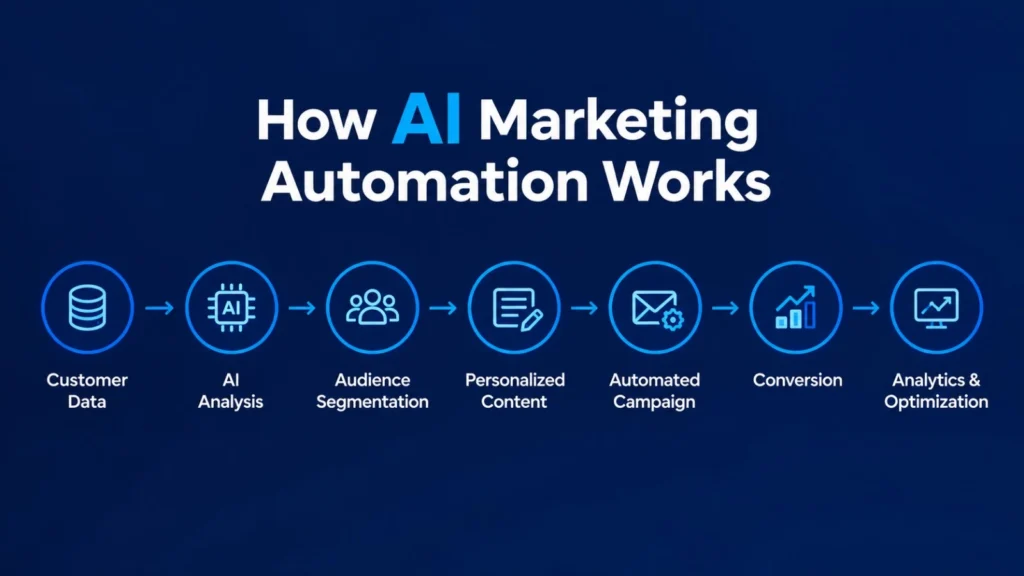
AI Marketing Automation Workflow
A practical AI marketing system can follow this simple structure:
Customer Data → AI Analysis → Segmentation → Content → Automation → Customer Action → Measurement → Optimization
Example
Imagine an ecommerce company selling skincare products.
A visitor reads three articles about dry skin.
The system identifies the visitor’s interest, places them into a relevant audience segment, recommends appropriate products, and triggers a personalized email sequence.
If the visitor purchases, the system stops the prospect sequence and starts a customer onboarding workflow.
This is the real power of AI marketing automation: one customer action can automatically influence the next marketing action.
How to Build an AI Marketing Strategy
An effective AI Marketing Guide should not begin with tools. It should begin with business problems.
Step 1: Identify Repetitive Tasks
List marketing activities your team performs repeatedly.
Examples include:
- Weekly reporting
- Email follow-ups
- Content briefs
- Lead qualification
- Social post creation
- Customer FAQs
Start with tasks that consume significant time but follow predictable patterns.
Step 2: Define the Business Goal
Connect every automation to a measurable outcome.
For example:
Weak goal:
“Use AI for marketing.”
Better goal:
“Reduce lead-response time by 50%.”
Other useful goals include:
- Increase qualified leads
- Reduce content production time
- Improve email conversion
- Increase customer retention
- Lower acquisition costs
Step 3: Choose the Right AI System
Different problems require different tools.
| Marketing Need | Useful AI Capability |
|---|---|
| Content creation | Generative AI |
| Customer questions | AI chatbot |
| Lead qualification | Predictive scoring |
| Campaign workflows | Marketing automation |
| Reporting | AI analytics |
| Customer personalization | Recommendation systems |
| Research | AI-assisted analysis |
Businesses already use AI-powered workflows, chatbots, personalized content, lead scoring, and journey orchestration as part of modern marketing automation.
Step 4: Start Small
Do not automate your entire marketing department overnight.
Choose one workflow.
Measure its performance.
Improve it.
Then expand.
This reduces risk and makes it easier to identify where AI genuinely creates value.
AI Marketing Tools and Technology
Your technology stack should match your business needs rather than simply following AI trends.
For example, generative AI can assist with content and ideation, while marketing automation software can connect customer data with workflows and campaigns.
OpenAI provides official developer documentation for building applications with its AI models, while platforms such as HubSpot provide AI-powered marketing and automation features for marketers.
If your marketing strategy also involves technical AI concepts, understanding machine learning basics can help you better understand how predictive systems and recommendation engines work.
A useful technology stack may include:
- CRM
- Analytics platform
- Marketing automation
- AI content tools
- Customer support automation
- Advertising platforms
- Data visualization
- Human review processes
The objective is not to collect the largest number of AI tools.
The objective is to build the smallest reliable system that produces measurable results.
Common AI Marketing Mistakes
Mistake 1: Publishing Unedited AI Content
AI can produce fluent writing that still contains incorrect information, weak examples, or generic claims.
Always review important content before publishing.
Mistake 2: Automating Bad Processes
AI cannot fix a fundamentally broken marketing funnel.
If your targeting, offer, messaging, or customer journey is weak, automation can simply make the problem happen faster.
Mistake 3: Ignoring Customer Data Quality
AI systems depend on the information they receive.
Poor segmentation, incomplete customer records, duplicate data, and incorrect tracking can produce poor recommendations.
HubSpot similarly highlights data quality as an important foundation for effective marketing automation.
Mistake 4: Removing Humans From the Process
Customers do not always want automated answers.
Give people an easy path to human assistance when an issue becomes complex.
Mistake 5: Measuring Activity Instead of Results
Generating 100 posts is not a marketing success by itself.
Track business outcomes such as:
- Leads
- Qualified leads
- Conversion rate
- Revenue
- Customer retention
- Acquisition cost
- Return on marketing investment
Key Takeaways
Here is the short version of this AI Marketing Guide:
- AI can automate repetitive marketing tasks.
- AI can help personalize customer experiences at scale.
- AI can support content research and production.
- Lead scoring can help sales teams prioritize prospects.
- Chatbots can handle repetitive customer questions.
- AI can assist with advertising optimization and analytics.
- Start with one measurable business problem.
- Keep human review in important marketing decisions.
- Clean customer data before building advanced automation.
- Measure revenue and conversions, not just AI-generated output.
The winning formula is simple:
Human Strategy + AI Intelligence + Automation + Quality Data = Scalable Marketing
FAQ
What is AI marketing?
AI marketing uses artificial intelligence to analyze data, automate marketing activities, personalize customer experiences, generate content, and support marketing decisions.
How can AI automate marketing?
AI can automate content workflows, customer segmentation, email campaigns, lead scoring, customer support, advertising analysis, and marketing reporting.
Is AI marketing suitable for small businesses?
Yes. Small businesses can start with simple applications such as AI-assisted content creation, automated email sequences, customer FAQs, and reporting. Starting with one repetitive task keeps implementation manageable.
Can AI replace marketing teams?
AI can automate many repetitive marketing activities, but it does not replace strategic thinking, creativity, brand judgment, customer relationships, or business decision-making.
How should a business start with AI marketing?
Start by identifying a repetitive marketing task that has a measurable business impact. Define the desired outcome, select an appropriate AI or automation tool, test the workflow, and measure the result.
Does AI-generated content help SEO?
AI can assist with research, outlining, and content production, but simply generating large amounts of AI content does not guarantee search visibility. Google emphasizes useful, reliable, people-first content and applies its search policies to AI-generated content as well.



Leave a response