
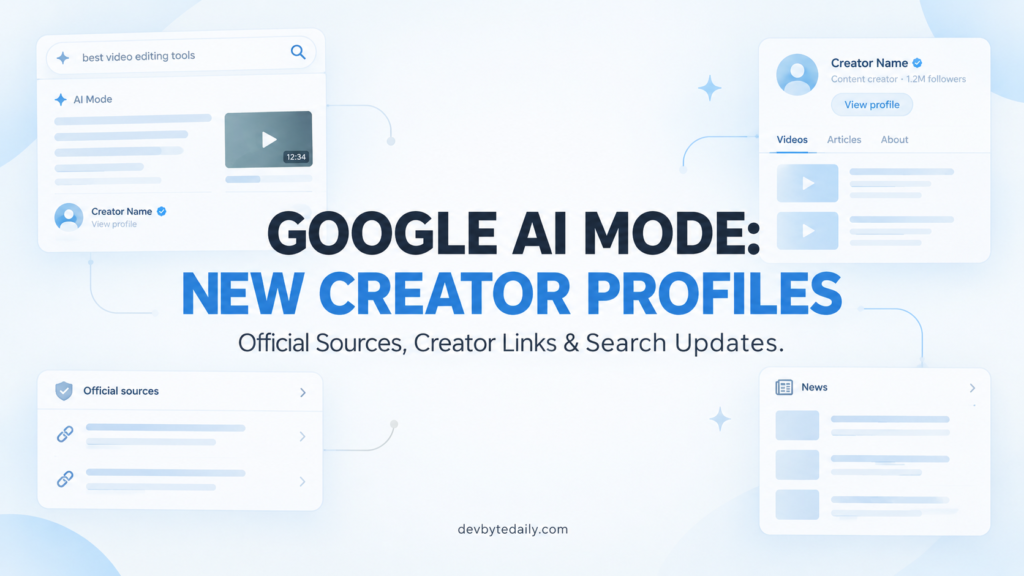
Google has started testing clickable creator and publisher names on video results inside AI Mode, along with a new “official sources” section that surfaces one or two top links for certain queries. Google’s Hema Budaraju, vice president of product management, announced both tests in an October 15, 2026 post on the company’s Keyword blog, alongside a wider rollout of inline links and expanded news carousels across AI Overviews and AI Mode. For site owners and content creators, the AI Mode creator profiles feature is the bigger shift. It routes the first click on a creator’s name to their Google Search profile, not to their own channel or website.
This is a news explainer, not an evergreen guide. The changes are rolling out now, in test form, and some details, including which countries see them, are still unconfirmed.
What Google Announced on October 15
Budaraju’s post, titled “AI Mode and AI Overviews updates to explore the web,” described four changes in one release: more inline links shown higher in AI responses, a new section for official websites, expanded news carousels, and the AI Mode creator profiles test, according to Search Engine Land’s Barry Schwartz, who covered the post the same day.
The inline-link changes were already live at the time of the post, Google said, with the higher placement of those links described as launching rather than testing. DevByteDaily already covered that part of the announcement, including Google’s claim that use of Preferred Sources grew more than 7x since the start of 2026, in AI Overviews Preferred Sources Jump 7x in New Google Link Update. This piece focuses on the two parts of the same announcement that got less attention so far: the AI Mode creator profiles test and the official sources section, both of which Google describes as tests rather than finished features.
AI Mode Creator Profiles: How the New Video Link Test Works
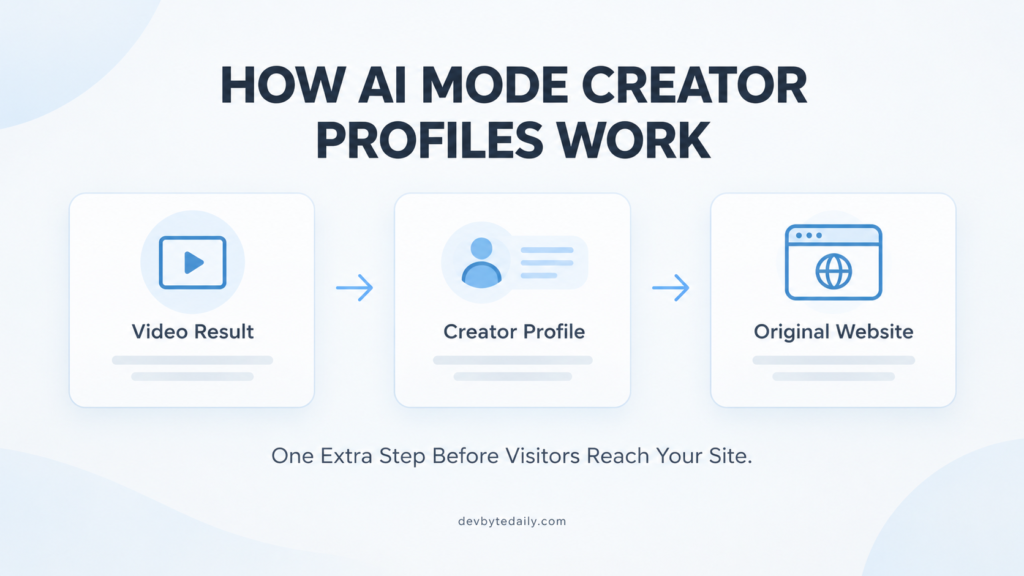
Google says it has started testing clickable creator and publisher names on video results inside AI Mode. Tap or click a creator’s name under a video result, and AI Mode can now send you to that person’s Google Search profile page, a Google-hosted page listing their published work and background, rather than straight to their own site or channel.
Search profiles themselves are not brand new. Google introduced them in the US on June 4, 2026, under the title “A new profile to help publishers and creators highlight their work on Search,” giving publishers and creators with a sizable following on at least one major social or video platform a dedicated, shareable page. What’s new, according to the October 15 post, is connecting that same profile system to AI Mode’s video results.
A Search profile can display a creator’s latest articles, videos, and social posts, alongside an avatar, a short bio, and links to their own site and social or video platforms. Google’s original announcement says the profile can appear on mobile through a knowledge panel, by tapping a creator’s or publisher’s name inside Discover, or at a direct URL, and that visitors can follow a source from its profile page, which Google says may make that source’s content more likely to surface again on Discover.
Google has not said which countries the AI Mode creator-profile test covers. Because Search profiles launched in the US first and remain limited to creators with a sizable following, the AI Mode test is likely US-only and limited in scale for now, though Google’s October 15 post does not confirm either detail, a gap also flagged in ppc.land’s coverage of the announcement. Eligible creators and publishers can follow Google’s own setup instructions, linked from the October 15 post, to claim or update a profile.
Why Creator Profiles Send the Click to Google First
The practical effect is straightforward. Before this test, a creator’s name on a video result was either plain text or linked directly to the source. Now, inside AI Mode, that name can link to a Google-owned profile page first. A viewer reads the creator’s bio and other credited work there, then decides whether to visit the original site.
That adds one extra step between an AI Mode user and your domain. It is also, in Google’s framing, a trust signal. An AI Mode answer that shows who made a video and lets people check that person’s track record is meant to make the citation feel more accountable, not less visible.
A New Official Sources Section Tops Some AI Mode Answers
The second test in the October 15 post is a dedicated section at the top of some AI responses that surfaces the one or two official pages that can complete a specific task, each with a short note on why Google picked it. Budaraju wrote that “sometimes, there are only one or two official places on the web to complete a specific task,” and the new section is meant to put those links where people see them first, per Google’s own post.
Google gave no criteria for how a page qualifies as official, no list of eligible query types, and no rollout timeline beyond calling it a test. For now it appears limited to queries with a narrow, clear answer, think renewing a passport or checking a flight status, rather than open-ended research questions.
That narrow scope matters for who should pay attention. A blog covering general advice on a topic is unlikely to see this section at all, since Google’s description points to single-task queries with one or two canonical answers. A government agency page, a bank’s official support page, an airline’s status checker, or a software vendor’s own download page are the kinds of results more likely to qualify. If you run one of those, the practical move is making sure that specific page, not a category page or a blog post about the topic, is the clearest, most current answer to the exact task someone is trying to complete.
News Carousels and Related Article Links Also Expand
The same post confirmed two smaller changes. Carousels of timely news articles, which already appeared in some AI Mode and AI Overviews responses, are rolling out to more locations and languages, and they now highlight a user’s Preferred Sources inside the carousel itself. Related-article links shown at the end of some AI responses now carry image thumbnails, which Google describes as a more clickable design than the plain text links they replace.
Neither change has a confirmed completion date. Google frames both as part of the same push toward, in Budaraju’s words, making “exploring the web simpler, more visual, and more engaging.”
What This Means for You
The following is general judgment based on the confirmed facts above, not a Google statement.
Two things are worth watching if you publish video content or run a site that depends on named-author credibility.
First, a Search profile is becoming more valuable real estate. If AI Mode is going to send clicks to that profile page before your own site, an outdated or missing profile means a weaker first impression, even when your actual content is strong. Claiming and completing a Search profile, if you’re eligible, is a low-effort task worth doing this month.
Second, the official sources section raises the bar for being the obvious answer to narrow, task-based queries. If your page is one of only a handful that can resolve a specific task, such as a tracking lookup, a login reset flow, or an official form, making that status unambiguous in your title, headings, and schema markup is more likely to matter now than it did a month ago. DevByteDaily’s broader AI SEO Guide covers the underlying ranking signals these tests build on.
Barry Schwartz raised a more skeptical point worth repeating. Google still does not show click data for these inline AI links inside Search Console’s AI performance reports, so there is no way to measure, from Google’s own tools, whether any of this sends more traffic to publishers. Treat “more links, more visibility” as Google’s stated intent, not a measured outcome yet.
What to Do Now
None of this calls for a rebuild of your SEO or GEO program. It calls for a short checklist you can work through this week while the tests are still fresh and competitors have not yet reacted:
- Check whether you or your named authors are eligible for a Google Search profile, and claim or update one if so.
- Audit your video content for clear, consistent creator attribution, since that is the field AI Mode is now linking from.
- Identify any pages that are genuinely one of few official answers to a specific task, and make that status explicit in the page’s title and structured data.
- Keep tracking AI referral traffic through server logs or GA4, since Search Console will not show clicks from these specific link types yet. DevByteDaily’s AI Search Visibility in GA4 guide walks through a basic setup.
- Revisit your broader AI-search content approach with a structured framework, such as the one in DevByteDaily’s Content Strategy for AI Search piece, since citation mechanics keep changing faster than core content strategy should.
How This Fits the Broader AI Search Picture
Google is not the only AI search product wrestling with how to credit sources inside a generated answer. ChatGPT, Perplexity, and Microsoft’s Copilot all show inline citations of some kind, and all three have faced the same basic criticism Schwartz raises about Google: a link inside an AI answer does not behave like a traditional blue link, and none of the major platforms publish granular click-through data for those citations the way Search Console does for organic results.
What makes the AI Mode creator profiles test distinct is that Google is routing credit through a page it owns and controls, rather than linking straight out. That is consistent with how Google has handled attribution elsewhere, including knowledge panels and Discover bylines, and it fits a pattern where Google increasingly mediates the relationship between a reader and a source rather than stepping out of the way entirely. Whether that nets out as more exposure for creators or simply more Google-owned surface area in the click path is the open question this test is meant to help Google answer, not site owners.
Limits and Open Questions
Several details remain unconfirmed as of this writing. Google has not said which countries see the creator-profile or official-sources tests, how long either test will run, or what share of AI Mode queries currently show either feature. The company has also not published criteria for how a page earns a spot in the official sources section beyond Budaraju’s general description, and it has not said whether the AI Mode creator profiles test will expand to AI Overviews or to non-video results.
No independent outlet has yet published measured click or impression data tied to these two specific changes. All reporting so far, including this piece, works from Google’s own description of the test plus Search Engine Land’s and ppc.land’s same-day coverage. Treat any claim about traffic impact, positive or negative, as speculation until Google or a third-party tool publishes numbers.
Quick Answers
Is the AI Mode creator profiles test live for everyone?
No. Google describes it as a test that began the week of October 15, 2026, with no confirmed country list or rollout percentage.
Do I need a Search profile to appear in AI Mode results at all?
No. A profile only changes where the creator-name link points when your video appears in a result; it does not control whether you get cited in the first place.
Will the official sources section replace normal AI Overviews citations?
Nothing in Google’s post suggests that. It is described as an additional section for a narrow set of task-based queries, not a replacement for existing inline citations.
Status and What to Watch Next
As of October 20, 2026, the creator-profile links and official sources section remain in testing, not general availability, per Google’s own post. The inline-link increases and their higher placement are already live across AI Mode and AI Overviews. The news carousel expansion is in progress with no stated end date.
Watch Google’s Search Status Dashboard and the Keyword blog for any follow-up post confirming a wider rollout of either test. Watch Search Engine Land and Search Engine Roundtable for independent sightings of the official sources section or creator profile links in the wild, since public screenshots tend to surface there before Google publishes more detail.


Leave a response