
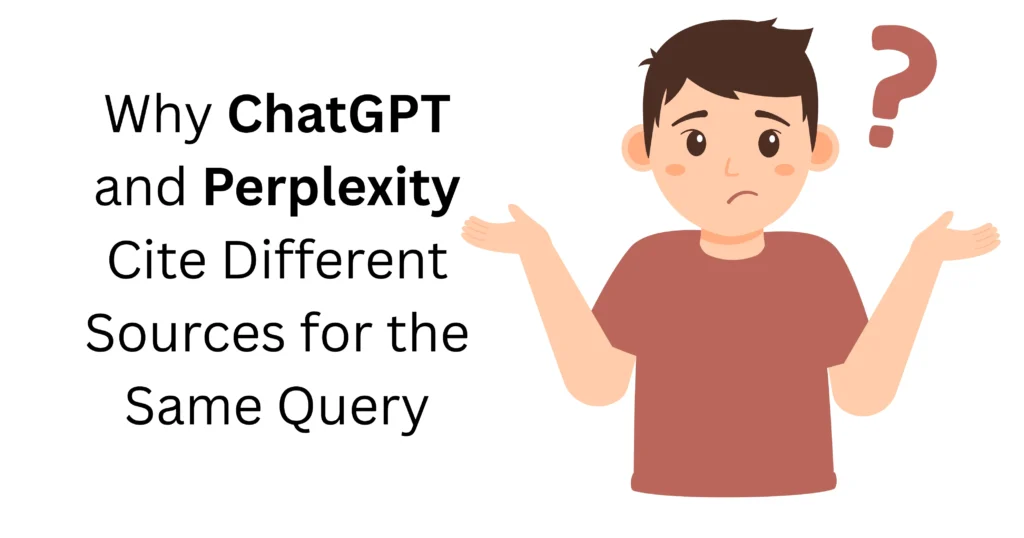
Ask ChatGPT and Perplexity the same question, and you will often get two completely different sets of sources. Not just different phrasing of the answer, but entirely different websites cited. If you have noticed this and wondered why, you are not imagining things. It comes down to how each tool actually finds information, not just how it writes about it.
They Are Not Searching the Same Way
The biggest reason is that ChatGPT and Perplexity are not built the same way under the hood. Perplexity was designed from the start as a search-and-answer tool. Every time you ask it something, it runs a real web search, pulls back a set of current pages, and builds its answer directly from what it finds right then. That is why Perplexity almost always shows you a list of sources next to its answer.
ChatGPT works differently depending on how it is being used. It has a lot of knowledge baked in from training, and it can also browse the web when it needs current information. But the way it decides what to search for, and which results actually to pull from, is not the same process Perplexity uses. Two tools asking “what happened with this topic recently” can end up querying the web in different ways, with different search terms, and naturally land on different pages.
Different Tools, Different Data Partners
Search results are not neutral. Every AI tool that pulls from the live web is working through some combination of its own crawler, licensing deals, and search API partnerships. Perplexity has built relationships with specific data providers and has its own indexing approach. ChatGPT’s web browsing draws on its own set of tools and integrations.
This matters more than it sounds like it should. If two tools are technically searching “the internet,” but one has better access to certain publishers, forums, or recent content than the other, they are not actually looking at the same internet. They are looking at two overlapping but different slices of it.
They Do Not Agree on What Counts as a Good Source
Once a tool has a pile of possible pages to pull from, it still has to decide which ones are worth citing. This is where things diverge even more. Some tools lean toward established, well-known publications. Others weight recency more heavily and will pull from a smaller blog if it happens to be the most recent thing written on the topic. Some are more willing to cite forum discussions or community threads, while others mostly ignore them.
None of these approaches is objectively right. They are just different sets of rules backed into how each system ranks and filters what it is willing to show you. A page that ChatGPT considers reliable enough to reference might not clear Perplexity’s bar, and the reverse happens just as often.
The Question Itself Gets Interpreted Differently
This part is easy to miss. When you type a question, the AI tool does not search for your exact words. It reformulates your question into one or more search queries first, and that reformulation step is different for every tool. Ask “why is my open rate dropping,” and one tool might search for that almost literally, while another expands it into something like “email deliverability decline causes 2026.” Those two searches will not return the same top results, even on the same search engine, let alone across different ones entirely.
So part of the reason you see different citations is not really about the AI models being smarter or worse than each other. It is that they are quietly asking slightly different questions on your behalf before they ever start picking sources.
Freshness Plays a Bigger Role Than People Expect
AI tools vary a lot in how “live” their web access actually is. Some check the web on every single query. Others rely more on a cached or periodically refreshed index that is not updated in real time. If your topic is something that changed in the last few days, a tool with a slower refresh cycle may still be citing older pages, while a tool that searches fresh every time picks up something newer. Neither is wrong, exactly. They are just working from different snapshots of the internet.
What This Actually Means If You Publish Content
If you write articles, run a blog, or manage content for a business, this is not just a curiosity. It has a direct effect on whether your content shows up at all. Getting cited by one AI answer engine does not mean you will get cited by another, even for the same query. Each one (ChatGPT and Perplexity) is running its own search, applying its own filters, and deciding independently whether your page clears the bar.
The practical takeaway is that chasing a single “AI SEO” formula is the wrong goal. What actually helps across the board is writing pages that are clear, specific, and easy for a search system to pull a direct answer from, no matter which tool is doing the pulling. Vague, padded content struggles everywhere. Specific, well-structured content tends to hold up across all of them, even though the exact citations will still vary.
It also explains why testing your visibility in just one tool can be misleading. A page might show up reliably in one AI answer engine’s citations and never once appear in another, not because the content is worse, but because the underlying search and ranking process is a completely different machine. If visibility across AI search matters to your business, it is worth checking more than one tool before concluding what is or is not working.
The Short Version
ChatGPT and Perplexity cite different sources for the same question because they are not really doing the same task. They search differently, pull from different slices of the web, apply different standards for what counts as trustworthy, and interpret your original question in their own way before they even start looking. The differences are not a bug in one tool or the other. They are just what happens when several separate systems are all trying to solve the same problem in their own way.



Leave a response