
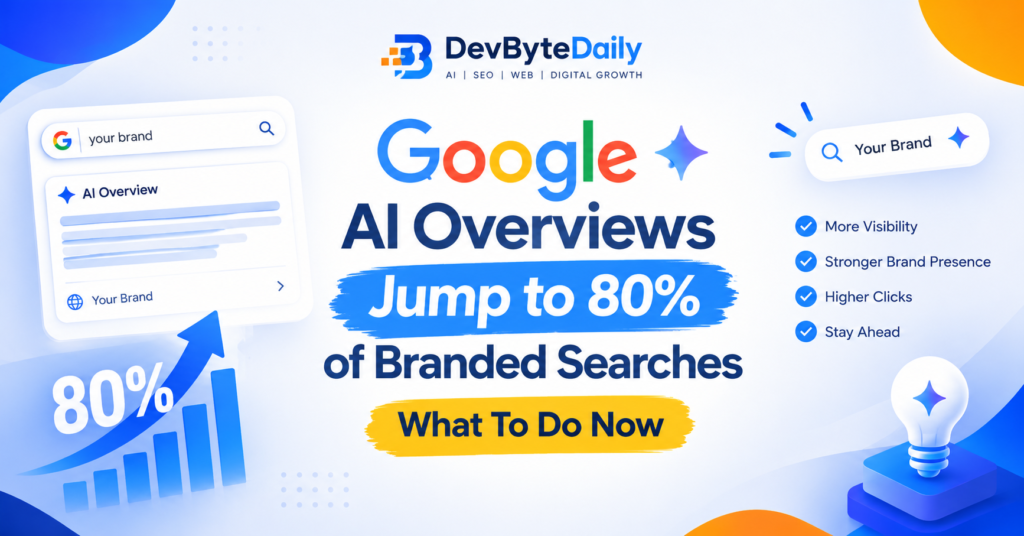
If you searched your own brand name on Google last week and saw a big AI-written summary sitting above your website, you are not imagining things. New tracking data shows that Google AI Overviews have exploded across branded searches, jumping from roughly a quarter of tracked queries to more than 80 percent in the span of about a week.
This is not a slow, gradual rollout. It is a sudden, measurable shift, and it is happening on the exact searches that matter most to you: the ones where someone types your company’s name because they already know who you are.
What Actually Happened
According to data tracked by DemandSphere and reported by Search Engine Land, AI Overviews, the AI-generated summary boxes Google shows at the top of search results, appeared on roughly 27 to 35 percent of branded queries through most of September 2026. Then, in the final days of the month, that number jumped sharply: 69.21 percent on September 26, a peak of 90.48 percent on September 27, and it stayed elevated at 80 to 82 percent through September 28 and 29.
That spike was independently confirmed by Chris Long, co-founder of Nectiv, who ran his own test using SerpApi on 100 enterprise brands. He found AI Overviews appearing for 93 of them, including household names like Reddit, Salesforce, Mailchimp, and Facebook, alongside a long list of smaller companies.
A branded query, if the term is new to you, is simply a search that includes your company or product name directly, like “Mailchimp pricing” or “Nectiv reviews.” These are traditionally the easiest, most reliable searches for a brand to win, because you would expect your own site to rank first for your own name. That assumption is now getting tested.
Why This Matters More Than a Typical AI Overview Story
AI Overviews showing up on broad, informational searches like “best running shoes for flat feet” is old news at this point. What is different here is the target: your own name. When someone searches your brand directly, they usually already have high intent, whether that is to visit your site, check your pricing, read reviews, or find your contact page. If Google answers that question before the user ever clicks through, you lose the chance to control that first impression.
Long cautioned that this expansion could reduce click-through rates on branded searches, though it is worth being precise here: neither his test nor DemandSphere’s data actually measured clicks. The visibility jump is confirmed. The click-through impact is a reasonable concern, not yet a proven number. Treat it as something to watch closely over the next few weeks rather than a settled fact.
Think about what this looks like in practice. Someone hears about a SaaS tool from a colleague and searches its name to check pricing. Instead of landing on the pricing page, they see an AI-written summary that pulls a number from a review site, an old blog post, or a stale cached version of the pricing page. If that number is wrong, the brand has no chance to correct it in the moment, and the user may never click through to see the real page at all. Multiply that across thousands of searches a month and the stakes become obvious, even without a confirmed click-through percentage.
How to Check If Your Brand Is Already Affected
You do not need expensive tooling to get a first read on this. Start with the basics:
- Search your own brand name, your product names, and your “[brand] + pricing,” “[brand] + reviews,” and “[brand] + alternatives” variations, both logged out and in an incognito window, since AI Overviews can vary by account and location.
- Check whether an AI Overview appears at all, and if it does, read exactly what it says about you. Is it accurate? Is it current? Does it reflect your actual pricing, features, or positioning?
- Note which sources the summary cites. Is your own website one of them, or is Google pulling from review sites, Wikipedia, Reddit threads, or competitor comparisons instead?
- If you use an AI visibility tracker, this is a good week to run it. Our guide on choosing between Ahrefs and Semrush for AI visibility tracking walks through how to set that up, and if you are already on Rank Math, the Rank Math AI Visibility setup guide covers tracking directly inside your WordPress dashboard.
Do this for your 10 to 20 most important branded and product terms, not just your company name on its own. That is where the real exposure usually shows up first.
What Google Is Citing, and How to Become a Source
The sites getting cited inside these AI Overviews tend to share a few traits, and none of them are secret tricks. They are the same fundamentals that have mattered in SEO for years, just with higher stakes now that an AI model is deciding what to summarize.
A clear, well-structured “about” and product story
If your homepage, about page, and product pages do not clearly state what you do, who you serve, and what makes you different, an AI system has nothing solid to pull from. Write these pages for a reader who has never heard of you, not just for existing customers.
Structured data that removes ambiguity
Schema markup, the structured code that tells search engines exactly what a piece of content is, such as an Organization, Product, FAQ, or Review, gives AI systems a clean, machine-readable version of your information instead of forcing them to guess from paragraphs of marketing copy. If you have not audited this recently, our breakdown of structured versus unstructured data is a good starting point for seeing what you are missing.
Direct answers to the exact questions people ask about you
Think about the questions people actually type alongside your brand name: pricing, comparisons, “is [brand] legit,” “[brand] vs [competitor].” If you do not have a page that answers that question plainly, in the first few sentences, something else will, and that something else is what gets cited instead of you.
For a broader framework on this, our guide to ranking in AI search and our longer AI SEO guide for Google AI Overviews both cover the same underlying principle from different angles: write the direct answer first, then explain.
Consistent, verifiable information across the web
AI systems cross-check what they find. If your pricing page says one number, your LinkedIn page says another, and a two-year-old review site says a third, that inconsistency makes it harder for any model to confidently cite you as the source of truth. Keep your name, pricing, and core product details consistent across your own site, your social profiles, and the third-party listings you control, such as your Google Business Profile.
Google Just Tightened Its Own Rules on AI Content, Too
There is a second piece of news that lands at almost the same moment and is worth pairing with this one. On October 1, 2026, Google quietly updated its official guidance on using generative AI content, adding stronger language that it is “critical to manually fact-check and review all AI-generated content for accuracy and trustworthiness before publishing.”
Google’s reasoning is straightforward: generative AI models do not retrieve verified facts; they predict a likely sequence of words based on patterns in their training data, which means outputs can contain inaccuracies, commonly called hallucinations. The updated guidance also extends this review requirement beyond your main article text to metadata that shows up in search results, including title tags, meta descriptions, structured data, and image alt text.
Put these two developments together, and the message for anyone running a website is consistent. Google is relying more heavily on AI to summarize your brand, while simultaneously telling you to rely less on unchecked AI output when you publish. If you are using AI tools to draft content, this is a good prompt to put a real human review step back into your workflow, especially on anything that states facts, prices, or claims about your product.
What This Data Does Not Tell Us Yet
It is worth being honest about the limits of this story, in the spirit of not overreacting to a single week of data. We do not yet know whether this elevated AI Overview rate holds steady, settles back down, or keeps climbing. We do not have confirmed click-through numbers, only a reasonable expectation that more AI Overviews on branded searches could mean fewer direct clicks for some brands. And DemandSphere’s tracking, while useful as an early signal, is one data provider’s methodology, not a universal guarantee of what your specific brand will see.
Treat this as a strong signal to start monitoring closely, not as proof that your traffic is about to collapse.
Common Questions About This Shift
Can I opt out of appearing in AI Overviews?
Not selectively. Google generates AI Overviews from the same index used for normal search results, so the usual way to keep content out of Google entirely is blocking it with robots.txt or a noindex tag, which also removes you from regular search results. There is no setting that lets you rank normally while excluding yourself only from the AI summary.
Does this mean traditional SEO does not matter anymore?
No. If anything, the fundamentals matter more, not less. Google still has to find, understand, and trust a page before it can summarize or cite it. Clear writing, accurate information, and solid technical SEO are exactly what feeds a good AI Overview and a good traditional ranking at the same time.
Should I rewrite all my content around this news today?
No. Start by checking what is actually happening on your own brand terms, fix any factual errors an AI Overview is already surfacing, and build the monitoring habit described below. A measured, ongoing response will serve you better than a rushed rewrite based on one week of data.
What To Do This Week
- Search your top 10 to 20 branded and product terms today and record whether an AI Overview appears, and what it says.
- Fix anything inaccurate or outdated that an AI Overview is currently surfacing about your brand, starting with pricing, features, and positioning on your own site.
- Add or update Organization, Product, and FAQ schema on your key pages if you have not already.
- Re-read any AI-assisted content you have published recently with Google’s updated fact-checking standard in mind, and correct anything that was never properly reviewed.
- Set a recurring monthly check, not just a one-time look, since this kind of rollout can shift again without warning.
AI Overviews on branded search are not going away, and based on this week’s numbers, they are likely to keep expanding into territory that used to belong entirely to your own homepage. The brands that come out ahead will not be the ones panicking over a single data point. They will be the ones that quietly made sure their own information, on their own site, is the most accurate and clearly structured version of the story that exists anywhere online.


Leave a response